In the past few years, civil society has been increasingly concerned about the environmental and social impact of food production and consumption. At the request of the Dutch EU Presidency, the EESC is preparing an exploratory opinion on how to achieve sustainable food systems in a resource-constrained world. The opinion takes a holistic and comprehensive approach, looking at the interdependence of food production and consumption as well as fostering inter-sectoral cooperation.
Download — EESC opinion: More sustainable food systems (exploratory opinion requested by the Dutch presidency)
The EESC fully backs the objective of switching to a greener, resource-efficient and circular economy. It is happy to see that the Commission has come forward with a broader set of proposals covering all the stages of the product lifecycle compared to the previous circular economy package; however, it raises concern over the lower level of ambition, which is likely to lead to lower economic and environmental benefits.
Over-indebtedness has grown with the financial crisis, the rising cost of living and use of cash credit. However, it has not been properly addressed at EU level. The EESC wants that an appropriate uniform procedure is put in place including verification of claims, a European framework for usury or preventive measures.
Download — EESC opinion: Consumer Protection and over-indebtedness
The opinion familiarizes the public with the phenomenon of collaborative consumption (CC). The document presents the conceptual approach and describes briefly best practices in CC. The EESC proposes also a general strategy for the sound development of CC in the EU. Given that CC covers mostly bottom-up initiatives, studies are needed before the appropriate regulations, rights and responsibilities of all the stakeholders involved can be established.
Planned obsolescence is associated with a form of industrial production that relies on a minimum renewal rate for its products. Although product renewal is necessary, certain abuses need to be addressed. The EESC would like to see a total ban on products with built-in defects designed to end the product's life.
A new report on Europe’s progress toward the Sustainable Development Goals (SDGs) highlights a significant slowdown, raising concerns about the EU’s ability to meet the 2030 targets. The Europe Sustainable Development Report 2025 (ESDR), published by the UN Sustainable Development Solutions Network (SDSN), finds that the pace of SDG progress between 2020 and 2023 was more than twice as slow as in the previous period.
This year – 2022 – the European Economic and Social Committee (EESC) will be co-organising the first-ever EU organic awards, together with the European Commission, European Committee of the Regions (CoR), COPA-COGECA and IFOAM Organics Europe, aimed at recognising excellence and rewarding the best and most innovative players in the EU organic value chain.
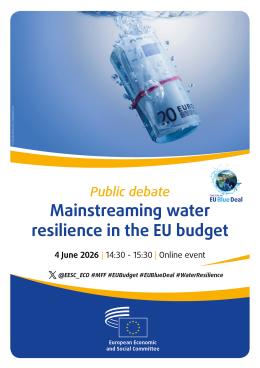
Mainstreaming Water Resilience in the EU Budget is a timely discussion on securing Europe’s water future. Discover how smarter EU investments can strengthen water resilience, sustainability, and preparedness, and how we should shape tomorrow’s funding priorities across programmes in the context of the EU´s next Multiannual Financial Framework.
The EESC will hold an online event on Tuesday 20 May 2025 to discuss the EU wine policy package in which the Commission proposed to amend the relevant wine regulations to introduce targeted measures to help the sector manage production potential, adapt to changing consumer preferences and exploit new market opportunities.