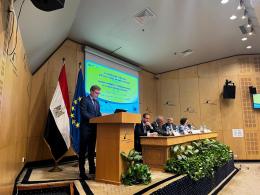
On 5 July President Röpke participated in the 2023 Euromed Summit organised in cooperation with the Union for the Mediterranean Secretariat, the Anna Lindh Foundation and Bibliotheca Alexandrina. This year's summit focused on water scarcity and desertification as well as on digital and energy transitions in the Euro-Mediterranean region.
On 13 April 2023, the European Economic and Social Committee (EESC) held a public hearing to address the pressing issue of water poverty and its implications on social policy. The event brought together water experts and stakeholders to mitigate the effects of water poverty, particularly on vulnerable communities. The hearing is part of the EESC's efforts to put water at the top of the EU agenda through a call for an "EU Blue Deal."
As water scarcity and pollution continue to pose global challenges, the current EU policy framework seems insufficient. To address this, top-level water experts gathered on 27 February at the European Economic and Social Committee (EESC) to identify possible solutions. The hearing marks the beginning of the EESC's work on water. The Committee is preparing a set of own-initiative opinions examining the economic, social, environmental, and geopolitical aspects of water and, in the autumn, will share civil society's recommendations for the future of water in the EU.
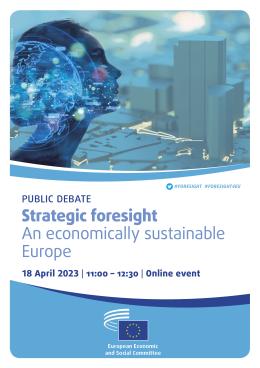
With this debate, the ECO section is providing ex-ante input to the European Commission, in preparation for the upcoming 2023 strategic foresight cycle that wants to shed light on the strategic decisions needed to ensure a socially and economically sustainable Europe with a stronger role in the world in the coming decades.
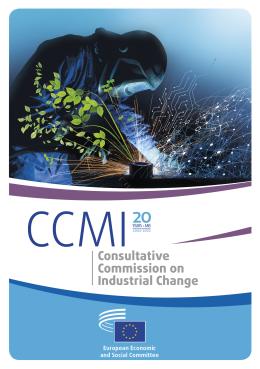
The Consultative Commission on Industrial Change (known by its French acronym of CCMI, Commission Consultative des Mutations Industrielles), is the heir of the European Coal and Steel Community (CECA in French) and joined the EESC in 2002. Since then, the CCMI’s remit does no longer only cover the traditional coal and steel sectors but has been extended to embrace all sectors of industry in both manufacturing and services.
The EESC believes that the current framework for international ocean governance is unable to ensure the sustainable management of oceans and their resources, and urgent action is imperative. However, the Commission and the High Representative still need to prioritise the threats currently faced by our oceans in order to adequately reflect the urgent need for action. One of the causes of ineffective international ocean governance is the existence of gaps in the current international ocean governance framework. The EESC recommends that the Commission and High Representative address these gaps and inconsistencies, but also that they increase compliance with existing rules, for example by improving the implementation of the Marine Strategy Framework Directive. The EU should refrain from proposing any new legislation when better or more coordinated implementation of existing rules and regulations would be more efficient.