As the EU prepares for a potentially larger Union, enlargement can no longer be treated separately from Europe’s climate ambitions, the European Economic and Social Committee (EESC) has warned. Candidate countries could bring both new challenges and significant opportunities for Europe’s transition to climate neutrality.
In an opinion adopted at its September plenary, the European Economic and Social Committee (EESC) stresses that modern construction methods can help lower housing costs and boost supply, but only if there is a convergence of innovation, quality and respect for workers’ rights and the interests of the public.
In a world marked by growing conflict, disinformation and fragmentation, Europe needs more dialogue, not less. That was the key message from speakers at the 2026 European Public Diplomacy Days (EPDD), held in Brussels from 30 September to 2 October 2026.
Responsibility for preventing cyberbullying must rest primarily with digital platforms rather than with children and young people. This is the central message of a new opinion in which the European Economic and Social Committee (EESC) calls for stronger platform accountability, straightforward reporting procedures and meaningful youth participation in the fight against harmful online behaviour.
Europe must scale up public investment to finance innovation, strategic infrastructure and the green and digital transitions, says the European Economic and Social Committee (EESC) in an opinion adopted in September. The EESC calls for more funding for the European Investment Bank (EIB) Group and a stronger role for national promotional banks, with public finance focused on projects that markets cannot fund adequately.
The European Economic and Social Committee hosted a hearing on how to foster innovation and digitalisation in the construction sector. Experts and industry representatives discussed the main barriers to innovation, from outdated regulations and lack of funding to skills shortages, and explored how digital tools, new materials and smarter rules could help modernise the sector.
Europe’s response to terrorism and violent extremism must combine effective security measures with prevention, democratic resilience and the systematic involvement of civil society. This is the central message of an opinion adopted by the European Economic and Social Committee (EESC), which warns that security measures alone cannot address the complex and interconnected threats facing the EU.
The EESC argues that the Commission’s Cloud and AI development plan relies on funding that has not been secured, does not determine whether Europe can generate enough electricity to power new data centres and gives affected communities too little say
Public services should not primarily be regarded as a cost to public finances, but as a strategic investment in democracy, social cohesion, economic development and the functioning of the EU. This is the core message of an opinion adopted by the European Economic and Social Committee (EESC) on how the sector can adapt to new challenges in the EU.
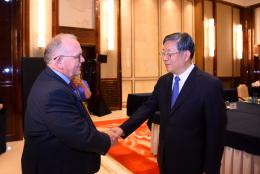
European Economic and Social Committee President Séamus Boland visited China from 13 to 18 September to strengthen cooperation and dialogue with the Chinese government, civil society organisations, trade unions, academics and social partners in a series of meetings and events in Hangzhou, Shanghai and Beijing.