
European Economic
and Social Committee
Fighting terrorism means protecting democracy, not sacrificing it
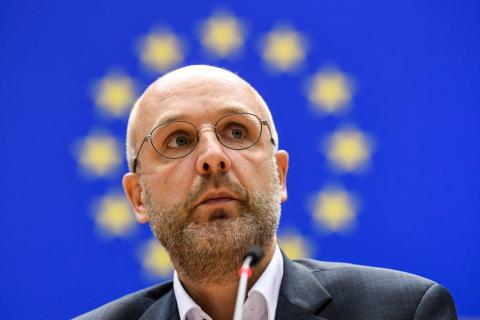
Europe’s response to terrorism and violent extremism must combine effective security measures with prevention, democratic resilience and the systematic involvement of civil society. This is the central message of an opinion adopted by the European Economic and Social Committee (EESC), which warns that security measures alone cannot address the complex and interconnected threats facing the EU.
Terrorism has changed. Extremist movements increasingly operate across criminal, political and digital environments, while hostile foreign actors exploit social divisions and extremist networks to destabilise European societies. In its opinion on the ProtectEU Agenda to prevent and counter terrorism, drafted by rapporteur Christian Moos, the EESC calls for a comprehensive response that addresses these connections without compromising democracy, fundamental rights or the rule of law.
'Terrorism, sabotage and organised crime increasingly overlap. ProtectEU requires stronger cooperation among authorities, smarter information sharing and greater prevention, developed together with civil society to strengthen resilience, security and democracy' Moos declared following the vote.
Democratic resilience is a security policy
The opinion's central argument is that democracy, the rule of law, fundamental rights and an active civil society are not simply values requiring protection. They are among Europe’s most effective tools for preventing radicalisation and strengthening security.
Strong public institutions, social cohesion, inclusive economic conditions, education and active civic participation can reduce people’s vulnerability to extremist narratives. By contrast, inequality, exclusion and declining trust in institutions can create fertile ground for radicalisation. The Committee therefore argues that counter-terrorism policy must be connected to social inclusion, education and labour-market integration.
The EESC is concerned that the current EU approach relies too heavily on securitymeasures and pays insufficient attention to the root causes of radicalisation, its links with organised crime and the role of civil society in prevention. It calls for a balanced strategy that places prevention, democratic resilience and civil society engagement on an equal footing with operational security measures.
This balance also means ensuring that measures against hate speech or extremist content cannot be misused to restrict legitimate expression, political opposition or journalism. Fundamental rights and freedom of expression must remain non-negotiable, including when the EU works with digital platforms or develops emergency responses to terrorist incidents.
The workplace as a line of prevention
One of the opinion’s most distinctive recommendations concerns the world of work, which the EESC describes as an underused space for preventing radicalisation.
Workplaces can help identify growing polarisation, address grievances and promote inclusive democratic cultures before extremist attitudes develop into violence. Workers’ representatives, employers, trade unions and social dialogue can all contribute to this effort by fostering participation, inclusion and mutual respect.
The Committee therefore calls for social partners and organised civil society to be more systematically involved in EU prevention programmes, early-warning mechanisms and national and local preparedness strategies. It also warns that shrinking civic space in parts of the EU is weakening precisely those organisations and networks on which effective prevention depends.
Effective security policy also requires properly resourced public services. Law enforcement authorities, prosecution services, courts, prisons and emergency services need adequate staffing, training, technology and institutional support. Persistent underfunding can undermine both operational effectiveness and public trust.
Protecting young people online
The growing involvement of minors in violent extremism is a particular concern. In its Communication "ProtectEU: Agenda to prevent and counter terrorism", the European Commission reports that almost one third of terrorist suspects in the EU in 2024 were under the age of 20, with the youngest aged only 12. Extremist groups increasingly use social media, gaming platforms, encrypted communication services and algorithmically amplified content to reach vulnerable young people.
The EESC therefore strongly supports the proposed Prevention Toolbox for Minors, including measures to improve education, media literacy and online safeguards. It also calls for a common European approach offering strong protection across digital platforms and content environments.
The Committee welcomes the stronger role envisaged for the Digital Services Act, the Artificial Intelligence Act and the European Board for Digital Services. However, it stresses that recommender systems, high-risk AI tools and opaque optimisation models must not be allowed to manipulate users or direct minors towards harmful content. Transparency, independent oversight and enforceable risk-mitigation obligations are needed to ensure that platforms do not amplify extremist narratives or facilitate recruitment.
Security without fortified societies
The opinion supports stronger protection of public spaces and critical infrastructure, including improved detection systems, counter-drone technologies, contingency planning and real-time information sharing.
At the same time, the EESC cautions against turning European cities into fortified or heavily militarised spaces. Security measures should be proportionate, unobtrusive and compatible with open democratic life. Free movement, accessible public spaces and a vibrant civic sphere are not obstacles to security, but foundations of Europe’s democratic identity.
The Committee also calls for stronger institutional cooperation. Fragmentation between law enforcement, intelligence services, judicial authorities, emergency responders and other actors can weaken prevention and crisis response. More systematic cooperation is needed, with civil society acting as a bridge between public authorities and local communities.
Supporting victims of terrorism
The specific needs of victims must also be given greater prominence. The EESC notes that victims of terrorism often see themselves as having been targeted as symbols of European values and may face complex judicial and compensation procedures, particularly in cross-border cases.
It therefore supports the establishment of an EU-wide network of national contact points to assist victims with legal proceedings and compensation claims. Victims’ associations should also be systematically involved in prevention efforts, while both their work and that of first responders should receive adequate support.
Fundamental rights must remain non-negotiable
The EESC recognises that terrorism, organised crime, malign foreign interference and hybrid violence increasingly overlap. It consequently supports stronger EU analytical capacities, better information sharing, action against terrorist financing and closer operational and judicial cooperation.
However, cooperation with third countries must be subject to strict safeguards. Fundamental rights, due process, data protection, democratic scrutiny and independent oversight must be guaranteed, including for EU citizens, migrants, suspects and anyone affected by cross-border security measures.
For the Committee, Europe will be safest when it remains true to the principles that terrorists and violent extremists seek to undermine. Protecting democracy is therefore not separate from the fight against terrorism. It is at the heart of it.
Work organisation
Recommended for you
Better regulation does not mean deregulation
News
At a high-level debate with European Commissioner Valdis Dombrovskis on 23 September, the European Economic and Social Committee (EESC) backed simpler EU rules but called for stronger evidence,…
EU fight against disinformation must target propagators and protect fundamental rights
News
In a newly adopted opinion, the European Economic and Social Committee (EESC) recognises the European Commission's determination to fight disinformation. However, it calls for more to be done to…
Solidarity with Greenland: We must stand united to protect democracy on both sides of the Atlantic.
News
The Trump administration has once again floated the idea of exerting control over Greenland, while the people of Greenland have reiterated their commitment to deciding their own future, free from…
Fight against counterfeiting
News
BackgroundNot only does counterfeiting result in loss of revenue for intellectual property rightsholders, it also poses significant risks to consumer safety, public health and the environment.Every…
Democracy at work
News
Background: A workplace that is democratic applies democratic practices, such as participatory decision-making systems. This means that workers' representatives are informed and consulted and…