
European Economic
and Social Committee
7 October is World Day for Decent Work
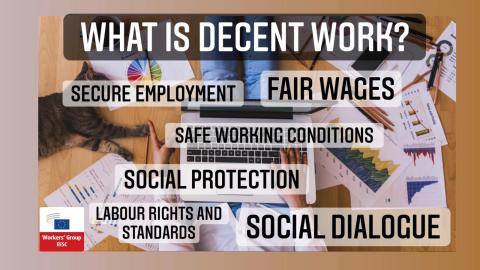
This year, celebrating the World Day for Decent Work (WDDW) on 7 October is more relevant than ever. The Covid-19 pandemic has exacerbated existing flaws in our societies when it comes to decent work, pay and income. It has highlighted the disastrous side-effects of unregulated globalisation such as the lack of supply of and unequal access to essential health care products in many regions of the world, with dramatic consequences for health care for the poor and for those without adequate social safety nets. Yet again, certain people – who were already among the most vulnerable – have been disproportionately impacted: young people in precarious jobs, women over-represented in the most affected sectors or staying at home to home school and care for family members, self-employed or platform workers, low-paid workers, migrants, and those in undeclared work.
On this World Day for Decent Work, the Workers' Group stands united in solidarity to fight for the dignity of all workers and the socially vulnerable. We join the ITUC and the ETUC in the call for A New Social Contract for Recovery and Resilience to counter the effects of the COVID-19 crisis in a sustainable way by finally responding to the needs of the people.
The crisis has shown that the most useful jobs from a social point of view, those which have enabled citizens to live and be cared for throughout this health crisis, be it in the fields of health, food distribution or cleaning, are the least well paid and are mostly occupied by women. They are the first we have in mind when we demand decent salaries and fair working conditions.
A genuine renewal of the European project needs strong social investments to complete economic policies, focusing on the preservation and creation of quality jobs, fair pay and an end to precarious work.
The Commission must continue with the implementation of the European Pillar of Social Rights and in particular with initiatives on fair minimum wages, minimum income, pay transparency, and strengthening occupational health and safety regulations. In this framework, collective bargaining and the interests of precarious and vulnerable workers must be guaranteed.
We also urge the Commission to ensure decent work in the platform economy: we need to ensure fairness in a sector that brings huge profits to companies, whilst its workers face an extremely precarious situation in terms of their labour rights, wages and working conditions. We need a minimum level of regulation and guaranteed rights for those workers, who have come under even more pressure due to the pandemic.
On this day of celebration of the World Day for Decent Work, it is important to send a signal to European workers that we can deliver on their expectations by drawing the right lessons from the COVID-19 crisis.
Work organisation
Recommended for you
Presidentes do CESE e do CR debatem desafios comuns para o futuro da Europa
News
Na reunião plenária de julho do Comité Económico e Social Europeu (CESE), a sua presidente, Christa Schweng, e o presidente recentemente eleito do Comité das Regiões Europeu (CR), Vasco Alves…
Movimento Transformers entre os finalistas do Prémio CESE para a Sociedade Civil dedicado à juventude
News
A associação sem fins lucrativos portuguesa Movimento Transformers figura na lista de finalistas do Prémio CESE para a Sociedade Civil de 2022 que, este ano, é atribuído a duas categorias, a saber,…
Associação portuguesa Movimento Transformers recebe Prémio CESE para a Sociedade Civil 2022 pelo apoio a jovens desfavorecidos
News
O Movimento Transformers é uma das organizações sem fins lucrativos que o Comité Económico e Social Europeu (CESE) distinguiu pelos seus projetos em prol da juventude. O Movimento Transformers…
«A tua Europa, a tua voz!» de 2023: jovens reclamam uma UE mais transparente, digital e simplificada
News
Em 23 e 24 de março, o Comité Económico e Social Europeu (CESE) acolheu a 14.ª edição do evento «A tua Europa, a tua voz!», que reuniu em Bruxelas 105 alunos de 35 escolas dos 27 Estados‑Membros da…
#RareDiseases – UE precisa de estratégia para ajudar 36 milhões de pessoas com doenças raras na Europa
News
Na conferência que organizou em Bilbau, o Comité Económico e Social Europeu (CESE) instou a União Europeia a lançar um plano de ação europeu para reforçar a cooperação entre os sistemas nacionais de…