
European Economic
and Social Committee
Four Years On: Ensuring Recovery and Hope for Ukraine’s Younger Generation
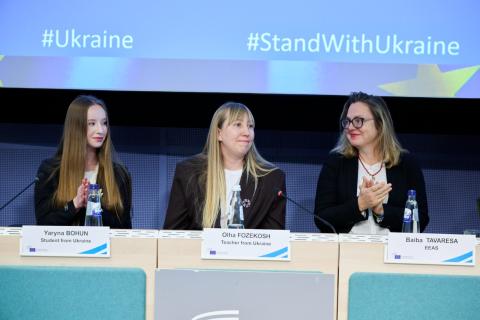
Ahead of the fourth anniversary of Russia’s full-scale invasion of Ukraine, the European Economic and Social Committee (EESC) placed a strong focus on the war’s lasting and complex impact on children and young people. The EESC calls for coordinated European action, with strong involvement from civil society and international partners, to help young Ukrainians recover and look to the future with hope.
‘Thousands of children across Ukraine wake up in apartments without electricity and heating. In some residential buildings temperatures are only around 10 °C at best. And for nearly two months of this cold winter children have been going to bed in sleeping bags layered in all their warm clothing, while parents place hot-water bottles around them’, said the First Lady of Ukraine Olena Zelenska, speaking remotely at the EESC’s February plenary session.
The debate on The lasting scars of Russia’s war against Ukraine – its devastating toll on children and youth aimed to raise awareness of the impact of the prolonged war on children and young people and to trigger civil dialogue and actionable responses. Four years on, Russia’s aggression against Ukraine continues to disrupt the lives of children and young people, who are suffering from severe war trauma, physical wounds, mental health damage, displacement, interrupted education and diminished future opportunities.
Figures speak louder than words. As Olena Zelenska underlined, 684 children have been killed and more than 2 000 wounded over the last four years. According to UNICEF, 73% of children feel unsafe, and 54% report feelings of sadness. Around 43% of children experience severe psychological distress, including anxiety, fear, and difficulties with concentration.
The Olena Zelenska Foundation puts children and young people at the heart of its work. In her video message the First Lady underlined the need for underground infrastructure to provide safe spaces where children can at least learn without risk. At the same time, the Foundation, in collaboration with UNICEF and other organisations, is developing a system for psychological support and rehabilitation.
‘I am grateful that you are listening to me’, said Ms Zelenska, ‘and I hope this debate will be more than conversation. Ukraine is now a hub of innovative social and humanitarian projects and ideas. And every initiative can and should be supported.’
During the debate, the participants heard the testimony of Yaruna Bohun, a Ukrainian student who spoke of her initial denial and the emotional struggle of adapting to refugee life while her parents remain in Ukraine. Yaruna Bohum ended her speech with a moving call: ‘Protect the children from war!’
Olha Fozekosh, a Ukrainian teacher in Belgium, shared the impact of the war on children who fled Ukraine: ‘Although these children may appear calm, the scars are evident. Every day I witness what war does to their hearts.’ Ms Fozekosh told the story of one of her students, bringing tears to the eyes of the audience: ‘Before the war Maria loved to create things with her own hands. She was making bracelets, ornaments, and little gifts. And now Maria doesn’t create a thing. When I asked her why, my student said, ‘I am empty inside.’
Reaffirming the Committee’s unwavering support for Ukraine’s recovery and reconstruction, Séamus Boland, EESC President, urged all players to work together to ensure that this generation can heal, rebuild and look towards a secure and hopeful future.
‘We will stand by Ukraine and its future for as long as it takes’, stressed Mr Boland. ‘We must do everything possible to ensure that Ukrainian children receive the support they need. They deserve to grow up in safe and dignified conditions. They will be essential to Ukraine’s recovery and reconstruction.’
The situation is even more severe for the almost 20 000 children who have been abducted by Russia. On this subject, Baiba Tavaresa, Head of the European External Action Service’s Ukraine Division, underscored that the return of Ukrainian children remained a top priority for the EU and that this commitment would persist in the future. To this end the EU, together with Ukraine and Canada, is to host an International Summit on the Return of Ukrainian Children in the spring. ‘Protection and return of Ukrainian children is an investment in lasting peace and in Ukraine’s future’, said Ms Tavaresa.
The plenary featured contributions from representatives of international and Ukrainian organisations, who shared their initiatives and projects to support children and young people suffering from multiple traumas and repeated exposure to extreme stressful conditions. The speakers stressed that raising awareness would not be enough without policy action, trauma-informed education and collective support networks. They drew attention to the fate of 1.6 million Ukrainian children living in territories occupied by Russia, who have been subjected to forced ‘Russification’ indoctrination and militarisation.
The Ukrainian speakers highlighted the need for detailed documentation of crimes so that Russia can be held accountable before the international courts. The speakers stressed that justice and accountability are key tools to prevent the repetition of such crimes. Moreover, accountability is demanded by Ukrainian victims of Russia’s war of aggression against their country, including children and their families.
The debate concluded with a strong call for European civil society organisations to contribute funding and initiatives to help Ukrainian civil society in its effort to support its children and young people.
Additional Quotes
Sandra Parthie, EESC Employers’ Group President: ‘The courage of the Ukrainian people reminds us that peace and freedom cannot be taken for granted. Ukrainians inspire us – they want to thrive, they have relocated their businesses, created safe environments for their teams, and we need to help them restore not only their economy but also their hopes. The EU business community is ready to support Ukrainian entrepreneurs and young people. We reaffirm our support to Ukraine in its EU path.’
Lucie Studničná, EESC Workers’ Group President: ‘As a mother and grandmother, I can’t even imagine what they are going through, and all the suffering caused to soldiers, to their families, to civilians, to internal and external refugees. To the ones who feel the bombs at home and the ones who doubt they will ever see their homes again. Europe must step up aid to Ukraine, and must also make sure rights and labour standards are respected as much as possible.’
Lidija Pavić-Rogošić, Vice-President of the EESC Civil Society Organisations’ Group, shared her experience from the impact of the Croatian War of Independence on children. ‘War leaves lasting wounds on children. The EU must ensure that Ukrainian children do not just survive but thrive. It must invest in psychosocial support, safe schools and local civil society organisations that help restore stability.’
Work organisation
Related content
Downloads
-
Four Years On: Ensuring Recovery and Hope for Ukraine’s Younger Generation