Vecinos del Este

This page is also available in:

Las actividades del CESE en relación con los países de la vecindad oriental incluyen a Armenia, Azerbaiyán, Bielorrusia, Georgia, Moldavia y Ucrania. El principal objetivo del CESE con respecto a los «Vecinos del Este de Europa» tiene por objeto mejorar las relaciones con las organizaciones de la sociedad civil en la región y hacer que participen en un diálogo con sus responsables políticos nacionales y con la sociedad civil organizada de la UE.

Los principales mecanismos de cooperación con Georgia, Moldavia y Ucrania son las plataformas de la sociedad civil, que complementan los órganos políticos que existen en el marco de los Acuerdos de Asociación de la UE con estos países. Las plataformas permiten a las organizaciones de la sociedad civil tanto de la UE como de los países socios en cuestión supervisar el proceso de aplicación y preparar sus recomendaciones destinadas a las autoridades pertinentes.

Por parte de la UE, estas plataformas están integradas por miembros del CESE, así como representantes de grandes redes europeas de la sociedad civil. Por parte de los países socios, representan a un amplio espectro de organizaciones de la sociedad civil. La composición de las plataformas se basa en una representación equilibrada de todos los grupos de interés (organizaciones de empresarios, sindicatos y grupos de actividades diversas).

El Comité de Seguimiento para los Vecinos del Este de Europafue creado en 2004 como un órgano específico encargado de las relaciones con la sociedad civil de los países de la vecindad oriental. El Comité de Seguimiento se suele reunir cuatro veces al año y sus miembros participan activamente en las actividades relacionadas con la Asociación Oriental, tales como las plataformas multilaterales de la Asociación Oriental y el Foro de la Sociedad Civil de la Asociación Oriental.
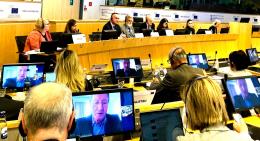
  • The External Relations Section (REX) of the European Economic and Social Committee (EESC) held a debate on 23 February 2026 to address the alarming deterioration of trade union freedoms in Belarus. Despite sustained international pressure and the appointment of an International Labour Organization (ILO) Special Envoy in June 2025, the Belarusian authorities continue to refuse any dialogue aimed at restoring compliance with fundamental labour standards. Around twenty trade unionists remain imprisoned.

  • On the occasion of the fifth anniversary of the ratification of the Enhanced Partnership and Cooperation Agreement (EPCA) between Kazakhstan and the EU, the European Economic and Social Committee (EESC) adopted at its March plenary session an action plan for enhancing cooperation between civil society organisations in the European Union and Kazakhstan. 

  • Civil society for an open democratic debate
    Event type
    Conference

    This conference in Lisbon is the fourth event on disinformation being hosted by the European Economic and Social Committee (EESC) as part of its ongoing project aiming to fight disinformation with the help of civil society.

  • Aprobados on 17/07/2025 - Bureau decision date: 23/01/2025
    Sygnatura
    REX/598-EESC-2025
    Plenary session number
    598
    -
    • Follow-up from the Commission REX/598
    Download format:
    Download — Dictamen del CESE: The importance of institutionalising civil and social dialogue in EU candidate and partner countries
  • The fifth meeting of the EU-Armenia Civil Society Platform (CSP) is scheduled to be held on 15 October 2024 in Brussels.

    The meeting will focus on assessing progress in the implementation of the EU-Armenia Comprehensive and Enhanced Partnership Agreement (CEPA), with a strong emphasis on its impact in the Areas of Democracy, Rule of Law, Anti-Corruption, and Human Rights.


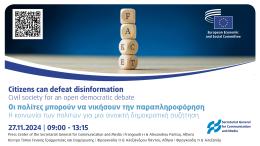
  • Civil society for an open democratic debate
    Event type
    Conference

    This conference in Athens is the third event on disinformation being hosted by the European Economic and Social Committee (EESC) as part of its ongoing project aiming to fight disinformation with the help of civil society.

  • The 14th meeting of the EU-Ukraine Civil Society Platform (CSP) took place on 15 December 2023. During the meeting, a debate focused on assessing the implementation of the European Commission's opinion and the state of play of the implementation of the EU-Ukraine Association Agreement.

    In addition, the CSP discussed the initiatives for Ukraine's green recovery, economic integration of Ukraine to the EU, as well as current challenges related to labour market.

    A joint declaration, prepared by both sides, was discussed and adopted.

  • Published in
    8 pages

    The External Relations Section (REX) of the European Economic and Social Committee (EESC) is responsible for dialogue between European civil society organisations and their homologues from the countries with which the European Union has formal relations (e.g. under the form of a Free Trade Agreement). Through this dialogue, made possible by a series of bilateral bodies, and through specialized opinions and information reports, the Committee is able to concretely contribute to EU foreign policy.

  • Document type
    Joint declaration
    Latest update
    • Joint declaration - 7th joint meeting of the EU-Moldova Domestic Advisory Groups
  • Aprobados on 26/10/2022 - Bureau decision date: 20/09/2022
    Sygnatura
    REX/564-EESC-2022
    Civil Society Organisations - GR III
    Download format:
    Download — Dictamen del CESE: Specific provisions for the 2014-2020 cooperation programmes supported by the European Neighbourhood Instrument and under the European territorial cooperation goal, following programme implementation disruption