Public debate on Defence-related investments in the EU budget in the context of the new geopolitical order, to contribute to the final report of the EESC´s ad hoc group on the new geopolitical order, and in the framework of the opinion ECO/679 - Defence-related investments in the EU budget.
Lessons learned and a new Inflation Governance Framework
Event type
Conference
Location
room VMA 22, Van Maerlant 2
Brussels
Belgium
On Wednesday, 3 September 2025, from 14:00 – 17:30 (CET), the European Economic and Social Committee (EESC) will host an event organised by the Foundation for European Progressive Studies, in cooperation with Fondazione Pietro Nenni and tasc, discussing lessons learned from the recent inflation episode and the new inflation governance framework that needs to be developed to prevent or mitigate the supply side inflation shocks in the future.
The objective of the public hearing is to examine how cohesion policy can more effectively address housing affordability challenges to advance its core goals of economic, social and territorial cohesion. The participants will explore how strategic housing investments can stimulate regional economic development, enhance competitiveness, improve labour market efficiency, and reduce territorial disparities. The aim is to provide concrete recommendations for improving the effectiveness of existing instruments for the remainder of the 2021-2027 period and developing a more comprehensive approach to affordable housing within the post-2027 cohesion policy framework.
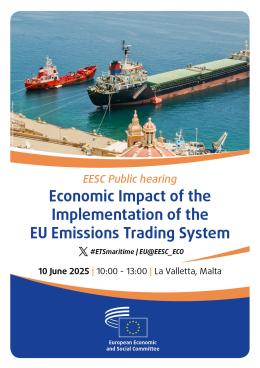
The European Economic and Social Committee (EESC) is organising a public hearing to assess the economic impact of extending the EU Emissions Trading System (ETS) to the maritime sector.
The hearing will focus on the risks of carbon and business leakage, and how these developments may affect port competitiveness and trade flows- particularly in smaller and peripheral EU Member States. The event will provide a platform for maritime stakeholders, economic experts, and EU institutions to discuss real-world implications and explore fiscal and strategic solutions to mitigate negative effects.
Speakers will include representatives from DG CLIMA, maritime and port organisations, as well as leading economists and policy analysts.
Malta’s strategic location and role in European maritime logistics make it an ideal setting for this timely discussion.
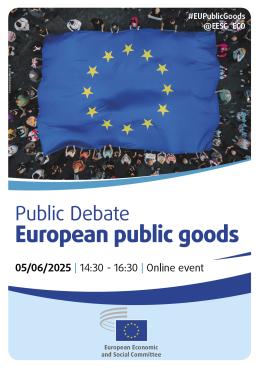
In a context such as the one that Europe is experiencing, characterised by multiple crises, it is appropriate to promote a reflection on European public goods and on fundamental political priorities capable of ensuring the sustainable growth of the EU and the well-being of its citizens. This reflection gets ever more important in view of the upcoming negotiations on the next European Multiannual Financial Framework for the period post 2027.
Public hearing with Polish civil society and policy makers
Event type
Public hearing
Location
Online event
ul. Wspólna 2/4
00-926 Warszawa
Warsaw
Poland
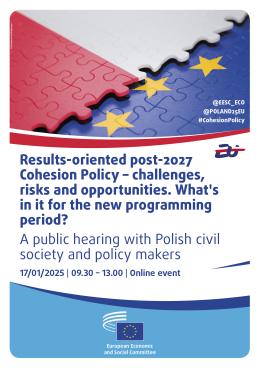
In the context of the ongoing exploratory opinion, requested by the Polish Presidency, to examine how civil society actors can make use of a results-orientation approach in cohesion policy in the next programming period, the EESC is organizing a hearing in Warsaw on 17 January 2025. The hearing will be important as the EESC will explore how civil society and local actors understand the concept of a results-orientation approach to cohesion policy, to which degree they are prepared and if they have the administrative capacity to implement it.
The hearing is co-organized with the Polish Presidency of the Council of the EU and it has the patronage of the Polish Presidency. The venue is the premises of the Ministry of Development Funds and Regional Policy of Poland.
The EESC is organising this public debat to discuss how civil society partners can use a results-orientation approach in cohesion policy for the next programming period. The principles of multi-level governance and shared management are contradictory or complementary to the results-focused cohesion policy ?
Public debate with Fabian Zuleeg, Chief Executive and Chief Economist, European Policy Centre (EPC)
Event type
Debate
Location
Online event
Belgium
Public debate on Reforms for a more resilient economy for all: the new EU legislature with Fabian Zuleeg, Chief Executive and Chief Economist, European Policy Centre (EPC)