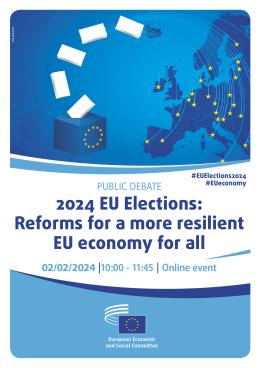
The written conclusions and recommendations of the conference will feed into an EESC resolution with policy recommendations to the new European Parliament and European Commission, to be adopted in July.
The European Council of December 2023 discussed the EU enlargement policy, including the stabilisation and association process and next steps in this respect. The enlargement policy will be one of the top priorities for the next coming years. One of the most important aspects of the enlargement process will be the cohesion policy and the structural funds.
The need for a structural policy to be applied following enlargement is justified both by the external necessity of reducing the gap between the applicant countries and the EU average and by the internal necessity of combating increasing disparities amongst and within accession countries.
Download format:
Download — Dictamen del CESE: The role of cohesion policy in upcoming rounds of EU enlargement
The Territorial Agenda (TA) 2030 is an inter-governmental declaration with no direct legal, financial or institutional implementation instrument. The application of the Territorial Agenda 2030 relies on informal multilevel cooperation between Member States, sub-national authorities, the European Commission, the European Parliament, the European Committee of the Regions, the European Economic and Social Committee, the European Investment Bank and other relevant players.
Download — Dictamen del CESE: Revision of the Territorial Agenda 2030 - Towards a more integrated and civic approach with stronger links with the cohesion policy
Climate change is an existential threat for the European economy. Therefore, a comprehensive approach is needed. In this context, based on the empirical and data analyses related to the impact of climate change on the real economy, macroeconomic and financial stability is essential. As things currently stand, intensified natural disasters will lead to unprecedented costs that will have an unpredictable impact on public finance.
The European economy is currently on a downward trend. This will lead to lower revenue and, at the same time, higher demand for spending – mainly related to the costs of climate change, higher borrowing costs and negative trends in demographic development.
Climate change is a matter of urgency and demands a green shift in our economies. To achieve the EU's climate targets, a profound modernisation of the capital stock is needed. This entails a massive expansion of public investments. The need for an EU-level investment fund to finance the green transition is also a matter of economic strength and sustainable competitiveness. One central element of closing the financing gap is an investment friendly reform of the EU fiscal rules. While the reform process is still ongoing and is supposed to be finished by the end of this legislature, it is already clear that the fiscal space for public investments at national level will not significantly increase with the reform.
This brochure brings you the highlights of the EESC's Connecting EU 2023 seminar, held in Bratislava in November 2023 under the title "European Elections 2024: Why vote?"
According to Article 175 of the TFEU the Commission shall submit a report to the European Parliament, the Council, the Economic and Social Committee and the Committee of the Regions, every three years, on the progress towards achieving economic, social and territorial cohesion.
The 9th report which covers the first period (2021-2023) of the programming period 2021-2027 will include a record of progress made towards achieving economic, social and territorial cohesion, including the socio-economic situation of regions as well as the integration of EU priorities. It will also include, where appropriate, an indication of future EU measures and policies necessary to strengthen cohesion, as well as to deliver EU priorities.
This public hearing is being organised as part of the preparation of the exploratory opinion ECO/630 on "Boosting long-term inclusive growth through reforms and investment" requested by the Belgian Presidency of the Council of the EU. It focuses on how to foster upwards social convergence and cohesion, in an economic governance framework defined around debt sustainability, productive investments and reforms. It also looks at the implications of such a framework for the European Semester and the strengthening of the European Pillar of Social Rights.
Already in 2018 the European Commission has proposed a Regulation on a mechanism to resolve legal and administrative obstacles in a cross-border context for the programming period 2021-2027. At the time, the EESC has adopted its opinion on 19 September 2018, and the European Parliament adopted its first-reading position on the proposal in February 2019. However, the Council's working party on structural measures decided to cease work on the proposal in May 2021. In October 2022, to break the impasse and take the lead on this issue, the EP's Committee on Regional Development started drawing up a legislative-initiative report, calling on the Commission to present a new legislative proposal. The EP voted the report at its September 2023 plenary session.
Download format:
Download — Dictamen del CESE: Facilitating cross-border solutions