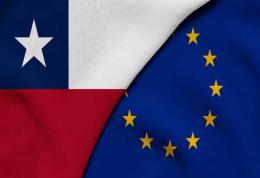
Chile

This page is also available in:

The EU's relations with Chile are among the closest in the region. The Association Agreement signed in 2002 marked one of the longest running associations and its update is further is further strengthening our bilateral ties. The EESC has had fluid contact with Chilean civil society over the years, primarily through biennial EU Latin America Organised Civil Society meetings.

Since October 2016 until February 2025, this relationship took the form of a Joint Consultative Committee, marking closer, more structured dialogue between civil society in both regions and with their respective political authorities. The Joint Consultative Committee was set up between the EESC and civil society partners and organisations from Chile. It was composed of nine members from each side, representatives from employers' organisations, workers' organisations and other interests groups. The JCC met once a year to debate and allows civil society organisations from both sides to debate topics of common interest and to follow up the modernisation of the Association Agreement.

In 2025, with the entry into force of the Interim Trade Agreement, and with the provisional application of the Advanced Framework Agreement, the mandate of the Joint Consultative Committee expired, giving way to a different form of Civil Society dialogue between the EU and Chile. The new legal framework calls for a creation of the Domestic Consultative Groups on both sides within two years from the entry into force of the Agreement.

Displaying 1 - 10 of 10
  • Final meeting under the Association Agreement
    Event type
    JCC Meeting

    The 13th and final meeting of the EU-Chile JCC under the 2002 Association Agreement marked a significant milestone in the EU-Chile partnership. This meeting served as an opportunity to reflect on past achievements and discuss the transition to the new Advanced Framework Agreement, which will reshape and strengthen cooperation between both parties.

  • -
    Event type
    JCC Meeting

    12th meeting of the EU-Chile JCC was held physically in Brussels on 12-13 June 2024. The EESC members and Chilean delegates discussed the transition to a new framework of our bilateral partnership, under the Advanced Framework Agreement, which is expected to enter into force by the end of the year or in early 2025. They also debated the current challenges for democracy in the EU, Chile and across the globe. Among the economic issues, state of play of bilateral trade and technology transfer dominated the discussions. Members also exchanged views on the participation of youth in civil dialogue, and shared good practices of inclusion of young people in the initiatives promoting sustainable development. Prominent on the agenda were also environmental issues, including healthy environment as a human right, climate financing, and the future of the implementation of the Sustainable Development Goals.
    The JCC adopted a Joint Declaration.

  • JCC meeting / Virtual

    The EU-Chile Joint Consultative Committee (JCC) held its sixth meeting on 21 January 2021.

    The members of the JCC reiterated the need to maintain the Joint Consultative Committee in the Chile-UE Association Agreement currently renegotiated, so that the JCC can express its views on any subject covered by the Agreement, including trade.

  • JCC meeting / Virtual

    The EU-Chile Joint Consultative Committee (JCC) held its sixth preparatory meeting in the new mandate on 7 December 2020, one week after the successful visit of Foreign Affairs Minister Andrés Allamand Zavalala in Brussels.

  • Event type
    JCC Meeting

    The fourth meeting of the EU-Chile Civil Society Joint Consultative Committee (JCC), established by the EU-Chile Association Agreement was held via a video conference on 27 November 2019. At this meeting, the members adopted a Joint Statement.

    The JCC is made up of eighteen members, nine from the European Economic and Social Committee (EESC) and nine from Chilean civil society organisations. It is co-chaired by Josep Puxeu Rocamora, EESC member, and Roberto Zúñiga Belauzarán, Director, National Confederation of Micro, Small and Medium Enterprises (CONAPYME).

  • Event type
    JCC Meeting

    The fifth meeting of the EU-Chile Civil Society Joint Consultative Committee (JCC), established by the EU-Chile Association Agreement was held via a video conference on 15 May 2020. 

    The members discussed topics of interest for both parties, such as the impact of the COVID-19 crisis on cooperation, trade and investment, decent work and informal economy and the Agenda for Sustainable Development; as well as proposals for strengthening of the role of the Joint Consultative Committee. The members adopted a Final Declaration on these topics.

  • -

    On 6 and 7 December 2018, the third meeting of the EU-Chile Civil Society Joint Consultative Committee (JCC), established by the EU-Chile Association Agreement was held in Santiago de Chile. The members discussed topics of interest for both parties, such as investment and cooperation, decent work and informal economy, the Sustainable Development Agenda and proposals to reinforce the role of the Joint Consultative Committee.  They adopted a Final Declaration on these four topics.

    The JCC is made up of eighteen members, nine from the European Economic and Social Committee (EESC) and nine from Chilean civil society organisations. It is co-chaired by Josep Puxeu Rocamora, EESC member, and Roberto Zúñiga Belauzarán, Director, National Confederation of Micro, Small and Medium Enterprises (CONAPYME).

  • Event type
    JCC Meeting
  • -
    Event type
    JCC Meeting
  • Published in
    8 pages

    The External Relations Section (REX) of the European Economic and Social Committee (EESC) is responsible for dialogue between European civil society organisations and their homologues from the countries with which the European Union has formal relations (e.g. under the form of a Free Trade Agreement). Through this dialogue, made possible by a series of bilateral bodies, and through specialized opinions and information reports, the Committee is able to concretely contribute to EU foreign policy.

Displaying 1 - 10 of 10