By Baiba MILTOVIČA, member of the EESC Civil Society Organisations’ Group, representing the Latvian National Association for Consumer Protection (LPIAA)
considers that a successful EU Ports Strategy will depend on integrated governance, long-term investment planning, coordination across multiple policy domains and a strong social foundation that guarantees decent work, fair competition and active social dialogue while taking passengers’ rights into consideration;
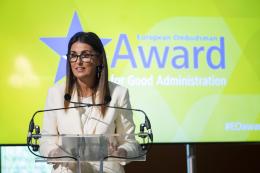
On 30 June, the European Economic and Social Committee initiative 'Empowering youth voices through the EESC Youth Test' joined three other finalists in the 'Excellence in diversity and inclusion' category at the ceremony for the Ombudsman Award for Good Administration. Amidst the shortlisted projects, the winning recognition was awarded to the DiscoverEU Inclusion Action, a European Commission initiative dedicated to opening Europe to young people with fewer opportunities.
considers that the development of a genuine European High-Speed Railways Network by 2040 must become a strategic priority for the Union, as ambitious as the Single Market, the euro and the Green Deal;
As the EU rethinks its priorities in a more hostile geopolitical climate, civil society communicators, policy-makers and journalists will gather in Sofia on 6-7 July for the XVIII Connecting EU Seminar to discuss how Europe can defend its values while responding to pressure on security, competitiveness and democratic trust.
The United Nations' Sustainable Development Goals must continue to serve as the compass for Europe's future well beyond 2030. Civil society organisations and policymakers must prepare for the end of the decade, when the SDGs should be strengthened. The energy transition and the circular economy agenda must play a central role in this process.