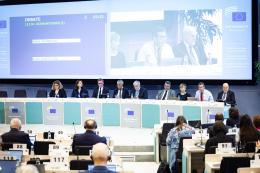
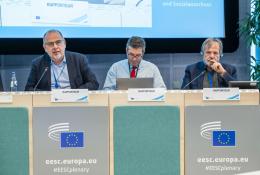
At its April plenary session, the European Economic and Social Committee (EESC) hosted a debate where EESC members underlined the strategic importance of the next Multiannual Financial Framework to address Europe’s growing challenges.
At its April plenary session, the European Economic and Social Committee (EESC) adopted a key opinion, outlining a broad strategy to address the ongoing cost-of-living crisis and strengthen the EU’s long-term economic and social resilience. Focused on the economic aspects, this opinion is among the first to be adopted in a wider set of coordinated recommendations to address the cost-of-living crisis, to be unveiled over the coming months.
The European Economic and Social Committee (EESC) will open its doors to the public for its traditional Open Day on Saturday 10 May 2025 from 10:00 to 18:00.
On 9 May, Europeans will celebrate Europe Day. 2025 marks the 75th anniversary of the Schuman Declaration, which laid the foundations for the European Union and paved the way for an unprecedented era of prosperity, peace, democracy, solidarity and cooperation in Europe.
At its April 2025 plenary session, the European Economic and Social Committee (EESC) adopted an opinion that aims to reshape how the EU’s economic governance works, putting people and participation at its core. The EESC wants national and EU-level economic decisions to better reflect real-life needs, and to be built on inclusive dialogue with civil society, trade unions and employers’ organisations.
To safeguard its democratic and social model based on freedom, equality and inclusion, the EU must resist attempts to water down its pioneering legislation regulating digital space