
European Economic
and Social Committee
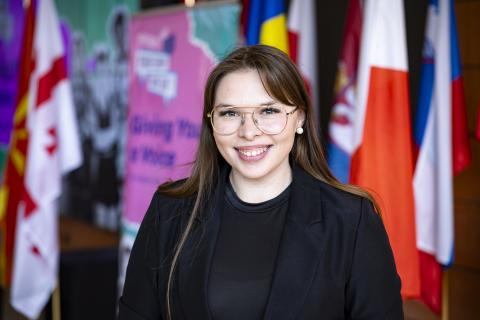
Young Moldovan Mădălina-Mihaela Antoci was one of the representatives of EU candidate countries at this year's EESC annual youth event Your Europe Your Say! (YEYS). She also took part in the EESC’s Civil Society Week where she delivered an inspiring speech during the opening panel Still united in diversity. President of Erasmus Student Network Moldova and a board member of the country’s National Youth Council, Mădălina-Mihaela shared what the EU means for young Moldovans and told us about her mission to encourage young people from her country to study abroad and embrace a global mindset.
Is the National Youth Council of Moldova engaging young people in discussions about EU integration? How do young Moldovans perceive the EU?
Absolutely! The National Youth Council of Moldova ensures that young voices are heard in Moldova’s EU integration process through consultations, advocacy campaigns and direct engagement with policymakers. For many young Moldovans, the EU represents progress, new horizons, and a future where their talents are recognised and valued. However, there are still gaps in awareness, and that’s where we step in – turning curiosity into active participation.
We are organising forums, debates and workshops on EU integration, policy and youth rights.
We are calling for youth inclusion in national decision-making processes.
We are launching campaigns to inform and educate young Moldovans about the benefits of EU membership.
Could you briefly introduce your work with the Erasmus Student Network (ESN) Moldova?
As President of ESN Moldova, I’m on a mission to connect young people to life-changing international opportunities. Our team works to promote mobility, create a welcoming environment for exchange students, and advocate international education. One of my key initiatives is Erasmus in Schools, where we inspire high school students to dream beyond borders and embrace a global mindset.
Could you share any figures on how many Moldovan students have benefited from the Erasmus+ academic programme so far, either in total or annually?
Right now, Moldova does not host incoming Erasmus+ students, but our young people are making waves abroad! Every year, between 500 and 700 Moldovan students study or do traineeships in top European institutions through Erasmus+. Since the programme’s launch, thousands have gained international experience, bringing back innovation, leadership and a fresh perspective. Through Erasmus in Schools, I strive to make mobility a reality for even more young Moldovans, proving that the world is theirs to explore.
In your view, what is the value of such academic exchange programmes for young people in a candidate country like Moldova?
Erasmus+ is not just a study programme – it’s a launchpad for Moldova’s future. It gives young people more than an education; it gives them adaptability, resilience and a European perspective. In a candidate country like Moldova, it’s about building a generation that sees beyond limitations, that innovates, collaborates, and is ready to lead our country into the European future.
What were your expectations for YEYS and Civil Society Week?
I expected powerful discussions, bold ideas and real commitments to youth inclusion in policymaking. These events are more than just meetings – they are platforms where young change-makers challenge the status quo and push for a stronger, more inclusive Europe. For Moldova, this is another step toward bridging the gap between the local reality on the ground and European ambitions, proving that our young people are not waiting for the future – we are creating it.
Mădălina Mihaela Antoci is a 21-year-old youth leader passionate about education, civic engagement and youth empowerment. She currently serves as the President of Erasmus Student Network Moldova and is a board member of the National Youth Council of Moldova.
A tireless advocate of the Erasmus+ academic programme, she has achieved remarkable success in encouraging young people to explore international opportunities while also emphasising the value of education at home. Through her efforts, she has inspired hundreds of students to engage in academic mobility and contribute actively to their local communities.