Joint ECFIN-EESC Conference "The way forward for EU economic governance" will promote a horizontal discussion cutting across the various themes of the review of the economic governance framework, with debates on debt sustainability and growth, macro-economic imbalances, investment, and the implementation of the rules. It will gather a great line-up of speakers, including Christa Schweng, President of the European Economic and Social Committee, and Paolo Gentiloni, Commissioner for Economy.
Digital and green transitions: contradictory or complementary? The consumer viewpoint
Event type
Conference
Location
Brussels
Belgium
In making their choices, consumers cannot always take into account the digital dimension and the ecological dimension at the same time. A young consumer who would be tempted to replace his mobile phone every year to keep up with digital developments cannot at the same time take into account the environmental impact of the transport of devices often coming from Asia.
AI made in Europe: empowering and protecting the public and businesses
Event type
Conference
Location
Rue Belliard 99-101
Brussels
Belgium
The first-ever legal framework on AI will be in the spotlight of the second edition of the AI stakeholder summit, co-organised by the Digital Transition and Single Market Observatory (EESC) and the Special Committee on Artificial Intelligence in a Digital Age (European Parliament).
Topics on the agenda: how to enhance the accession process – a credible EU perspective for the Western Balkans; the contribution of CSOs to the Green Agenda and sustainable development of the Western Balkans as part of the EU accession process; the state of social dialogue, as well as enabling civic space in the Western Balkans. @EESC_REX #EESC_WB
The conference "The Anti-Money Laundering Legislative Package" will take stock of the state of play and debate in particular the legislative proposals tabled by the European Commission in July 2021 to strengthen the EU's anti-money laundering and countering terrorism financing (AML/CFT) rules.
The conference is organised on 5 October 2021, starting at 14:30.
The event is accessible via webstream. No registration is needed, and participation is free of charge.
As in previous years, the European Economic and Social Committee, as the body representing organized civil society at the EU, will be following the High Level Political Forum (HLPF), from Tuesday, 6 July, to Thursday, 15 July 2021. The HLPF is the United Nations central platform for follow-up and review of the 2030 Agenda for Sustainable Development and the Sustainable Development Goals.
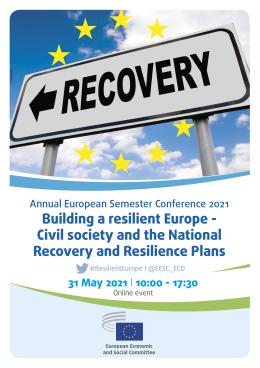
Building a resilient Europe - Civil society and the National Recovery and Resilience Plans
Event type
Conference
Location
Brussels
Belgium
The Recovery and Resilience Facility is moving into its next phase, and the European Semester Group of the EESC is following the process. In this high-level conference we will discuss whether the national recovery and resilience plans will deliver as regards the aim of achieving fair, inclusive, competitive and sustainable growth and cohesion through the new growth strategy – the European Green Deal. Focus will be on the implementation of the national recovery and resilience plans, with particular attention on the implementation of the European Pillar of Social Rights and the just transition towards a green, digital and sustainable European economy. The conclusions of this event will be forwarded to EU institutions and the "EU Recovery Summit" conference in Lisbon on 28 June 2021.
Strategic foresight is increasingly being embedded into EU policy making. It involves exploring different possible future scenarios and considering the opportunities and challenges connected to them, to contribute to policy action that shapes the future in a way we would like.
The conference will focus on the economic aspects of strategic foresight, and how strategic foresight influences considerations and policy making in public authorities in the EU, and how economic and social actors use foresight in their organisations.