
European Economic
and Social Committee
BRAILLE: FROM A READING AND WRITING SYSTEM TO RECOGNITION AS CULTURAL HERITAGE?
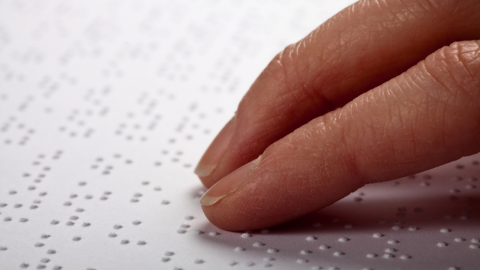
In its Public Square column, EESC Info gives the floor to voices from across public life – civil society, journalists, NGOs and institutions – to share the causes they champion and the issues they believe deserve attention. In this issue, the European Blind Union’s Rainer Delgado writes about why, as a braille-user, he is keeping his fingers crossed that the writing system used by blind and partially sighted people will be included on UNESCO’s Representative List of the Intangible Cultural Heritage of Humanity.
Italian Cooking, Yodelling in the Alps, Arabic Coffee, Dry Stone Construction, Handmade Glass, Modern Dance…these are cultural traditions in Europe which were recognised as cultural heritage of humanity by UNESCO some time ago. And in one year’s time (at the end of 2027), the braille system could also join that list.
Under the name ‘Braille: Reading and Writing by Touch’, France and Germany submitted a nomination for braille to be included in UNESCO’s list of Intangible Cultural Heritage of Humanity earlier this year. Before this important development took place, the European Blind Union was already raising awareness about the teaching and use of the code through its braille Working Group.
These efforts have already paid off; over the last six years, eight European countries (Germany, France, Belgium, Portugal, Slovenia, Austria, Finland and Spain) have included braille in their national lists of cultural heritage. This will undoubtedly help strengthen the candidacy that’s currently being studied by UNESCO.
During the nomination process, blind and partially sighted people had to describe to others why braille is essential as a cultural tool and communication system. While they were all sending their reflections on that subject, braille users surely thought about how much this invention by a young boy from Coupvray in France has evolved over the 200 years since its invention.
For sighted people, written text is everywhere, it’s just another item to be found in their daily lives. But for us, people with visual impairments, being able to feel text through braille is an amazing experience. And, of course, it has come a long way: modern technology has allowed us to read information on computers and smartphones through braille displays. At the same time, the production of braille books is much more efficient today than in the past, and we can also find it on medicine packaging, in elevators, or at train stations. It’s even a key tool to allow us to work on an equal basis with others in skilled jobs.
Moreover, braille is more than a daily ally for overcoming the barriers we find in different areas of life; it’s part of our personality, our identity. We read in braille; we write in braille – we even build precious personal bonds with it.
We – braille users – are keeping our fingers crossed that it will be recognised as Intangible Cultural Heritage by UNESCO. Because it’s not only about giving us access to information, but also about cherishing a treasure that has touched our hearts and led us towards inclusion.
Reiner Delgado is a member of the European Blind Union’s Braille Working Group. You can find more information on this topic on the livingbraille.eu platform.