
European Economic
and Social Committee
Diversifying EU trade strategy in a shifting global order
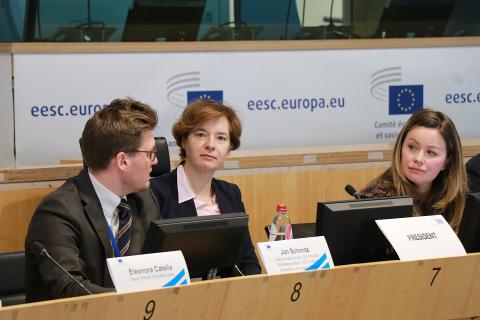
Global trade is facing a period of profound change. Geopolitical tensions, growing fragmentation and rising costs are reshaping international markets and business decisions. Supply chains are no longer optimised for the lowest price, but for reliability and resilience. While the World Trade Organisation (WTO) remains a cornerstone of the global trading system, many decisive developments are increasingly taking place outside its framework, endangering the international rules-based system and stability of our economies.
Against this backdrop, on 18 March 2026 the EESC Employers’ Group hosted a debate titled "Diversifying EU Trade Strategy in a Shifting Global Order" with Jan Schmitz, Deputy Head of Unit on Multilateral Affairs, WTO reform, competition and export finance at EU Trade; Eleonora Catella, Deputy Director at BusinessEurope; and Dominic Alexander Boucsein, Head of International Trade at Eurochambres.
The EU’s comparative advantage: stability in an unstable world
Opening the debate, Jan Schmitz, Deputy Head of Unit for Multilateral Affairs at the EU Commission’s Directorate‑General for Trade, stressed that despite the difficult global context, there are also positive signals. Paradoxically, geopolitical instability is currently one of the main drivers enabling progress on trade agreements, because while others shift unpredictably, Europe has remained stable and reliable.
Negotiations with key partners such as Mercosur, India and Australia are advancing, partly because these partners increasingly view the EU as a stable and reliable counterpart at a time when other major players are perceived as less predictable. “We may be slow,” he noted, “but we are reliable.” This reliability has become a strategic asset for the EU.
Beyond traditional Free Trade Agreements (FTAs), the EU is also pursuing more targeted partnerships, including on critical raw materials, as illustrated by recent agreements with countries such as South Africa. These partners are seeking long‑term stability, which the EU is well placed to provide.
While acknowledging that the World Trade Organisation (WTO) is not in good shape, Mr Schmitz underlined that it remains a pillar worth preserving. Its rules were designed for countries willing to abide by them, and a majority of global trade still takes place under the WTO framework.
Business reality: uncertainty, disruption and rising costs
From the business perspective, geopolitical instability is heavily impacting investment and trade decisions. Eleonora Catella, Deputy Director at BusinessEurope, underlined that for businesses the pace and frequency of recent shocks make long‑term planning increasingly difficult.
Companies are shifting from long‑term strategies to short‑term crisis management, as disruptions to value chains occur with little warning. Recent tensions in the Middle East, for example, have rapidly translated into higher energy and transport costs. BusinessEurope’s analysis shows that 55% of companies depend on imports of highly specialised, tailor‑made inputs, making them particularly vulnerable to disruptions.
For business, stability and predictability are now paramount. Even imperfect frameworks, such as the EU-US Turnberry trade deal , can provide a degree of certainty that supports investment decisions. FTAs remain essential tools, but they must be complemented by broader initiatives, such as Global Gateway, and by a functioning multilateral system.
Ms Catella was clear on business expectations: the EU must accelerate the ratification of concluded agreements. The stalled ratification of Mercosur was described as particularly unfortunate.
Ms Catella finally also insisted that in order to remain competitive and attract investment, the EU needs to work more on simplifying its regulatory framework, completing the Single Market and removing the remaining internal barriers.
On a similar note, Dominic Boucsein, Head of International Trade at Eurochambres, echoed these concerns. He pointed to an unprecedented increase in uncertainty, driven by wars, tariff threats and sharp cost fluctuations. Geopolitical risk is now central to investment decisions, with different impacts depending on company size and sector.
For Eurochambres, predictable and stable conditions are essential. However, while FTAs are useful, the world is not waiting for Europe. De‑risking strategies must be backed by credible political risk mitigation, particularly in critical raw materials, where Europe remains vulnerable.
Mercosur and the importance of communication
The discussion on Mercosur highlighted broader lessons for EU trade policy. According to Mr Schmitz, provisional application shows that trade agreements can still move forward, even in a politically sensitive environment. Perceptions have shifted: as stability erodes, the benefits of trade are more widely understood.
However, better communication is crucial. Today, there is a clear need for EU policymakers as well as businesses to explain the concrete benefits of trade agreements — investment, jobs and growth — to national governments, employees and the wider public. Opposition often reflects lack of information, emotional fears rather than informed rejection.
Overall, the debate confirmed that global trade is becoming more uncertain, more political and more costly, but also more strategic. The EU has a crucial responsibility in both unlocking key pending agreements and in accelerating trade diversification with new and existing partners. While others shift unpredictably, Europe has remained stable and reliable, and this will be its strength.