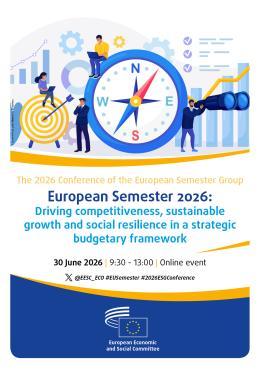
European Semester 2026: Driving competitiveness, sustainable growth and social resilience in a strategic budgetary framework
Location
online event
Belgium
The EESC’s European Semester Group is bringing together speakers from the EU institutions, organised civil society, the Member States and research institutes for its annual conferenceto be held on Tuesday 30 June 2026.
Volunteering plays a central role in building resilient and inclusive societies that are better prepared for existing and future challenges. This public hearing will gather institutional actors, civil society organisations, social partners, and experts to reflect on the role that volunteering can play in the “whole-of-society” approach to preparedness (called for by the European Commission). Discussions will feed into the related EESC Opinion (SOC/864).
The agenda and all information regarding this plenary session will be available 8 days prior to the event. You will be able to follow the debates by web streaming. Web streaming
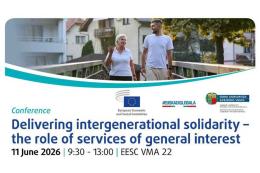
This conference will serve as a platform to showcase the societal and political significance of public services in promoting intergenerational solidarity, providing concrete action points for policymakers and practitioners. The aim is to broaden the debate and to serve as a constructive contribution to the development and refinement of the Intergenerational Fairness Strategy announced by the European Commission, to be adopted in the second quarter of 2026.
Reset and Recharge: All-island contributions to a resilient EU-UK relationship
Event type
Conference
Location
Europe House - 5 Balfe Street, Dublin, Ireland
Dublin
Ireland
The EU-UK Follow-Up Committee of the European Economic and Social Committee (EESC) is pleased to announce that the Annual All-Island Stakeholder Forum will be held in Dublin on 10th June 2026. This forum is the second of its kind, the first having been held in Dundalk last year.
This year’s forum is titled: ‘Reset and Recharge: All-island contributions to a resilient EU-UK relationship’. It is organised in collaboration with an Advisory Group of representative organisations from the three ‘pillars’ of the EESC – workers, employers and civil society organisations – from both jurisdictions.*
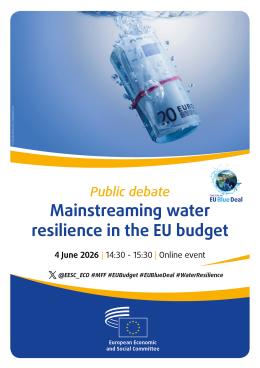
Mainstreaming Water Resilience in the EU Budget is a timely discussion on securing Europe’s water future. Discover how smarter EU investments can strengthen water resilience, sustainability, and preparedness, and how we should shape tomorrow’s funding priorities across programmes in the context of the EU´s next Multiannual Financial Framework.
This public hearing will gather policymakers and civil society stakeholders to discuss on how public banks can better support EU industrial policy, innovation, the scale-up of EU businesses, and, ultimately, economic growth.
This public hearing will aim to present and discuss the European Commission’s Strategy on Intergenerational Fariness, a new strategic framework to guarantee that current decisions are made with the future in mind, ensuring a fair balance of benefits and burdens across all generations. The event will gather key institutional actors, civil society organisations, social partners and experts to reflect on the Strategy's priorities and to contribute to the preparation of the EESC Opinion (SOC/868).
The event will be webstreamed (EN, original). No registration is needed and participation is free of charge.
Follow us on X: @EESC_SOC
Ask your questions to the panelists via Sli.do with the event code: #IntergenStrategy
This hearing will bring together representatives from EU institutions, organised civil society and voices from candidate countries to gather input for the EESC’s opinion on enlargement and climate.