Improving living and working conditions across the EU: the role of organised civil society
-
Location
Warsaw
Poland
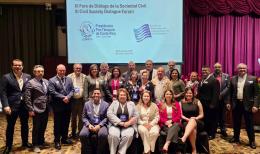
The 2025 Annual meeting of presidents & secretaries-general of the ESCs of the EU & the EESC was held on 25-26 June 2025 in Warsaw. Co-organised with the Polish Councils, the Social Dialogue Council (RDS) and the Council for Public Benefit Activity (RDPP) under the 2025 Polish Presidency of the Council, the debates were dedicated to "Improving living and working conditions across the EU: the role of organised civil society".
On 25 June 2025, the EESC is hosting a high-level debate in the framework of the European Public Diplomacy Week. The debate, titled "From trade to water: civil society's soft diplomacies", is divided in three panels, tackling Trade, Enlargement, and Water respectively. Each panel will be followed by a discussion, thus contributing to highlight the role played by civil society in soft diplomacy. Join us from 11:00 to 12:30 CET!
The 2025 EU–Japan Workshop explored how Artificial Intelligence (AI) is reshaping the workplace and driving economic competitiveness. This hybrid event brought together EU and Japanese stakeholders to discuss AI’s role in transforming job roles, promoting innovation, and raising ethical and policy challenges. It also focused on how AI can support sustainable and inclusive growth in both regions.
A stronger and more inclusive European Semester that works for all: Strengthening Europe's Economic Resilience, Sustainable growth and Competitiveness
Location
Brussels
Belgium
The EESC's European Semester Group is bringing together speakers from the EU institutions, organised civil society, the Member States and research institutes for its annual conference on "A stronger and more inclusive European Semester that works for all: Strengthening Europe's Economic Resilience, Sustainable growth and Competitiveness ", to be held from 9.30 a.m. to 1 p.m. on Tuesday 24 June 2025.
The annual Euro-Mediterranean Summit of Economic and Social Councils and Similar Institutions provides civil society organisations (CSOs) from the UfM Member States with a platform to debate common challenges and opportunities and to exchange best practices. The event gathered around 120 participants, notably representatives of a wide range of CSOs from the Euro-Mediterranean region, youth representatives, EU and MENA government representatives, guest speakers and representatives from embassies and the media.
During the meeting, the EU DAG was briefed on the latest developments in South Korea following the recent elections, as well as on status of the EU-Korea FTA and the implementation of the TSD Chapter.
In its 13th meeting, the EU DAG for Vietnam was updated on the current situation in Vietnam following the administrative restructuring. Information was also given on various EU-funded projects in the country. The main discussion covered the state of play of the implementation of the TSD Chapter. Moreover, the DAG discussed the state of labour rights and assessment of the new Trade Union Law in the region.
Following the first EU-UK Summit that took place on 19 May 2025, the EU DAG invited Ambassador Pedro Serrano (EU Ambassador to UK) and Mr Jan Hendrik Dopheide ( Commissioner Šefčovič Cabinet Member) for a timely exchange of views on the summit' outcomes.