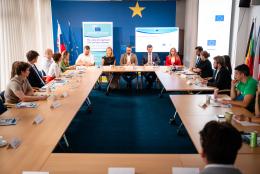
Launch of the European Employment and Social Outlook (EESO) 2026
Location
European Economic and Social Committee (EESC), Rue Belliard 99/101
Brussels
Belgium
Jointly organised by the European Commission and the European Economic and Social Committee (EESC), this conference will be an opportunity to discuss key insights from the European Employment and Social Outlook (EESO) 2026 – the flagship report from the European Commission’s Directorate-General for Employment, Social Affairs and Inclusion’s (DG EMPL).
The conference will feature high-level speakers from EU institutions and research institutes. Executive Vice-President of the European Commission, Ms. Roxana Mînzatu, and the President of the EESC's Section for Employment, Social Affairs and Citizenship, Ms. Cinzia Del Rio, will open the event.
In the context of the creation of a Savings and Investments Union that benefits EU citizens, financial literacy positions as an enabler. In this debate we put-together the voices of the European Commission and local organisations to exchange on their projects and policy proposals.
In this Opinion, the EESC stresses that the Anti-Racism Strategy 2026-2030 requires strong political commitment and calls for stronger action against racism, discrimination and xenophobia. It recommends binding mechanisms, reinforced monitoring, stricter enforcement with effective penalties, and national plans in all Member States. The EESC supports sustainable funding, including for civil society, and stronger action in housing, health, education, work and online hate.
Exploratory opinion at the request of the European Commission, in the context of the implementation of their Financial Literacy Strategy. The opinion considers that organised civil society is in a privileged position to improve financial literacy, due to their local networks and expertise with different groups of the population. The opinion also makes specific policy recommendations to the European Commission and Member States to potentiate their impact.
Download — EESC opinion: The role of civil society in improving financial literacy
Introduced by the European Economic and Social Committee (EESC) in 2024, the Youth Test is now being recognised as a pioneering method for integrating youth voices into policy-making. A recent roundtable in Bratislava brought together young leaders, policymakers and civil society to examine how the Youth Test can be meaningfully integrated into national decision-making processes.