Europe's migration policy must be built on rights, integration and legal pathways, not just border controls and returns, the European Economic and Social Committee (EESC) says in its opinion on the European Migration and Asylum Strategy, adopted during its July plenary session.
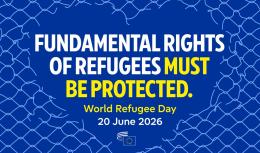
On World Refugee Day (20 June), the European Economic and Social Committee (EESC) reaffirms its long-standing commitment to a fair, humane and comprehensive European approach to migration, asylum and refugees: one that upholds fundamental rights while recognising the social and economic contributions of people on the move.
The 10th edition of the European Migration Forum (EMF), co-organised by the European Economic and Social Committee (EESC) and the European Commission’s Directorate-General for Migration and Home Affairs, called for continued collaboration between civil society, EU institutions and Member States to ensure that migration policies are effective, rights-based and responsive to the realities on the ground. The EESC reaffirmed its commitment to representing the voices of civil society and promoting policies that foster social inclusion, dignity and opportunity for all.
The 9th European Migration Forum, organised by the European Economic and Social Committee (EESC) and the European Commission’s Directorate-General for Migration and Home Affairs, focuses on how civil society can play a key role in the forthcoming implementation of the Pact on Migration and Asylum, while highlighting the direct work of civil society organisations on the ground.
At its April plenary session, the European Economic and Social Committee (EESC) discussed the Talent Mobility Package. This initiative comprises a series of new measures designed to make the Union more attractive to talent from outside the EU, and to facilitate mobility within it.
Employment in agriculture has been steadily declining over the last 15 years. The agri-food industry relies heavily on the contributions of seasonal and migrant workers to meet the demands of planting, harvesting, and processing crops. The current situation, best practices, opportunities, and the state of play of European policies on seasonal and migrant workers were discussed at a seminar organised by SafeHabitus and hosted by the European Economic and Social Committee (EESC).
The 8th European Migration Forum (EMF), organised by the European Economic and Social Committee (EESC) and the Directorate-General for Migration and Home Affairs, explored questions around migrants' vulnerabilities, bridging the skills gap and countering prejudice surrounding migration.
The European Economic and Social Committee (EESC) recently addressed migrant integration at a public hearing with experts and social partners, highlighting the need for comprehensive approaches that go beyond economic participation. Key recommendations include investing in language training, supporting migrant women, and fostering a culture of tolerance to create more inclusive societies.
The European Commission has announced new measures to tackle human trafficking. This comes in response to a 2021 report assessing the effectiveness of the EU's 2001 Anti-Trafficking Directive, which found the response by Member States to be insufficient. The EESC opinion calls for a gender focus, greater support for victims, more accountability for companies, and improved monitoring mechanisms.
After nine months of war in Ukraine, the EU institutions and the Member States are still striving to overcome the challenges of the migration crisis caused by Ukrainians fleeing the war on a massive scale. Civil society organisations (CSOs), NGOs and national stakeholders are also seeking practices to ensure the protection and integration of Ukrainian refugees, paying special attention to children and people with disabilities, with winter and war fatigue making these efforts harder.
European organised civil society and citizens have shown unprecedented solidarity with Ukrainian refugees, throwing open their homes, helping these refugees enter the labour market and quickly integrating Ukrainian children into European schools. The EU should now learn from this success story to help all refugees and migrants, the 2022 Forum said.
The state-sponsored instrumentalisation of migrants, aimed at destabilising the EU, and the current war in Ukraine, resulting in an unprecedented influx of refugees, call for a review of European migration policy. The European Economic and Social Committee (EESC) insists that solidarity and burden-sharing among Member States are needed for a common response to refugee crises. At the same time, the EESC highlights the need to guarantee migrants' safety and human rights.
With the threat of war at its doorstep, the Schengen area should be further strengthened through better police and judicial cooperation, with its internal borders kept open
Responding to the state-sponsored instrumentalisation of migrants at the EU's external borders, the European Economic and Social Committee (EESC) held a conference on this topic, highlighting the momentum of the Europeanisation of migration policy. So far, authoritarian leaders have instrumentalised humanitarian suffering to blackmail Europe, as they are aware of the gap on migration policy on the continent. Nowadays, the geopolitical atmosphere calls for a common, holistic and cohesive migration policy that cannot be further delayed.
Often a source of labour exploitation, the employment of illegally staying migrants is also a pull factor for migrant smuggling which claims thousands of lives every year of people embarking on dangerous journeys to reach Europe. Both criminal practices should be met with resolute action at national and EU level
The two-day European Migration Forum (EMF), held virtually by the European Economic and Social Committee (EESC) and the European Commission, stressed the indispensable role of migrants during the pandemic and the great potential of their contribution to the EU's economic and social recovery after the COVID-19 crisis.
The EESC says it fears that, without proper guarantees and strong reintegration measures in countries of origin, voluntary returns of migrants could result in a violation of their fundamental and human rights
The speech delivered by von derLeyen in the 2021 State of the Union Address has to be critically received, mainly for what it lacks in terms of ambition and clarity, despite naming virtually all the key challenges Europe faces.