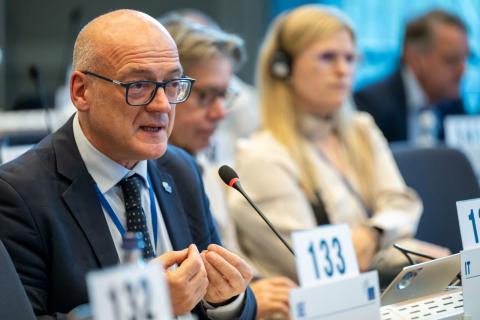
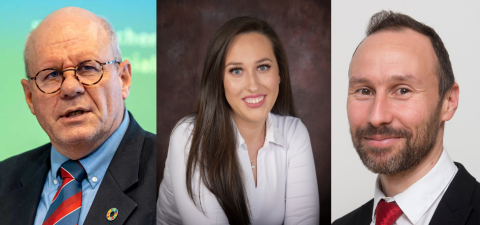
During the meeting, the EU DAG will receive an update from DG Trade on the EU-Korea FTA and the implementation of the TSD Chapter. EU DAG members and DG Trade will report back from the Civil Society Forum and workshop held in September 2024. In addition to that, European Chamber of Commerce in Korea (ECCK) will make a presentation on this year's ECCK White Paper, and the EU DAG will discuss current situation in South Korea in light of the geopolitical situation with Professor Ramon Pacheco Pardo.
The EESC supports efforts to develop a more human-centred and future-proof industrial ecosystem. At the same time, it calls for an in-depth debate on Industry 5.0 and its social and economic implications.
The EESC supports efforts to develop a more human-centred and future-proof industrial ecosystem. At the same time, it calls for an in-depth debate on Industry 5.0 and its social and economic implications.
Industry 5.0 aims to place social and environmental issues at the heart of business processes, advancing beyond Industry 4.0’s focus on digitalisation and automation. The EESC recently adopted an opinion titled Industry 5.0 - how to make it happen, advocating for a people-centred industrial model that values human skills and creativity.
Industry 4.0 largely overlooked the human impact of automation and paid limited attention to environmental priorities like waste reduction, circularity, and green energy. The EESC stresses that Industry 5.0 should address these gaps, prioritising democratic values, social equity, and sustainable competitiveness. Giuseppe Guerini, rapporteur for the opinion on Industry 5.0, argues that digital transformation should contribute to a ‘New Industrial Clean Deal’, where human factors and creativity play a central role.
Industry 5.0 brings people back into the core of production, viewing their knowledge and skills as essential to competitive advantage. It balances automation with human creativity, using collaborative robots for repetitive tasks, allowing workers to focus on design, planning, and customer service. This shift also emphasises worker health, safety, and support for those displaced by automation.
The EESC calls on the EU institutions to support a future-proof, human-centred industrial ecosystem rooted in social justice and inclusive competitiveness. While backing Industry 5.0, the EESC stresses the need to define its economic, social, and technological impacts further. Existing European policies, such as the Green Deal, AI Act, and Skills Agenda, provide a foundation for this vision but should be updated to align with Industry 5.0 principles.
For Industry 5.0 to succeed, the social partners and workers must be involved at all levels. This inclusive approach will foster a collaborative work environment that combines human and machine strengths, making workplaces more innovative, engaging, and sustainable.(gb)
October and November were marked by the failure of two top global environment summits: COP16 – the UN Convention on Biological Diversity and COP29 – the UN climate conference, both focusing on finance which is desperately needed for nature preservation and for mitigating climate change. We asked the EESC representatives at this year's COPs – Peter Schmidt, Diandra Ní Bhuachalla and Arnaud Schwartz – to share their thoughts on what is at stake if the world fails to act on climate.
October and November were marked by the failure of two top global environment summits: COP16 – the UN Convention on Biological Diversity and COP29 – the UN climate conference, both focusing on finance which is desperately needed for nature preservation and for mitigating climate change. We asked the EESC representatives at this year's COPs – Peter Schmidt, Diandra Ní Bhuachalla and Arnaud Schwartz – to share their thoughts on what is at stake if the world fails to act on climate.
By Peter Schmidt, Diandra Ní Bhuachalla and Arnaud Schwartz
Representing EU civil society at COP29 in the Azerbaijan capital of Baku, the EESC advocated for urgent, tangible climate action and the prioritisation of social and environmental justice in climate negotiations.
By Peter Schmidt, Diandra Ní Bhuachalla and Arnaud Schwartz
Representing EU civil society at COP29 in the Azerbaijan capital of Baku, the EESC advocated for urgent, tangible climate action and the prioritisation of social and environmental justice in climate negotiations.
Peter Schmidt, chair of the Ad Hoc Group on the COP told us about the EESC’s key messages on the main theme of COP29 – climate finance.
Peter Schmidt: The surge in extreme climate weather events worldwide is a powerful reminder to step up climate ambition. With this year on its way to being the hottest on record, human-induced climate disasters such as floods, wildfires and droughts are occurring more frequently and with greater intensity, exacerbating social inequalities. The cost of climate inaction is far greater than the cost of action.
The stakes are high for COP29. Agreeing on global climate finance solutions is crucial for developing countries to unlock the means for global climate action. The EESC’s participation at COP29 in Baku brought forward recommendations based on our opinion on climate finance focusing on reshaping the international financial architecture to unlock and facilitate effective and accessible climate finance.
We emphasised the need to establish the New Collective Quantified Goal to bridge climate finance gaps, which should make climate finance more fit for purpose, biodiversity-friendly, impactful and accurately targeted towards the most vulnerable countries and communities. Climate finance flows should be guided by the principles of the Just Transition, in line with the Paris Agreement and with the Sustainable Development Goals at the core. Long-term commitments from both public and private actors are key, and public finance will play a crucial role in mobilising and de-risking private investments for climate initiatives.
While access to climate finance should be enabled for local initiatives and grassroots movements, the Committee also calls for a comprehensive approach to break the cycle of indebtedness and underinvestment in adaptation. We call for the equitable distribution of climate funds to address disparities. Additionally, civil society engagement is crucial for creating an inclusive, democratic approach that ensures climate investments are effective and sustainable.
The EESC youth delegate to COP (2023-2025), Diandra Ní Bhuachalla, shared her expectations from COP29. From the perspective of a young person, what would be the most pressing climate issues that need to be solved first?
Diandra Ní Bhuachalla: Following the disappointment of the COP28 outcomes, I sought to manage my expectations as much as possible for COP29. Recognising that the outcomes of yet another annual conference would be limited due to the choice of Presidency – yet another state heavily dependent on profits from fossil fuels – it was especially hard to maintain hope.
Nevertheless, having consulted with various youth organisations across Europe through the structured Youth Task Force meetings as part of the EESC’s Youth Delegate to COP programme, I decided that it was best to focus on Climate Justice and the Just Transition, Climate Finance and a New Collective Quantified Goal, and increasing meaningful youth participation in international decision-making processes.
Now, knowing how many negotiations failed to progress in the first week due to a complete lack of agreement and cooperation – including on gender, climate finance, and the just transition – I realise that my expectations were again too high and have pivoted my advocacy efforts in side-events and bilateral meetings as a result. Now, my two main hopes are that existing language, especially on human rights, remains, and that we achieve slight progress to line things up perfectly for COP30, which is the basket that everyone seems to be placing all of their eggs of hope in.
Due to the intersecting nature of climate change and its effects, I could not possibly attempt to rank issues in order of importance or urgency. Young people are worried about their futures, in terms of their job security and whether they will be forced to re-train; in terms of their homes and families and safety from storms, floods, and erosion; in terms of the health and quality of life of their future children or indeed the next generation; and in terms of how our generation will be tasked with much more difficult climate negotiations when we become decision-makers, because not nearly enough action is being taken today given that the impact of this will be felt for decades.
We need climate justice now. We need realistic climate finance now. We need a fair, just, and equitable employment and energy transition now. We need ambition now. We need implementation now.
We need all of you now.
COP16 on biodiversity, which took place in Cali, Colombia in October, ended in disarray and with no agreement on nature funding. We asked Arnaud Schwartz, EESC representative at COP16, if we can remain optimistic despite this setback. What actions should be taken to make progress in protecting biodiversity?
Arnaud Schwartz: 200 billion dollars a year. That – according to the UN – is the amount of money that would be needed (including all types of funding – public, private, national and international) to meet our biodiversity targets. So what is this about? It is about nothing more than putting a stop to the collapse of the world of living organisms, currently disappearing at an ever-faster rate, and it is about restoring nature and giving it a chance of survival in a ‘liveable’ world, rather than allowing it to be devastated by greed and stupidity.
What is the future after the failure of COP16?
Each and every one of us should ask ourselves this question and raise it with those around us, especially since it is known that, in France alone, every year, more than a quarter of this sum is being used to prepare for, or wage, war. Indeed, globally speaking, the Cali meeting was a missed opportunity, due to a lack of political will and a lack of economic solidarity.
However, not everything is lost.
There is a feeble light at the end of the tunnel: this COP recognised indigenous peoples and local communities for their role as guardians of biodiversity – after about 30 years of prevarication – as well as those of African origin; a new UN fund, known as the Cali Fund, was also created. In the long run, this fund is to be used to raise voluntary contributions from private companies, half of which will go to the groups of people mentioned above. Whew!
You are ... you are ... well ...
You are part of us; we are a part of you. And in order to continue along our common path, it might make sense to start by putting our economy back on track to benefit the common good. So ... in order to stop pulling the rug out from under our own feet, what are we waiting for before revisiting international finance and trade rules?
The primary focus of the EESC delegates at COP29, Peter Schmidt and Diandra Ní Bhuachalla, was climate finance, in which they were guided by the recent EESC opinion Climate finance: a new roadmap to deliver on high climate ambition and the SDGs. One of the key events led by the EESC in Baku was ‘A global perspective towards fostering a just transition in the agri-food sector’ on 18 November. The event explored building sustainable, low-carbon food systems that are fair to farmers, food chain workers and future generations. The aim was to improve collaboration between policymakers and civil society, amplifying voices from the global south and advancing inclusive climate solutions for all.
As a member of the EU delegation, Arnaud Schwartz took part in meetings calling for greater synergies between the UN processes on Biological Diversity (CBD) and Climate Change (UNFCCC), the phasing out of environmentally harmful subsidies as a means to free up more financial resources, and a more active role for organised civil society in implementing the Kunming-Montreal Global Biodiversity Framework. You can find more information about the EESC's contribution to COP16 here.
The EESC held a conference on low-carbon hydrogen in Pärnu, Estonia on 12 November. The aim of the event was to discuss and identify strategic actions for the development of sustainable infrastructure for hydrogen and its derivatives, focusing on financing and usage.
The EESC held a conference on low-carbon hydrogen in Pärnu, Estonia on 12 November. The aim of the event was to discuss and identify strategic actions for the development of sustainable infrastructure for hydrogen and its derivatives, focusing on financing and usage.
Entitled Offshore Power for E-Fuels: Boosting the New Hydrogen Economy, the conference brought together the Embassy of the Netherlands in Estonia, the Pärnu County Development Centre, the Metrosert Applied Research Centre, Invest Estonia and the e-methanol plant developer Power2X.
Green and low-carbon hydrogen are crucial components in our energy transition, and recent initiatives, such as the EU Hydrogen Bank, have highlighted that there is momentum in developing sustainable hydrogen markets. To this end, EU and national policy makers need to provide the necessary means to put these ambitions into practice and ease cooperation among Member States to adopt effective strategies.
Commenting on this urgent need, the president of the EESC’s Section for Transport, Energy, Infrastructure and the Information Society Baiba Miltoviča said: ‘The rapid deployment of renewable hydrogen is critical – not only for the transformation of our energy system but also for the social and economic well-being of the European Union. However, it’s essential that we direct our resources wisely. To maximise our impact, we need to prioritise hard-to-abate sectors and establish effective ecological and social standards that ensure fair and safe working conditions.’ (mp)