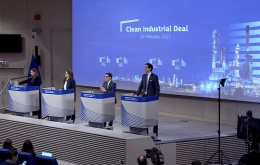
The recently published Clean Industrial Deal (CID) has correctly acknowledged the strategic importance of energy-intensive industries and identified their key issues. Commission proposals in the CID include some commendable ideas, such as green lead markets or additional funding. Yet, the proposed measures lack the necessary urgency and boldness to reverse the decline of Europe's industries and fall short of protecting their global competitiveness and domestic market.
The European Economic and Social Committee (EESC) has issued key recommendations on the 2025 European Semester – Autumn package, urging strategic investments and stronger cooperation to enhance the EU’s resilience and competitiveness.
The European Economic and Social Committee (EESC) has issued key recommendations on the 2025 European Semester – Autumn package, urging strategic investments and stronger cooperation to enhance the EU’s resilience and competitiveness.
The EESC put forward its recommendations in an opinion adopted at its plenary session in February, placing the emphasis on sustainability, labour market reforms and better alignment between national and EU policies, while calling for greater civil society involvement.
The EESC regretted the absence of the Annual Sustainable Growth Survey, a crucial policy document. It highlighted the need for EU institutions to prepare for geopolitical risks affecting trade, inflation and growth.
The EESC threw its support behind the Competitiveness Compass initiative and called for investments in the energy and digital sectors, including a European Fund for Strategic Investments. Additionally, it called for stronger civil society participation, a pragmatic review of the Recovery and Resilience Facility (RRF), and enhanced Member State cooperation to improve economic policies and productivity. (tk)
Cohesion policy has long been a pillar of European integration, promoting economic, social and geographical unity across the EU. As the post-2027 Multiannual Financial Framework (MFF) takes shape, it is essential to modernise cohesion policy to increase efficiency, sustainability and responsiveness to new challenges.
Cohesion policy has long been a pillar of European integration, promoting economic, social and geographical unity across the EU. As the post-2027 Multiannual Financial Framework (MFF) takes shape, it is essential to modernise cohesion policy to increase efficiency, sustainability and responsiveness to new challenges.
In its recently adopted opinion on Strengthening the results orientation of post-2027 cohesion policy, the EESC stressed the need to take a results‑oriented approach to ensure that cohesion policy continues to deliver tangible benefits while reducing inequalities and promoting sustainable competitiveness.
‘Cohesion policy must remain the EU’s key instrument for regional development. A results-oriented approach ensures that every euro spent contributes to economic and social well-being,’said the rapporteur for the opinion, David Sventek.
The MFF 2028+ will need a major overhaul to support regional development, the green and digital transitions, and economic competitiveness. With investment needs exceeding EUR 750–800 billion annually, strong EU funding is essential.
The EESC calls for fiscal capacity to be maintained at 1.8% of EU GDP and for cohesion policy funding to be increased. Key priorities include shared governance, tailored regional policies, results-based funding, and simplified processes.
A results-driven approach enhances efficiency but requires better implementation and oversight. Balancing competitiveness with social investment, strengthening technical support, and ensuring transparency will make cohesion policy more impactful, fostering economic resilience and reducing disparities across Europe. (tk)
Faced with rising security threats, Europe urgently needs a unified defence funding strategy. In response to a request from the upcoming Polish EU Presidency, the EESC has adopted an opinion calling for bold action: increased investment in modern systems, deepened NATO cooperation, and greater funding within the EU’s financial framework.
Faced with rising security threats, Europe urgently needs a unified defence funding strategy. In response to a request from the upcoming Polish EU Presidency, the EESC has adopted an opinion calling for bold action: increased investment in modern systems, deepened NATO cooperation, and greater funding within the EU’s financial framework.
Europe’s security risks are growing, exposing its reliance on external defence suppliers – 78% of the EUR 75 billion spent by EU countries on defence procurement over one year went to non-EU suppliers. Strengthening the European defence technological and industrial base (EDTIB) is crucial to reducing this dependency.
‘The EU’s defence funding mechanisms must be overhauled to meet contemporary challenges,’ explains rapporteur of the EESC opinion on Defence Funding in the EU, Marcin Nowacki. ‘Existing budgetary rules limit military spending, and while initiatives like the European Defence Fund (EDF) and the European Peace Facility (EPF) represent progress, they remain insufficient to address the scale of current threats.’
NATO cooperation is essential for interoperability and a unified strategy. Joint procurement, cyber and space security partnerships, and the IRIS2 satellite project will enhance resilience. Defence funding must align with broader EU priorities without compromising social and environmental goals. Strategic investment, innovation and long-term planning are key to ensuring Europe’s security and autonomy. (tk)
Tourism is a powerhouse for the EU economy and can strengthen Europe’s competitiveness. It is time to rethink the way tourism works and move beyond sustainability towards regenerative tourism – where destinations don’t just survive but thrive.
Tourism is a powerhouse for the EU economy and can strengthen Europe’s competitiveness. It is time to rethink the way tourism works and move beyond sustainability towards regenerative tourism – where destinations don’t just survive but thrive.
The European Economic and Social Committee (EESC) is urging the European Union to transform its tourism sector, emphasising sustainability and regeneration to ensure long-term economic and environmental benefits.
As tourism remains a vital pillar of the EU’s economy, particularly in regions heavily reliant on the industry, the EESC is advocating an accelerated transition to sustainable tourism and a shift towards regenerative tourism strategies, as outlined in its opinion on Tourism in the EU: sustainability as a driver for long-term competitiveness.
‘We must ensure that tourism plays a role in reviving European competitiveness. This is essential, given that tourism is such an important part of the GDP of many Member States and regions, as well as their value chains,’ said the rapporteur for the opinion, Isabel Yglesias.
Ms Yglesias said that the opinion built on the Palma Declaration, adopted during the Spanish Presidency of the Council in the second half of 2023, which had generated broad consensus on how to ensure that sustainability is at the heart of the future of tourism.
To achieve this, European institutions and national, regional and local governments must actively support the sector in its transitions, ensuring continuous dialogue with all relevant stakeholders and strengthening social dialogue.
While sustainability efforts in tourism have come a long way, the post-pandemic travel boom has been putting pressure on many popular destinations. This surge is making it harder for regions to balance economic growth with sustainable development, all while grappling with staff shortages and a mismatch between available jobs and workers’ skills.
This is why the EESC is also calling for a move toward regenerative tourism, and for it to be included in the European Strategy for Sustainable Tourism, which the European Commission will present in the coming months.
Unlike traditional sustainable tourism, which focuses on reducing environmental harm, regenerative tourism aims to restore and enhance natural, social and economic capital. This forward-thinking approach integrates circular economy principles and seeks to leave a lasting positive impact on destinations and local communities. (ll)