
European Economic
and Social Committee
EU-India Strategic Partnership, a new chapter
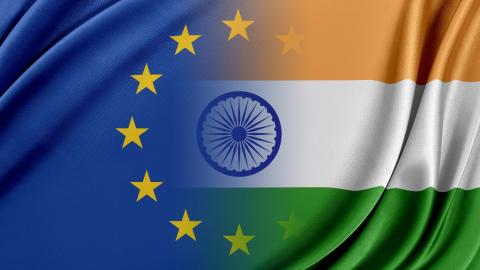
As the EU is looking to expand its circle of key partners – against a backdrop of uncertainty over transatlantic relations - India seems to be a perfect ally, being the largest formal democracy in the world, whose market and economic growth (including in green technology) represent a valuable opportunity for EU companies.
The World Bank expects India to overtake Japan and Germany as the world’s third-largest economy by 2030.
India's strategic geographical position at the heart of the Indo-Pacific region, through which passes around 80% of total global trade by volume, makes it a key partner for maintaining the security of the region and the freedom of navigation that are so crucial to EU interests.
For some time, the EU and India have been negotiating a free trade agreement, an investment protection agreement and an agreement on geographical indications. They also cooperate on a wide range of policies, including on security, climate and energy, connectivity, research and innovation, and space. However, the partnership has not yet reached its full potential and the geopolitical urgency might have given it new impetus.
In the past few years, India, which maintains a privileged relationship with Russia and is strengthening its ties with the Trump administration, has developed security relations with several EU countries. In particular, New Delhi has over the last few decades built up a robust partnership with France, the only EU country with territories and a permanent military presence in the Indo-Pacific. India has been one of France's main armaments partners for many years. Through an Annual Defence Dialogue (at defence minister level) and the High Committee on Defence Cooperation (at secretary of state level), France and India have agreed on Horizon 2047, a roadmap towards the centenary of their bilateral relations.
Other EU countries – including Italy, Germany, Spain and Sweden – have developed strategic partnerships with India and have also started to develop defence cooperation with it. Some analysts have pointed to the absence of a formal institutional framework at EU level as limiting EU-India military collaboration; it has been proposed that India be included in the European Defence Fund, and that a formal bilateral military partnership be established.
The recent visit of the EU's College of Commissioners to India is a clear indication of the EU's strategic upgrade of its relationship with India. In its opinion, the EESC underlines the need for a new ambitious roadmap adapted to the current political and strategic circumstances.
As a matter of urgency, the European Commission must step up negotiations with India on a Free Trade Agreement, with a view to establishing India as a preferential partner of the European Union in a strategic context, expanding cooperation in all fields, further promoting fair, inclusive and rules-based international trade, and building on the shared history and values of our ancient civilisations, as well as on our common understanding of contemporary realities.
The EESC recommends furthering cooperation between the EU and its Member States and India in bilateral and multilateral projects on infrastructure, construction – especially deep-water ports and airports – and energy connectivity.
There is a clear case for deepening cooperation between the EU and its Member States and India on defence and security, especially in the R&D and innovation sector, including joint space and dual-use projects, with special emphasis on the contribution of small and medium enterprises (SMEs).
The EESC also calls upon the European Council, the European Commission and EU Member States to reactivate the EESC’s EU-India Round Table, as a matter of urgency, with the involvement of civil society.

Author: Aurel Laurenţiu Plosceanu, EESC VP and Member of the Employers' Group, Rapporteur of opinion REX/588 EU-India Strategic Partnership
Recommended for you
EU-India Strategic Partnership, a new chapter …
News
As the EU is looking to expand its circle of key partners against a backdrop of uncertainty over transatlantic relations, India seems a perfect ally, being the largest formal democracy in the world,…
EU-India Strategic Partnership
News
BackgroundThe EU – India bilateral relations date back to the early 1960s with India being among the first countries to establish diplomatic relations with the European Economic Community in…
EU-India Strategic Partnership
Opinion
Key pointsThe EESC:urges the European Commission to work consistently towards upgrading the Strategic Partnership with India, the largest formal democracy in the world, proposing a new ambitious…
EESC and Albanian Government Launch New Chapter of Civil Society Dialogue in Tirana
News
The European Economic and Social Committee (EESC) deepened its engagement with the Western Balkans this week with a series of high-level meetings and the official launch of the EU–Albania Joint Civil…
EESC steps up relations with the Brazilian civil society, reinforcing EU's strategic partnership with Brazil
News
On 9 April, the President of the European Economic and Social Committee, Oliver Röpke signed a Memorandum of Understanding with the newly established Sustainable Economic and Social Development…