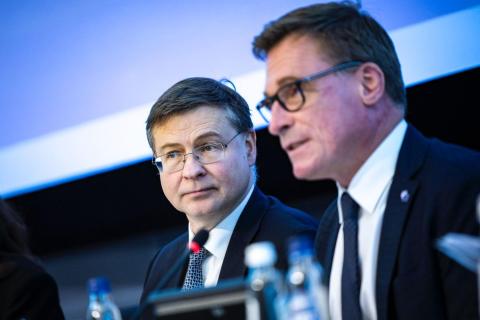
The European Economic and Social Committee (EESC) has called for the European Commission’s 2025 Work Programme – which sets out the EU’s legislative and policy priorities — to focus on economic resilience, social fairness and sustainability. In a plenary debate with Commissioner for Economy and Productivity Valdis Dombrovskis, the EESC — which plays a crucial role in shaping the work programme — reaffirmed its commitment to helping develop an agenda that tackles urgent challenges while building a more inclusive and forward-looking European Union.
The European Economic and Social Committee (EESC) has called for the European Commission’s 2025 Work Programme – which sets out the EU’s legislative and policy priorities — to focus on economic resilience, social fairness and sustainability. In a plenary debate with Commissioner for Economy and Productivity Valdis Dombrovskis, the EESC — which plays a crucial role in shaping the work programme — reaffirmed its commitment to helping develop an agenda that tackles urgent challenges while building a more inclusive and forward-looking European Union.
In December 2024, the EESC presented its contribution to the work programme under the theme ‘Moving Forward Together: A Bolder, Simpler, Faster Union.’ This vision seeks to address the EU’s economic and geopolitical challenges head on. Each year, through extensive consultations and recommendations, the EESC refines the work programme to ensure it best serves European citizens and businesses.
EESC President Oliver Röpke welcomed the strong collaboration with the European Commission. While recognising the Commission’s efforts, he called for a more ambitious and inclusive approach. ‘We remain committed to shaping policies that promote economic stability, social equity and democratic values,’ he said.
MrDombrovskis reaffirmed that the Commission’s work programme for the next five years aims to boost economic competitiveness and security. ‘Taking action to cut red tape is an important element of building this more competitive Europe. Our simplification agenda is about making sure that our rules help achieve — rather than impede — our economic, social, environmental and security goals,’he said.
Key priorities for 2025
Economic growth and competitiveness
The work programme focuses on structural reforms, the new multiannual financial framework (MFF) and stronger capital markets. The EESC advocates a broader approach to economic resilience, tackling sluggish growth, the cost-of-living crisis and rising geopolitical uncertainty.
Smarter regulation, not just less
The EESC supports the Commission’s commitment to reducing administrative burdens but warns that regulatory simplification must not come at the expense of social protection or environmental standards.
Driving innovation and investment
With a strong emphasis on digital networks, AI and quantum technologies, the work programme prioritises the EU’s technological leadership. The EESC urges the Commission to create conditions that prevent capital outflows and foster long-term investment in Europe.
A fairer and greener Europe
Addressing challenges such as skills shortages, food security and sustainable finance, the work programme aims to strengthen social and environmental sustainability. The EESC stresses the importance of policies that promote social cohesion and a just digital transition.
Preparing for enlargement and the future
As the EU gears up for potential enlargement beyond 2028, the work programme outlines plans for financial and political stability. The EESC insists that civil society perspectives must be integrated to ensure policies meet the needs of all Europeans. (tk)
By Antonio García Del Riego, EESC Employers' Group member
Europe finds itself at a critical juncture as it faces historic challenges, from the green transition to war at its doorstep and intensifying global competition. Meeting these challenges will require more than policy declarations. It will require money and the ability to mobilise it, channel it, and multiply it. In short, it requires a strong, competitive and autonomous financial system. Unfortunately, that is not what we have.
By Antonio García Del Riego, EESC Employers' Group member
Europe finds itself at a critical juncture as it faces historic challenges, from the green transition to war at its doorstep and intensifying global competition. Meeting these challenges will require more than policy declarations. It will require money and the ability to mobilise it, channel it, and multiply it. In short, it requires a strong, competitive and autonomous financial system. Unfortunately, that is not what we have.
Finance is the bloodstream of any modern economy. Every new factory, electric vehicle, hospital expansion or clean tech start-up depends on someone taking the risk to fund it. And in Europe, that 'someone' is often a bank. SMEs, which make up 99% of EU companies, depend overwhelmingly on bank credit to grow, invest, and export. Yet, the very institutions that form the core of our financing ecosystem are at risk of being outcompeted and overregulated.
Europe often talks about 'strategic autonomy' in energy, defence, and digital infrastructure, but rarely is financial autonomy part of the conversation. It should be.
Today, over 60% of investment banking in Europe is handled by just four American banks. The upcoming Basel IV rules will be applied in full in the EU, but not in the US, UK, or Japan. This asymmetry puts European banks at a competitive disadvantage. If we want European banks to finance the twin transitions and support strategic sectors, they must compete on equal footing.
The Capital Markets Union must move beyond rhetoric and become a true single market for savings and investments. To get there, we need smart, proportionate, and enabling regulation that protects stability and consumers, but also unleashes growth and competitiveness. This means:
proportionality;
technology-neutrality; and
outcome-based rules.
Europe cannot afford to be naïve. In a world shaped increasingly by power politics and economic blocs, financial strength is sovereignty. The United States and China understand this. So should we.
Minutes of the 226th meeting of the REX Section of 10 March 2025
In its own-initiative opinion, the European Economic and Social Committee (EESC) stresses that phasing out fossil fuel subsidies (FFSs) is a necessary step in Europe's green transition. The goal is to reduce the environmental impact of the energy system while maintaining competitiveness and easing the cost-of-living crisis. However, the process must be fair, realistic, and adapted to the specific needs of sectors such as agriculture.
Download — EESC opinion: Strengthening European values in candidate countries by supporting the public service sector and empowering social partners and civil society organisations