The European Public Diplomacy Days (EPDW) will be held from 30 September to 2 October 2026 and will bring together various different EU institutions working on public diplomacy and international people-to-people initiatives, with a view to sharing best practice and exchanging ideas. Besides the EU institutions, there will be contributions from civil society, networks of regions and cities, cultural projects, academics and other practitioners from across the world.
As the world celebrates the International Volunteer Year 2026 (IVY 2026), experts from across Europe gathered at an EESC hearing to underline the vital contribution that volunteers make to building resilient, prepared and cohesive societies. The hearing, organised as part of the EESC's work on the forthcoming opinion on the role of volunteering for European preparedness, explored how volunteering strengthens communities before, during and after crises.
At its June plenary session, the European Economic and Social Committee (EESC) adopted an opinion evaluating the implementation of the EU Whistleblower Protection Directive. While the Directive has strengthened legal protections and established reporting channels across the EU, the EESC warns that significant gaps remain between legal provisions and their practical application.
At its June plenary session, the European Economic and Social Committee (EESC) adopted an opinion evaluating the implementation of the EU Whistleblower Protection Directive. While the Directive has strengthened legal protections and established reporting channels across the EU, the EESC warns that significant gaps remain between legal provisions and their practical application.
Drawing on evidence from Denmark, France, Italy, Latvia and Romania, the evaluation found that implementation remains uneven across Member States and that practical obstacles continue to discourage reporting. Stakeholders highlighted uncertainty about procedures, inconsistent enforcement and delays in handling cases, while fear of retaliation remains one of the main reasons individuals choose not to come forward.
The EESC acknowledges that the Directive has marked an important step forward by strengthening protection mechanisms, establishing multiple reporting channels and increasing cooperation between competent authorities. However, more action is needed to ensure that whistleblowers receive effective protection in practice.
‘The European Commission has identified significant delays in transposition and numerous gaps in national implementation. This risks compromising the effectiveness of the Directive and creating legal uncertainty for those wishing to report violations of European Union law.
It is essential to promote a true culture of legality and transparency. In many contexts, those who report irregularities or violations are still perceived negatively. Instead, we must recognise the civic value of whistleblowers, who contribute to the protection of the public interest, democracy and fundamental rights,’ said EESC rapporteur Giulia Barbucci.
The Committee calls for stronger safeguards against retaliation, including preventive measures, financial assistance and access to independent advice. It also urges Member States to allocate sufficient resources to the authorities responsible for whistleblowing procedures, improve professional training and ensure reporting systems are independent, confidential and accessible. The EESC further recommends exploring shared reporting mechanisms to help smaller organisations meet their obligations.
The opinion highlights the important role of trade unions, civil society organisations and the media in supporting whistleblowers and promoting transparency. The EESC advocates their closer involvement in designing and monitoring whistleblowing systems. Beyond legal reforms, it also calls for awareness-raising, better information on whistleblowers’ rights and improved data collection to assess the effectiveness of existing measures and identify remaining weaknesses.(lm)
Europe will need significantly more investment if it wants to secure the critical raw materials required for its green, digital and defence transitions, the European Economic and Social Committee (EESC) warned in an opinion adopted at its June plenary session.
Europe will need significantly more investment if it wants to secure the critical raw materials required for its green, digital and defence transitions, the European Economic and Social Committee (EESC) warned in an opinion adopted at its June plenary session.
The opinion responds to the European Commission's RESourceEU Action Plan, which seeks to reduce Europe's dependence on imported raw materials and strengthen strategic supply chains. The EESC supports the initiative but argues that its objectives will be difficult to achieve unless Europe tackles the competitiveness and investment challenges facing the sector.
The issue has become increasingly urgent in recent years. Materials such as lithium, cobalt, copper and rare earths are essential for batteries, renewable energy technologies, digital infrastructure and defence systems. As global demand grows and geopolitical tensions reshape supply chains, access to these resources is becoming a strategic economic and industrial challenge for Europe.
Today, much of Europe's supply depends on a limited number of countries. The EU is therefore seeking to diversify its sources, strengthen domestic production and develop more resilient value chains. According to the EESC, achieving those goals will require far greater investment than is currently on the table.
While welcoming the Commission's proposal to mobilise EUR 3 billion, the Committee believes that financing needs are substantially higher and should be reflected in the next EU long-term budget.
The EESC argues that improving competitiveness must be a priority. High energy costs continue to weigh on European industry, particularly in critical raw materials sectors where energy-intensive processes play a central role. The opinion therefore calls for measures to lower energy costs, support long-term renewable power contracts and facilitate industrial electrification.
The opinion also emphasises that strategic projects need public trust. Faster permitting procedures may help speed up investment, but simplification should remain administrative and must not weaken environmental protection, workers' rights or public participation. Members also highlighted the importance of transparency, accountability and the involvement of local communities.
For the Committee, the debate ultimately goes beyond raw materials. Europe's ability to compete in clean technologies, digital industries and strategic sectors will depend on whether it can secure the resources that underpin them. (gb)
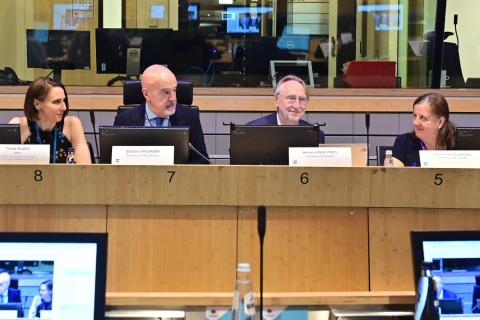
On Thursday 2 July 2026, members of all 15 EU Domestic Advisory Groups (DAGs) and representatives of the European Commission and the European Parliament met at the EESC to discuss the evolving role of organised civil society in the implementation of EU trade agreements and to ensure that sustainability commitments are effectively monitored and followed up.
On Thursday 2 July 2026, members of all 15 EU Domestic Advisory Groups (DAGs) and representatives of the European Commission and the European Parliament met at the EESC to discuss the evolving role of organised civil society in the implementation of EU trade agreements and to ensure that sustainability commitments are effectively monitored and followed up.
Global trade is facing growing pressure amid geopolitical tensions and increasing economic fragmentation. Against this backdrop, participants in the fifth meeting of the annual DAGs meeting examined how DAGs can remain effective and influential while the EU's network of trade agreements continues to expand, increasing demands on implementation, monitoring and civil society engagement.
As global trade undergoes a profound and fast-paced transformation, the role of the DAGs is more important than ever, said Stefano Palmieri, president of the EESC's Section for External Relations (REX) as he opened the meeting. 'DAGs are not an accessory to trade policy; they are central to making trade agreements credible, sustainable and accountable in practice.'
Tanja Buzek, vice-president of REX, EESC DAG Coordinator and Chair of the EU DAG for Canada, highlighted that DAG members help identify concerns on the ground and provide advice on labour, environmental, social, economic and sustainability commitments. She noted that 'this role is being extended beyond traditional Trade and Sustainable Development (TSD) chapters to the monitoring of the agreement as a whole.'
'DAGs function as our early-warning mechanism. They help identify implementation gaps and assess how developments affect workers, businesses and communities. They have become an indispensable tool for the proper implementation of our trade agreements,' said Bernd Lange, Chair of the European Parliament Committee on International Trade (INTA).
While acknowledging the challenging trade environment, Sofia Muñoz Albarrán, DG Trade, European Commission, said that the effective implementation of trade agreements relies on the role of civil society and reaffirmed the commitment to DAGs.
A series of parallel breakout sessions saw participants discuss practical ways to strengthen the effectiveness, visibility and impact of DAGs. Topics included the use of the TSD complaints mechanism under DG TRADE's Single Entry Point (SEP), civil society engagement in emerging EU trade-related arrangements such as critical raw materials partnerships, the future structure and communication strategies of an expanding DAG network and opportunities for enhanced cooperation with the European Parliament on implementation, monitoring, topics of common interest and political follow-up to DAG recommendations and concerns. (pm)
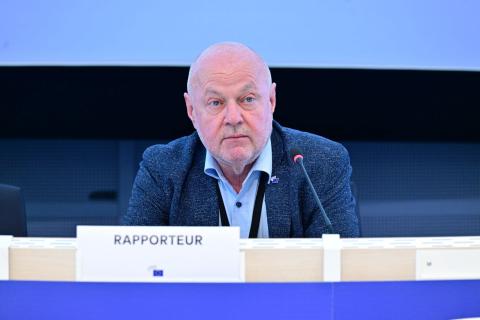
The June plenary session saw the adoption of the opinion on Implementing the New European Bauhaus by Rudolf Kolbe. At a time when the EU is facing a housing crisis compounded by rising energy costs and a number of social fractures in terms of income, age and origin, it is important to set out practical solutions.
The June plenary session saw the adoption of the opinion on Implementing the New European Bauhaus by Rudolf Kolbe. At a time when the EU is facing a housing crisis compounded by rising energy costs and a number of social fractures in terms of income, age and origin, it is important to set out practical solutions.
‘The New European Bauhaus is one of the EU’s most ambitious recent initiatives. And let me be clear: this is not a building programme nor a design trend. It connects the European Green Deal with people’s everyday lives through three values: sustainability, inclusion and aesthetics,’ said Mr Kolbe. ‘My conclusion is simple: the time to act is now. And civil society must be fully part of it, so that the New European Bauhaus becomes everyday practice, everywhere.’
In the opinion, the EESC sets out some key recommendations to successfully apply the concepts of the New European Bauhaus. To tackle the housing crisis, it is essential to upgrade isolated pilot projects to widespread and adaptable solutions which are specific to the different territories.
1) Developing key performance indicators (KPIs)
The EESC recognises that the New European Bauhaus has an added value in translating policy objectives into tangible, people-centred solutions, while fostering green innovation and enhancing competitiveness. For this reason, it is important to measure the extent to which its values and principles are reflected in new and revised EU policies and regulatory acts. This objective can be achieved by developing key performance indicators (KPIs) assessing horizontal cross-cutting implementation.
2) Revision of the Public Procurement Directives
In the upcoming revision of the Public Procurement Directives, public authorities must give priority to life-cycle and quality criteria for services shaping the built environment, enabling innovation and circularity.
3) Sustainable, affordable and quality housing policies
The New European Bauhaus and affordable housing policies are inseparable. One without the other simply does not work. The next step to implementing the New European Bauhaus must therefore focus on investment in sustainable, affordable and quality housing, using the Energy Performance of Buildings Directive (EPBD) and the renovation wave as key levers. (mp)