
European Economic
and Social Committee
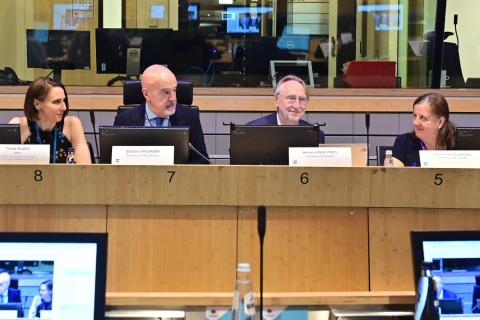
On Thursday 2 July 2026, members of all 15 EU Domestic Advisory Groups (DAGs) and representatives of the European Commission and the European Parliament met at the EESC to discuss the evolving role of organised civil society in the implementation of EU trade agreements and to ensure that sustainability commitments are effectively monitored and followed up.
Global trade is facing growing pressure amid geopolitical tensions and increasing economic fragmentation. Against this backdrop, participants in the fifth meeting of the annual DAGs meeting examined how DAGs can remain effective and influential while the EU's network of trade agreements continues to expand, increasing demands on implementation, monitoring and civil society engagement.
As global trade undergoes a profound and fast-paced transformation, the role of the DAGs is more important than ever, said Stefano Palmieri, president of the EESC's Section for External Relations (REX) as he opened the meeting. 'DAGs are not an accessory to trade policy; they are central to making trade agreements credible, sustainable and accountable in practice.'
Tanja Buzek, vice-president of REX, EESC DAG Coordinator and Chair of the EU DAG for Canada, highlighted that DAG members help identify concerns on the ground and provide advice on labour, environmental, social, economic and sustainability commitments. She noted that 'this role is being extended beyond traditional Trade and Sustainable Development (TSD) chapters to the monitoring of the agreement as a whole.'
'DAGs function as our early-warning mechanism. They help identify implementation gaps and assess how developments affect workers, businesses and communities. They have become an indispensable tool for the proper implementation of our trade agreements,' said Bernd Lange, Chair of the European Parliament Committee on International Trade (INTA).
While acknowledging the challenging trade environment, Sofia Muñoz Albarrán, DG Trade, European Commission, said that the effective implementation of trade agreements relies on the role of civil society and reaffirmed the commitment to DAGs.
A series of parallel breakout sessions saw participants discuss practical ways to strengthen the effectiveness, visibility and impact of DAGs. Topics included the use of the TSD complaints mechanism under DG TRADE's Single Entry Point (SEP), civil society engagement in emerging EU trade-related arrangements such as critical raw materials partnerships, the future structure and communication strategies of an expanding DAG network and opportunities for enhanced cooperation with the European Parliament on implementation, monitoring, topics of common interest and political follow-up to DAG recommendations and concerns. (pm)