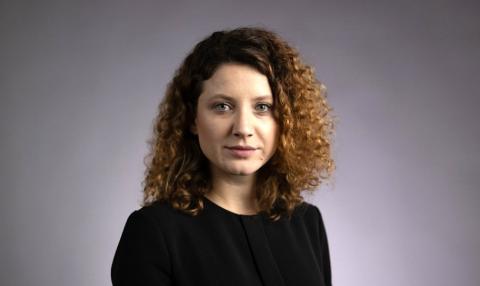
Hanna Liubakova, an independent Belarusian journalist in exile, is calling for a solidarity campaign to free her compatriot, journalist Katsiaryna Andreyeva, who is currently serving an eight-year sentence for livestreaming the government crackdown on peaceful demonstrations in Minsk in 2020.
Hanna Liubakova, an independent Belarusian journalist in exile, is calling for a solidarity campaign to free her compatriot, journalist Katsiaryna Andreyeva, who is currently serving an eight-year sentence for livestreaming the government crackdown on peaceful demonstrations in Minsk in 2020.
'My brilliant friend and colleague Katsiaryna Andreyeva is still imprisoned. Her crime was telling the truth. I am asking for a campaign of solidarity to secure her release,' Ms Liubakova said in a video testimony, published by the European Economic and Social Committee (EESC).
The Polish-Belarus film 'Under the Grey Sky', which had been screened at the EESC and featured in EESC Info, is inspired by Ms Andreyeva's story. A journalist with Belsat TV, she was initially given seven days of administrative detention on accusations of ‘organising riots and disrupting public transport’. It later became an eight-year prison sentence for high treason.
Ms Liubakova was one of the speakers at the EESC's conference Challenges for Women in Media – supporting and hindering factors, organised for International Women's Day 2026, where she flagged the risks faced by women journalists in exile and under authoritarian regimes.
Herself sentenced to ten years in absentia for so-called extremism, she is on a wanted list in Russia and across CIS countries.
'In reality, my crime was journalism. This is what transnational repression looks like,' she said.
For years, Alexander Lukashenko's regime has been one of the world's top jailers of women journalists, not a ranking any country should be proud of, Ms Liubakova said. 'For women journalists, repression has an extra layer: threats, pressure on families and attempts to discredit us as 'bad women', not just professionals.'
Twenty-eight journalists remain behind bars in Belarus, a country where independent media are treated as enemies.
'This is because information is critical infrastructure – it determines whether society can resist propaganda and authoritarian control,' Ms Liubakova said.
'Supporting independent media is not a charity. It is an investment in Europe's democratic resilience,' she concluded.
The 2026 Civil Society Week under the theme ‘People, Democracy, Resilience – Our Future’ was organised by the European Economic and Social Committee (EESC) from 2-5 March. Together with the European Citizens' Initiative, the event fostered citizen participation, underscoring its significance in safeguarding European democracy and civil society. The week concluded with the achievement of an important milestone. The stage is now set for the EESC to take part in the Commission's Civil Society Platform and host its annual summit.
The 2026 Civil Society Week under the theme ‘People, Democracy, Resilience – Our Future’ was organised by the European Economic and Social Committee (EESC) from 2-5 March. Together with the European Citizens' Initiative, the event fostered citizen participation, underscoring its significance in safeguarding European democracy and civil society. The week concluded with the achievement of an important milestone. The stage is now set for the EESC to take part in the Commission's Civil Society Platform and host its annual summit.
The third edition of the Civil Society Week brought together more than 1 400 participants, including youth organisations, activists, organised civil society representatives from across Europe, journalists and EU policymakers. During Civil Society Week, 36 civil society organisations and more than 90 speakers were present, turning the event into a dynamic forum where participants met to network, reflect and exchange ideas on issues that directly affect people’s everyday lives.
The event was launched on Monday, 2 March with an opening session featuring Séamus Boland, EESC President, and DrKatherine Zappone, former Irish Minister for Children and Youth Affairs. Mr Boland highlighted the importance of the event as a practical demonstration of why EU institutions, social partners and civil society organisations must work together.
Throughout the week, dynamic sessions, packed discussions and strong audience engagement illustrated the growing momentum of organised civil society in Europe. More than a conference, Civil Society Week once again proved to be a living laboratory of democratic participation — a space where cooperation, shared responsibility and collective commitment to Europe’s future were not just discussed but put into practice.
The European Commissioner for Democracy, Justice, the Rule of Law and Consumer Protection, Michael McGrath, commended the EESC on its work as a vital link between EU institutions and civil society, describing civil society organisations as 'the watchdog of our democracy'. He noted that the EESC is already participating in the Civil Society Platform's Steering Group, with the first workshop already having taken place.
He also reiterated the European Commission’s commitment to deepening cooperation with civil society organisations and the EESC by actively involving them in the development of the Civil Society Platform.
The European Citizens' Initiative (ECI) took centre stage on the second day of the Civil Society Week on 3 March. After 14 successful years, the ECI has proven that it is no longer an experiment. With four initiatives surpassing the one-million-signature threshold in 2025, the ECI carries institutional responsibility.
‘What was once an ambitious and novel idea has since evolved into a unique cross-border tool for participatory democracy’, said EESC member Maria del Carmen Barrera Chamorro, Chair of the EESC’s Group on the European Citizens’ Initiative.
Ten ECI initiatives were presented on ECI Day, including ‘Ban on conversion practices in the EU’, ‘Stop Destroying Videogames’, ‘Ethics, transparency and integrity for European political parties’, and ‘My Voice My Choice’.
Maroš Šefčovič, Commissioner for Trade and Economic Security, Interinstitutional Relations and Transparency, underlined the dynamics of the ECI and its momentum. ‘The European Citizens’ Initiative allows people across our Member States to remain actively engaged with EU policies – and its numbers underline the popularity of this agenda-setting tool’, he said
Concluding the Civil Society Week, EESC President, said: 'I am immensely proud of what we have achieved together. We created a living forum – a powerful demonstration of collaboration, commitment and shared responsibility. Europe’s successful democratic future depends on this work, and I look forward to building on these efforts this year, in particular as we join the Civil Society Platform and its Steering Group and host the annual summit.'
The key messages emerging from four days of exchanges centred on the following European Commission’s key priorities:
• Supporting people and strengthening our societies.
• Protecting our democracy and upholding our values;
• Delivering together and preparing our Union for the future.
Those are to be achieved through citizenship education, strengthening social cohesion and affordable housing; building an enabling environment for civil society and democratic resilience, civic engagement through ECIs, completing the European Democracy Shield, building a functioning Civil Society Platform as a key element of the implementation of the ‘EU Strategy for Civil Society' and media and digital resilience for safeguarding democracy. Preparing the EU for the future should include allocation of sufficient funds for civic space, supporting volunteering and investing in social spending and promoting social economy.
The conclusions will feed EESC's debates and opinions and will be presented to EU institutions. (at)
Posts with non-consensual sexualised images are mushrooming across the internet, targeting women in more than 90% of cases. Although EU law clearly defines the sharing of such images as violence, the implementation of the AI Act and other rules is stalling amid a broader deregulatory mood in Europe, Oliver Marsh of digital rights watchdog AlgorithmWatch tells EESC Info.
Posts with non-consensual sexualised images are mushrooming across the internet, targeting women in more than 90% of cases. Although EU law clearly defines the sharing of such images as violence, the implementation of the AI Act and other rules is stalling amid a broader deregulatory mood in Europe, Oliver Marsh of digital rights watchdog AlgorithmWatch tells EESC Info.
# The rise of generative AI has made it easier than ever to create non-consensual sexualised images. How significant is this problem today in Europe, and who tends to be most affected?
It is hard to estimate the exact scale of the problem, but it is clearly significant. For example, various research has found thousands of ads on Meta platforms (Indicator Media) and tens of thousands of sexualising posts produced by the Grok chatbot (AI Forensics) ─ potentially even millions (CCDH) ─ appearing in a matter of months. And this is based on research into publicly accessible material ─ we do not know how much is being shared privately, for example schoolboys sharing modified images of their classmates (AlgorithmWatch) . Regarding who is most affected, different research projects find that the subjects are usually women, whether in 80% or as high as more than 90% of the cases (AI Forensics, French Foreign Ministry).
#These images are often described as a new form of digital gender-based violence. What are the real-world consequences for victims, particularly women and girls?
The EU has explicitly included non-consensual sharing of intimate images as a form of violence in its Directive of 14 May 2024 on combating violence against women and domestic violence . This is important in terms of using the Digital Services Act to address the problem (see below), as the rules there are explicitly supposed to address gender-based violence as an example of systemic risk ─ and the EU is clear that non-consensual sharing of intimate images is violence under its terms.
I may not have the expertise to add much beyond what is available online about how this affects victims, but a point that is commonly noted is that just because the images aren't real does not make them less traumatic. Our Journalism Fellow Ana Ornelas has worked on this topic, I believe, including in discussions such as this for Media Diversity. We should also consider how this is another threat against women doing activities which require a public profile, such as running for elected office. Though people are also subjected to this even without a public profile, e.g. by people they know, as mentioned in the AlgorithmWatch link above.
#From your research, what role do online platforms and algorithmic systems play in amplifying or enabling this type of abuse?
A lot of these images, and the apps or websites which can create them, are shared via platforms such as Discord and Telegram (Wired,Graphika). There are also Reddit forums in which people share tips, such as how to 'jailbreak' popular AI tools to get them to make sexualised images (Guardian). Very large platforms such as X, Meta, and app stores can spread these to very wide audiences, including via ads. Such platforms can and should use moderation ─ both algorithmic and human ─ to find and remove the accounts doing this (Indicator). Some are better than others. From our research, we see that X, for example, does not even remove some clear and easy-to-find examples of accounts that help people make non-consensual nude images. Grok is an extreme example of how bad the problem is on X, but the problem goes well beyond Grok (AlgorithmWatch).
#The EU has recently adopted major digital regulations such as the Digital Services Act and the AI Act. In your view, will these frameworks be sufficient to address this issue, or do important gaps remain?
In theory, they provide a series of tools to (i) make companies conduct risk assessments and (ii) provide data and reporting options for external parties to identify when platforms fail to mitigate risks properly. The DSA could help ensure large platforms and search engines take measures to mitigate the spread of such images (and when it relates to illegal imagery, on other platforms too). The AI Act could potentially help address the creation and deployment of the tools themselves. For example, so far the EU Commission's response to the Grok case earlier this year was to say they are 'looking very seriously into this matter' and to announce further investigations. This is completely insufficient for such a serious failure by X. Also, together with others, we were highlighting the issue of non-consensual nudity on X, and other platforms, for months before the Grok case. Implementation of the AI Act is being snarled up in a general deregulatory mood in Europe, exemplified in debates around the Digital Omnibus.
#What role can civil society organisations play in protecting victims and pushing for stronger accountability from platforms and technology developers?
Despite how serious this problem is, there are still forces slowing regulation. Companies argue that forcing them to put safeguards in place holds back the development of their technologies. Many politicians and administrations in Europe are swayed by these arguments and are worried that Europe will 'fall behind' in AI if they try to regulate it too much. Civil society can be a counterweight to these arguments ─ albeit far less well-resourced than technology companies ─ and speak up against the harms when companies are not held accountable, ensuring that politicians and regulators actually stand by their statements that non-consensual sexualisation is a horror that must be strongly addressed.
Dr Oliver Marsh is head of Tech Research at AlgorithmWatch, where he leads research work and partnerships on policy areas including the Digital Services Act and the AI Act. He previously worked on platform and data governance as an official in Downing Street in the UK, and as an analyst of online harms for CASM Technology, The Institute for Strategic Dialogue and Demos.
AlgorithmWatch is a Berlin and Zurich based NGO whose mission is to ensure that algorithms and AI strengthen justice, human rights, democracy and sustainabilityinstead of authoritarianism.
In her acclaimed book-length essay, Same River, Twice: Putin's War on Women, the award-winning Finnish-Estonian writer Sofi Oksanen warns that misogyny is a foundation of state power in Russia, where traditional values are used to silence women and domestic violence legalisation has been relaxed. However, its goals are much broader: its international aim is to offer empathy and a spiritual haven for authoritarian rulers and misogynists around the world, threatening the rights of women and minorities globally. In Ukraine, misogyny is an instrument of war, and sexual violence perpetrated by Russian soldiers has genocidal intent, Sofi Oksanen tells EESC Info.
In her acclaimed book-length essay, Same River, Twice: Putin's War on Women, the award-winning Finnish-Estonian writer Sofi Oksanen warns that misogyny is a foundation of state power in Russia, where traditional values are used to silence women and domestic violence legalisation has been relaxed. However, its goals are much broader: its international aim is to offer empathy and a spiritual haven for authoritarian rulers and misogynists around the world, threatening the rights of women and minorities globally. In Ukraine, misogyny is an instrument of war, and sexual violence perpetrated by Russian soldiers has genocidal intent, Sofi Oksanen tells EESC Info.
Same River, Twice intertwines your family’s history with a century‑long pattern of Russian aggression toward women. How does this personal historical lens help us understand the continuity of misogynistic state violence, and what responsibilities do you think the international community bears in confronting this legacy?
One thing is that I took seriously the changes in Russian legislation, for instance. At the same time, it seems not even Russians themselves really understood them, and many were confused, but that was exactly the point.
For instance, the gay propaganda laws and foreign agent laws: they are all rather vague, and I remember many people in the West even laughing at them, because they were so weird.
Even Western media seemed to consider them somehow toothless. But these laws did not precisely define what could be said or shown. That was precisely why they were effective: the possibility of arbitrariness was part of their mechanism. If the authorities wished, they could use the law against virtuallyanyone. For the LGBTQ+ community, the law signalled that visibility was a risk. And when the visibility of a certain group becomes a risk, the next step is to broaden this practice to another group. And another group. And another group.
The oppression of sexual and gender minorities must be seen as part of a broader whole. It is not merely a matter of the mistreatment of particular groups of people, but of humanity as such. Throughout history, persecution has first targeted the most vulnerable group. The repression has then been expanded until it has come to affect all citizens.
When the legal protection of Russian women was relaxed, others in the West, I guess, thought it didn't concern them.
When they started to hail Stalin as a great leader, others in the West, I guess, thought it didn't concern them.
When they started to distort history, others in the West thought it didn't concern them.
Until it did.
To me, all this also tells us that in the West, Soviet history is not well enough known. Or what would the West have said if Germany had suddenly had a leader with a Gestapo-background?
Yet, it was totally fine that the Russian Federation suddenly had a KGB man as president.
The only way to stop this tradition of violence is to stop Russia's impunity.
At present, 'peace talks' don't really touch much on this issue.
If that is the case, sustainable peace is just a dream.
Your essay argues that misogyny is a core pillar of Putin’s regime. Could you walk us through how this misogyny is woven into the state’s ideology and institutions, and give concrete examples of how it shapes policy and propaganda?
Russia is not alone in its misogynistic project: its international aim is to offer empathy and a spiritual haven for authoritarian rulers and misogynists of the world. Even in the most egalitarian democracies, there is misogyny, homophobia and racism. Russia empowers and supports those who hold these opinions, incubating like-minded communities abroad. So, this is its aim on the international scene, and this is a key component of its foreign policy.
The Soviet Union had an ideology to export and expand its influence abroad. Communist ideology might sound attractive on paper. But now Russia is in a different position, and it has understood that misogyny is, for them, a good export product. In domestic politics, the very same misogyny is used to keep women out of positions of power (see more below).
In 2017, domestic violence was essentially legalised when the legislation addressing it was relaxed.
The Orthodox Church has campaigned strongly for these amendments.
Patriarch Kirill has declared that the criminalisation of domestic violence was a foreign invention.
And then there is the education system supporting the gender roles and ideas blessed by the Kremlin.
The foreign agent law is another instrument, branding NGOs, human rights organisations and women's rights organisations as unpatriotic foreign agents.
All this sends a clear message about what a proper patriot looks like: a victim-shaming bully.
In Ukraine, misogyny is an instrument of war, colonisation, and imperial aims. It's a cheap weapon, and efficient.
In what ways does the targeting of women reinforce Putin’s consolidation of power domestically?
It keeps women out of all the places where there's power. It makes sure women stay out of politics, economic power and public forums in general. The only women who are allowed to enter the public sphere are the ones supporting Putin's regime, like Maria Lvova-Belova, who is in charge of deporting Ukrainian children to Russia and their naturalisation as Russians.
In general, studies show that online hate speech targeting women makes women more hesitant to enter public discussions. In Finland, studies have shown that online hate speech already makes women less willing to enter local politics, jobs related to legislation, journalism and so on. If this is the effect of gendered hate speech in Finland, one of the most gender-equal countries in the world, what is the impact on a country where gender equality as such is considered a Western export product, corrupting Russian values?
The gender roles supported by the Kremlin in Russia are based on patriotic, military thinking, where women are supposed to stay at home and deliver babies.
At the same time, Western leaders are targeted by very misogynistic disinformation campaigns: in the Russian public sphere there's no space for positive female role models supporting gender equality.
You describe the sexual violence perpetrated by Russian forces as a ‘systemic and genocidal’ tactic. How does the regime deliberately employ rape and other gender‑based crimes to achieve military and political objectives, and what impact does this have on Ukrainian communities?
What we know from previous wars is that the better command responsibility an army has, the better it is for women, or civilians in general. So, not all armed forces rape and torture civilians - they will not do it if they are not allowed to, or if there's punishment for these actions.
In the Russian army, there's a tradition encouraging looting, torture and sexual violence targeting civilians. If previous generations have never been held accountable for these crimes, how could the present generation even think they could be held responsible for them?
Over 90 percent of Ukrainian prisoners (including civilians) are tortured in Russian captivity. The methods used keep repeating the same patterns and tools, they seem to be especially keen on torture with electricity, and the same methods are used against women and men alike. Torturing genitals is common.
Rape is genocidal when you can show genocidal intent and motivation: castration is quite clearly genocidal. If you harm someone's genitals in a way that might affect their ability to have children, it's genocidal. Many witness testimonies describe how Russian soldiers comment on their sexual violence by saying sentences like: 'We'll rape you until you don't want to have sex with Ukrainian men anymore', or 'You won't be able to bear more Ukrainian babies into this world', and so on.
The main goal of the Kremlin is to destroy Ukraine as a nation, and a nation is destroyed by destroying communities and families, and that is exactly what sexual violence does.
Sexual violence can also be seen as biological colonisation as one of the consequences is the number of children born out of rape.
Finnish-Estonian novelist, librettist and playwright Sofi Oksanen is one of the most awarded literary authors in Scandinavia. Her books have been translated into 46 languages and sold in more than two million copies. She gained international fame with Purge, a play turned novel and later adapted into both film and opera. Critics hail her as a mistress of human drama, who incorporates historical and contemporary issues that move the reader. Her most recent work is Same River, Twice: Putin’s War on Women, a literary essay on colonialism and oppression, women, and war.
EESC member Lidija Pavić-Rogošić writes about the Croatian branch of Soroptimist International ─ the global network of professional women united by a shared mission: to educate, empower, and enable women and girls to improve their lives. In Croatia, Soroptimists have launched several projects supporting women, ranging from entrepreneurship and leadership initiatives to a mindfulness programme for women with breast cancer and help for victims of domestic abuse rebuilding their lives.
EESC member Lidija Pavić-Rogošić writes about the Croatian branch of Soroptimist International ─ the global network of professional women united by a shared mission: to educate, empower, and enable women and girls to improve their lives. In Croatia, Soroptimists have launched several projects supporting women, ranging from entrepreneurship and leadership initiatives to a mindfulness programme for women with breast cancer and help for victims of domestic abuse rebuilding their lives.
Soroptimist International Club Zagreb Centar operates as part of the global volunteer organisation Soroptimist International, founded in 1921 and now present in more than one hundred countries, and bringing together around 65,000 women volunteers. The movement’s mission focuses on empowering women and girls through education, creating opportunities, advocating for equality, and strengthening their position in society.
The Zagreb club brings this mission into the local context through projects that connect the professional expertise of its members with community needs and provide support to women in different life situations.
Croatian Soroptimists launched a particularly notable partnership initiative supporting women entrepreneurs in the town of Glina and its surroundings in central Croatia, a region heavily hit by an earthquake in late 2020. The Zagreb Centar Club has built trust and strengthened local capacities in the area through workshops, mentoring, and support in creating a website and Facebook page. For this work, the Club received the Soroptimist International Europe Award, confirming the value of its approach to empowering and supporting women.
Another important step forward is the R.I.S.E. Leadership Academy, implemented in cooperation with the Soroptimist Club from Maribor. The program brought together around twenty young participants from different professions and life experiences from Croatia, Slovenia, Poland, Austria, Bosnia and Herzegovina, and Türkiye. Its aim is to encourage young women and girls to take on leadership roles, strengthen their communication and organisational skills, and connect them with mentors who can support their further development. The Academy, where R.I.S.E. stands for Resilience, Influence, Strength, and Empowerment, has become a space for learning, support, and mutual empowerment, as well as an example of how cooperation between two clubs can create a programme with regional reach and lasting impact.
The Zagreb Centar Club has also developed a project focused on the emotional and psychological well-being of women. A mindfulness programme for the association St. Agatha, supporting women diagnosed with breast cancer, provided a safe space for calming the mind, strengthening inner resources, and coping more easily with the challenges of treatment. Through guided exercises and support, participants developed resilience, connection, and a sense of control over their inner balance.
Cooperation with a safe house in Zagreb further confirms the club’s commitment to women in their most vulnerable life moments. The Club provides support to women leaving the shelter and beginning independent lives. This work highlights the importance of continuous, discreet, and practical support that enables women to make a new start.
The common denominator of all the Club’s activities is a commitment to volunteer work, the professionalism of its members, and the belief that change happens when women have knowledge, support, and the opportunity to act. The projects in Glina, the Leadership Academy, the mindfulness program for St. Agatha, and the cooperation with the safe house demonstrate how the global mission of Soroptimist International is transformed into concrete results that change the lives of women and strengthen the communities in which we live.
Lidija Pavić-Rogošić is Vice President of the Civil Society Organisations' Group within the EESC. Architect by profession, she is director and founder of the Croatian CSO ODRAZ - Sustainable Community Development. She also serves as Vice President of Soroptimist International Club Zagreb Centar.
Nearly 3 000 women were killed in Europe in 2024, most of them by a current or former intimate partner. At the same time, women fleeing violence still struggle to find safe accommodation, while helplines receive almost one million calls from survivors per year. These are some of the findings of the WAVE Country Report 2025, a biannual publication by Women Against Violence Europe (WAVE). For EESC Info, WAVE gives a short analysis.
Nearly 3 000 women were killed in Europe in 2024, most of them by a current or former intimate partner. At the same time, women fleeing violence still struggle to find safe accommodation, while helplines receive almost one million calls from survivors per year. These are some of the findings of the WAVE Country Report 2025, a biannual publication by Women Against Violence Europe (WAVE). For EESC Info, WAVE gives a short analysis.
Violence against women remains one of the most widespread violations of human rights in Europe. Despite decades of advocacy and legal progress, the findings of the WAVE Country Report 2025 demonstrate that, while women across Europe continue to face significant risks, the services designed to protect them remain insufficiently funded and unevenly distributed.
Published by WAVE (Women Against Violence Europe), the Country Report provides a comprehensive overview of women’s specialist services in 46 European countries, including national women’s helplines, shelters, women’s centres, services for survivors of sexualised violence, and prevention initiatives. The report also examines emerging issues such as technology-facilitated violence, offering a detailed picture of the realities facing survivors and the organisations supporting them. A separate chapter examines femicide in Europe, presenting available data on gender-related killings of women and analysing gaps in monitoring and prevention systems across countries.
Persistent gaps in support services
Women’s specialist services (WSS) are a cornerstone of effective responses to violence against women. These services provide essential support such as emergency accommodation, legal advocacy, psychological counselling and long-term recovery assistance. The WAVE Country Report, however, highlights persistent gaps in the funding and availability of WSS across Europe.
One of the most critical areas concerns access to safe accommodation. Across the 46 countries analysed, 3,224 shelters accessible to women provide around 48,860 bed spaces for survivors and their children. While this represents an increase compared to previous reporting, it remains far below the minimum standards recommended by the Council of Europe’s Istanbul Convention. Only 12 out of the 46 countries currently meet the benchmark of one family place in a shelter per 10,000 inhabitants, meaning that the vast majority of European countries still lack sufficient safe accommodation for women fleeing violence.
These gaps have direct consequences for survivors. When shelters operate at full capacity, women may be forced to remain in unsafe environments, travel long distances to access protection, or face further risks through sofa-surfing or even sleeping on the street. Limited shelter capacity also places significant pressure on frontline organisations already working under constrained resources.
Helplines are another crucial entry point for survivors seeking support. By 2024, 39 out of 46 European countries (85%) reported having at least one national women’s helpline, with most operating free of charge and available 24 hours a day. These services collectively received nearly one million calls in 2024, demonstrating both the scale of the problem and the central role of helplines in connecting survivors with assistance.
The realities faced by frontline organisations
Women’s specialist services remain the backbone of support for survivors across Europe. Many shelters, counselling centres and helplines were established by feminist civil society organisations and continue to operate through survivor-centred, rights-based approaches grounded in decades of expertise.
However, the Country Report shows that many of these services operate under difficult conditions. Although most shelters receive some form of state or municipal funding, financial support is often short-term, project-based, or insufficient for long-term planning. This creates uncertainty for organisations as they struggle to maintain staffing levels, expand services, or respond to increasing demand.
Women’s centres play a particularly important role in providing non-residential support, including legal advice, psychological counselling and advocacy. Across Europe, at least 3,401 women’s centres are currently operating, but this still represents a major gap compared to recommended levels of service provision. On average, Europe has one centre for every 129,329 women, reflecting a shortfall of approximately 61% compared to recommended coverage levels.
These services are often the first place women turn when seeking help, especially if they are not yet ready or able to leave an abusive situation.
Emerging forms of violence
Alongside long-standing forms of gender-based violence, new challenges are emerging that require urgent attention from policymakers. One of the most significant developments highlighted in the WAVE Country Report 2025 is the rapid growth of technology-facilitated violence against women and girls (TFVAWG).
Across Europe, 37 out of 46 countries reported an increase in technology-facilitated violence over the past two years. In nine countries, respondents to WAVE’s survey could not give a definitive answer, mainly because such data is not systematically collected. The most commonly reported forms include cyberstalking, digital surveillance and spyware, as well as online harassment, hate speech and threats. Image-based abuse, including the non-consensual sharing of intimate images, is also increasingly reported.
These forms of TFVAWG often intersect with offline abuse. Perpetrators may use digital tools to monitor victims, share intimate material without consent, or continue harassment long after a relationship has ended. Survivors frequently face barriers to reporting these crimes, including stigma, uncertainty about where to seek support, limited awareness among police and justice actors of existing legal protections, and the frequent absence of adequate legal frameworks to address tech-facilitated violence against women.
Women in public roles, such as journalists, politicians and human rights defenders, are particularly targeted by coordinated online attacks intended to silence or discredit them.
The continued reality of femicide
The most extreme form of violence against women remains femicide, the gender-related killing of women and girls. Data gathered by WAVE delegates and national experts indicates that at least 2,871 women were victims of femicide in Europe in 2024, based on data available from 35 countries.
In countries where additional information was available, 76% of victims were killed by a current or former intimate partner, a stark reminder of the far too frequent lethal consequences of domestic violence. However, the report emphasises that these numbers likely represent minimum estimates due to the continued lack of consistent monitoring and data collection across Europe.
In many countries, femicide data is primarily collected by feminist civil society organisations rather than state institutions, reflecting ongoing gaps in official monitoring systems.
The need for stronger political commitment
Europe has taken important steps to address violence against women in recent years, including the adoption of the EU Directive on combating violence against women and domestic violence in 2024. However, the WAVE Country Report 2025 makes clear that legislation alone is not sufficient.
Ensuring effective protection for survivors requires sustained political commitment, adequate funding for women’s specialist services, and the full implementation of existing legal frameworks, including the Istanbul Convention.
Women’s organisations across Europe have demonstrated extraordinary resilience and dedication in supporting survivors and advocating for change. Strengthening and sustaining their work is essential if Europe is to move closer to a future where all women and girls can live free from violence.
WAVE (Women Against Violence Europe)is a feminist network of over 160 women’s specialist organisations working to end violence against women and girls across Europe. Based in Vienna, WAVE strengthens the capacity of women’s support services and advocates for survivor-centred policies through research, advocacy, and training. Its flagship publication, the WAVE Country Report, monitors the availability and quality of women’s specialist services across Europe.
Created in response to the prevalence of 'manels' in policy debates and conferences in the EU capital, the Brussels Binder is now a trusted directory for conference organisers in search of women speakers. Their free database now lists 2000 women experts (and counting) across all sorts of policy areas. Although the initiative has already begun to shift habits in Brussels, the Brussels Binder - one of the winners of the 2019 Civil Society Prize for Gender Equality – tell us the job is far from done: the EU will not close its gender gaps if women remain underrepresented in policy debates.
Created in response to the prevalence of 'manels' in policy debates and conferences in the EU capital, the Brussels Binder is now a trusted directory for conference organisers in search of women speakers. Their free database now lists 2000 women experts (and counting) across all sorts of policy areas. Although the initiative has already begun to shift habits in Brussels, the Brussels Binder - one of the winners of the 2019 Civil Society Prize for Gender Equality – tell us the job is far from done: the EU will not close its gender gaps if women remain underrepresented in policy debates.
Could you tell us a little bit more about your story and purpose? How was Brussels Binder created and what prompted you to launch it?
Back in 2015, a small group of women working in Brussels think tanks began meeting informally to exchange ideas about the policy debates happening around us. In those conversations, we kept coming back to the same observation: women were still underrepresented on conference panels in Brussels.
That was clearly wrong in a city where experts from across Europe gather to inform and shape major policy discussions. Further research confirmed what we were seeing ─ panels were often overwhelmingly male.
So we created a practical solution: a database of women policy experts that event organisers, journalists and institutions could easily turn to. The database remains at the centre of our work, but today our activities are broader. We organise events, advocate for more diverse panels, monitor 'manels' and encourage panel organisers to make sure theirs has gender balance.
Your organisation was founded nine years ago in Brussels. How much has your database with female experts grown since? Do you feel you have made a difference with your initiative – are women experts invited to take part in EU policy debates more frequently thanks to your initiative? Do you have any figures on the current situation with regard to manels and the proportion of women speakers on panels?
Today, the Brussels Binder database includes an impressive 2000 women experts across a wide range of policy fields, and it continues to grow.
We believe we have made a difference. Panel organisers in Brussels are much more conscious today of the need to ensure their discussions are diverse. There is also a growing understanding that simply adding a female moderator is not the solution ─ something we have highlighted in our own campaigns.
We also run a reporting system where people can flag 'manels'. When that happens, we contact organisers in a constructive way, offering support and directing them to our database. We are increasingly seeing positive responses and commitments to do better.
For our tenth anniversary next year, we plan to analyse the available data more systematically and present a clearer picture of progress in panel diversity in Brussels.
The Commission has just unveiled its new Gender Equality Strategy. What are your views on the strategy?
It’s encouraging to see the Strategy highlight the importance of women’s participation in public and political life, and to recognise the role civil society can play in advancing gender equality.
At the same time, one pillar of a healthy democracy still needs stronger ambition: women’s fair representation in public debate and policymaking. Equality is not only about protection and opportunity; it is also about visibility and a seat at the tables where decisions are shaped.
The EU cannot close its gender gaps if women remain underrepresented in expert panels, media debates and key policy discussions. Continued efforts to ensure more balanced representation in public debate will be essential.
You have recently launched FORGE – Forum for Gender Equality in Europe. Could you tell us a few words about its set up and goals?
FORGE is a new coalition bringing together nine civil society organisations working on gender equality at European level. The Brussels Binder is a founding member, together with HerVoicEU and HerEU.
The idea is to create a stronger, collective civil society voice on gender equality in European policymaking. Each organisation brings its own expertise, networks and perspective, but we share the same goal: ensuring that women’s participation, leadership and visibility remain central to decision-making across Europe.
With the new EU Gender Equality Strategy for 2026–2030, FORGE aims to contribute policy expertise and practical recommendations to support its implementation and help turn commitments into real progress.
In 2019, you were one of the winners of the EESC Civil Society Prize for gender equality. What did the prize mean to you at the time?
Winning the European Economic and Social Committee Civil Society Prize in 2019 was a very meaningful recognition of our work. For a small, largely volunteer-driven initiative, it was encouraging to see the importance of women’s representation in public debate acknowledged at European level. We were, and remain, grateful to the EESC for recognising and shining a spotlight on our work.
The prize helped increase our visibility and also supported practical improvements to the project, including strengthening our database and expanding our outreach, training and community activities.
How can people support the work of the Brussels Binder?
First, use our database. If you are organising panels or events, it will help you find women experts.
Second, women experts can sign up to the database, making their expertise visible and helping ensure their voices are heard.
Third, organisations can become official partners of the Binder, where we work on initiatives together, or support us in other ways ─ for example by hosting events or inviting Brussels Binder speakers.
Finally, individuals ─ women and men ─ can join us as volunteer members and become part of our dynamic, committed community. We have a serious goal, but we promise fun along the way.
The Brussels Binder is the go-to resource for improving gender balance in policy debates. The Brussels Binder is a common good – a free database consisting of profiles of female experts based in Europe. It covers a multitude of sectors and it is constantly growing. It is a place where women experts connect and exchange.
To mark International Women’s Day 2026 (IWD2026), the European Economic and Social Committee (EESC) rolled out a programme of events and communications focusing on women’s roles in media, their experiences of harassment and invisibility, and the critical but often undervalued work they perform across Europe. The Committee’s activities underscored a common message: women’s safety, dignity and recognition are essential pillars of a fair and democratic society.
To mark International Women’s Day 2026 (IWD2026), the European Economic and Social Committee (EESC) rolled out a programme of events and communications focusing on women’s roles in media, their experiences of harassment and invisibility, and the critical but often undervalued work they perform across Europe. The Committee’s activities underscored a common message: women’s safety, dignity and recognition are essential pillars of a fair and democratic society.
Through its IWD2026 programme, the EESC delivered a clear and consistent message: women’s contributions – whether in newsrooms, care roles or civic spaces - must be visible, valued and protected.
Strengthening women’s voices and safety in media
The EESC Equality Group hosted a high‑level conference entitled Challenges for Women in Media – supporting and hindering factors, examining the obstacles faced by women journalists and creators, especially those navigating online spaces.
In her opening remarks, Christa Schweng, President of the Equality Group, stressed the significance of the issue: 'Women in media continue to face structural barriers, targeted harassment, and persistent stereotypes… Gender equality in media is not only a matter of fairness: it is a matter of democracy, safety, and societal integrity.'
Speakers highlighted the persistence of gender stereotypes and the impact of online harassment, including technology‑facilitated gender‑based violence. They described how digital platforms, while offering visibility, have also become major sources of intimidation, threats and exploitation for women.
Participants also stressed that despite representing over 40% of journalists worldwide, women remain significantly underrepresented in senior editorial roles, weakening their influence on public narratives and newsroom culture
EESC Vice‑President for Communication Marija Hanževački drew attention to the need for robust implementation of EU legal instruments: 'Regulation is needed so that women’s safety and agency in offline and online media can be ensured.'
Belarusian independent journalist in exile Hanna Liubakova illustrated the risks faced by women in exile and under authoritarian regimes, pointing to travel restrictions, limited access to basic rights, and the psychological toll of state repression..
"When the authorities put me on the terrorist watch list, some people from Belarus started to ask me what I had done. It's painful to see how the regime influences people's minds," Ms Liubakova said. She underscored the transnational nature of this repression, which makes it difficult for journalists to travel safely without risking arrest in countries cooperating with the Belarusian regime.
A short wrap-up video of the conference can be found here.
During Civil Society Week, the EESC also hosted a discussion on the largely unrecognised work performed by women in Europe – from care and domestic work to essential services carried out by both EU and migrant women. This event entitled Invisible Work, Visible Impac" placed a spotlight on how unpaid and informal work sustains households, communities and economies, yet frequently remains unprotected and undervalued.
Opening the panel, EESC President Séamus Boland highlighted the systemic neglect of women’s labour: 'The absence of respect and the absence of dignity afforded to women – often migrant women – whose work is taken for granted, ignored and undervalued in our societies.'
The three key themes dominated the debate:
Unpaid care work, performed predominantly by women, is indispensable to European societies but often results in financial insecurity, isolation and reduced career opportunities.
Migrant women frequently work in undervalued sectors such as domestic work and long‑term care. Many arrive with formal qualifications that remain unrecognised, limiting their employment opportunities despite acute labour shortages in essential services.
Long‑term care systems depend heavily on both unpaid carers and migrant workers, yet policy frameworks still overlook their needs and protections.
Panellists called for better recognition of qualifications, fair pay, stronger labour protections, gender‑responsive migration policies and long‑term investment in care as essential social infrastructure.
EESC delegation at UNCSW70
The EESC marked International Women’s Day 2026 not only in Brussels but also on the global stage, sending a delegation to the 70th session of the UN Commission on the Status of Women (UNCSW70) in New York. The delegation contributed to discussions on the year’s priority theme – ensuring access to justice for all women and girls – and highlighted the Committee’s work on equality, civil society participation and women’s rights. The EESC also adopted a resolution on UNCSW70 in the run-up to the event.
To accompany the EESC’s presence at UNCSW70, EESC Vice‑President for Budget Alena Mastantuono recorded a dedicated video message underlining the importance of strong institutions, inclusive justice systems and continued international cooperation in advancing gender equality. (lm)