On 12 May 2025 a group of Serbian students arrived in Brussels after completing an 18-day, 2 000-kilometre relay ultramarathon from Serbia to Belgium. Their journey, dubbed ‘From My Village to Brussels’ (#trkadobrisela), aimed to raise awareness about democratic backsliding and corruption in Serbia.
On 12 May 2025 a group of Serbian students arrived in Brussels after completing an 18-day, 2 000-kilometre relay ultramarathon from Serbia to Belgium. Their journey, dubbed ‘From My Village to Brussels’ (#trkadobrisela), aimed to raise awareness about democratic backsliding and corruption in Serbia. Their initiative has garnered international attention, highlighting the role of young people in campaigning for democratic reform.
On 13 May, the students were hosted at the European Economic and Social Committee (EESC) by the Vice-President for Communication Laurenţiu Plosceanu. In his welcome speech, the Vice-President commended their dedication to democratic values and civic engagement. (at)
The European Economic and Social Committee (EESC) held its 10th Western Balkans Civil Society Forum in Budva, Montenegro, gathering over 100 participantsto discuss how to accelerate socio-economic convergence with the EU to improve living standards across the region.
The European Economic and Social Committee (EESC) held its 10th Western Balkans Civil Society Forum in Budva, Montenegro, gathering over 100 participantsto discuss how to accelerate socio-economic convergence with the EU to improve living standards across the region.
Nik Gjeloshaj, Deputy Prime Minister of Montenegro for Economic Policy and Minister for Economic Development, said: ‘We are confident that we will be able to close two chapters at the intergovernmental conference during the Polish presidency in June, and that additional chapters will be ready for closure by the end of this year.’
Oliver Röpke, President of the European Economic and Social Committee (EESC), underlined: ‘This forum sends a strong signal – the future of the Western Balkans lies in the European Union, and civil society must be at the heart of that journey. The European Economic and Social Committee will continue to stand firmly beside our partners in the region, every step of the way.'
Amer Kapetanović, Secretary-General of the Regional Cooperation Council, stressed: ‘Regional cooperation is no longer a nice-to-have, it’s a need-to-do. The Common Regional Market is coming into focus, with the potential to accelerate convergence and unlock up to 10% GDP growth through practical reforms and solutions. More than 500 civil society organisations have been directly involved in shaping it, because meaningful change only happens when people are part of the process.’
Andi Dobrushi, Regional Director of the Open Society Foundations – Western Balkans, explained: ‘This Forum is about more than policy – it is about the people whose relentless work has carried the region forward through decades of transformation. At OSF-WB, we support a broad range of actors who bring both grassroots legitimacy and policy insights to the table.’
H.E. Johann Sattler, Head of the Delegation of the European Union to Montenegro, said: ‘Together, we can ensure that this once-in-a-generation opportunity for the Western Balkans is not missed.’ (at)
The European Economic and Social Committee (EESC) held a conference underscoring the importance of community engagement in the fight against disinformation. By fostering media literacy, encouraging critical thinking, promoting active communication and leveraging AI as an ally, societies can become resilient to false information and toxic propaganda.
The European Economic and Social Committee (EESC) held a conference underscoring the importance of community engagement in the fight against disinformation. By fostering media literacy, encouraging critical thinking, promoting active communication and leveraging AI as an ally, societies can become resilient to false information and toxic propaganda.
The conference Citizens can defeat disinformation held in Lisbon on 22 May 2025 was the fourth in the EESC’s ongoing project to combat disinformation with the help of civil society. It was organised in cooperation with the Portuguese Economic and Social Council and with the support of the European Commission Representation and the European Parliament Office in Lisbon.
Stressing the crucial role of citizens in this fight,EESC president Oliver Röpke said: ‘To counter disinformation, we must empower citizens and civil society, not only as watchdogs, but also as active participants in democratic resilience.’
As disinformation plays with emotions, it is important to pause and distance oneself before engaging. Participants noted that when something speaks to the audience’s heart, it is important to question the intention and source of the information. Only by not engaging can we reduce the visibility and virality of this content.
As reiterated by the president of the Portuguese Economic and Social Council, Luís Pais Antunes, not only are misinformation and a lack of information challenges for our modern societies, but so too is an excess of information.
The conference signalled the importance of joining forces, stressing that only by acting together, engaging civil society in a systematic way, putting forward action plans for media literacy and ensuring robust legislation can disinformation be defeated, giving way to trustful, fact-based information.
‘Media literacy needs to be taught in schools. This is where the state plays a key role. Democracy means credibility,’ said Aimilios Perdikaris, chair of the Board and General Manager at Athens Macedonian News Agency.
‘Democracy cannot survive without free information and without free, impartial and critical media,’ said Carlos Abreau Amorim, Portugal’s Deputy Minister for Parliamentary Affairs, adding that the Portuguese government would strengthen journalistic ethics, since ‘a lack of credibility in journalism is the greatest ally of disinformation.’
Referring to AI as a massive challenge in the fight against disinformation, Niko Efstathiou, journalist fellow at the Reuters Institute for the Study of Journalism in Oxford, said that AI can create convincing, deepfake news to spread campaigns to the most vulnerable populations. However, AI can also be incredibly useful in scanning through content, so as to detect misinformation in real time. (at)
EU Green Week 2025 wrapped up on 5 June following three days of focused debate, practical case studies and policy discussion that placed the circular economy at the core of Europe's environmental agenda. From biodiversity and climate resilience to construction and bioeconomy innovation, the sessions made it clear: circularity is not a side strategy — it is the direction Europe must take.
EU Green Week 2025 wrapped up on 5 June following three days of focused debate, practical case studies and policy discussion that placed the circular economy at the core of Europe's environmental agenda. From biodiversity and climate resilience to construction and bioeconomy innovation, the sessions made it clear: circularity is not a side strategy — it is the direction Europe must take.
The European Circular Economy Stakeholder Platform (ECESP) — a joint initiative by the European Commission and the European Economic and Social Committee (EESC) – played a key role in shaping the week’s discussions, acting as both organiser and host of several sessions that brought together public authorities, civil society, business and research. One of the week’s central themes was how to translate circular principles into structural change, something ECESP continues to facilitate across sectors and regions.
Two of the leading voices behind this shift were EESC members Peter Schmidt and Cillian Lohan, long-standing drivers of the circular agenda within the EU institutions.
‘Circularity is a policy, anxiety is not,’ said Mr Schmidt, calling for stronger political will. ‘Circular businesses cannot compete with fossil-based industries on their own. If we are serious, we have to change the market rules.’
He pointed to the need for the EU to ban unsustainable products outright and make planetary boundaries the basis for economic decision-making, not profit margins. ‘This is about fairness too,’ Schmidt added. ‘The circular transition must bring people together — it cannot leave communities behind.’
Mr Lohan emphasised the need for system-level solutions. ‘We need structural reform, not more pressure on consumers,’ he said. ‘Real sustainability is only possible when it is built into the system, not when it depends on individual action.’
From vision to practice
At EU Green Week, participants explored how to advance circularity across key sectors. Sessions covered topics such as reducing primary resource extraction to ease pressure on ecosystems and help meet climate targets. It was stressed that circular thinking should be mainstreamed into climate and land-use policies.
Projects in the bioeconomy showed promising innovations — such as turning human waste into fertiliser — but they are often stalled by regulatory hurdles.
Across all discussions, one message stood out: the EU has the tools and ideas — what is needed now is coherence, investment and the courage to scale up.
ECESP calls for new leadership
Looking ahead, the ECESP is preparing for its next phase. During Green Week, the platform launched a call for applications to form its next coordination group, which will begin a two-and-a-half-year mandate in October 2025.
Applications can be submitted until 17:00 CEST on 30 June 2025. (ks)
Oliver Röpke, President of the European Economic and Social Committee
Organisation
European Economic and Social Committee
The European Economic and Social Committee stands in full solidarity with the organisers of Budapest Pride and with the LGBTIQ+ community in Hungary. At a time when fundamental rights are increasingly challenged in parts of Europe, it is more important than ever to defend the right to peaceful assembly and freedom of expression. These rights are not only protected under EU law but are core to our democratic identity.
At its April plenary session, the EESC adopted the opinion The road to the next Multiannual Financial Framework in which that would provide the EU with the financial resources needed to achieve its political priorities.
At its April plenary session, the EESC adopted the opinion The road to the next Multiannual Financial Framework in which that would provide the EU with the financial resources needed to achieve its political priorities.
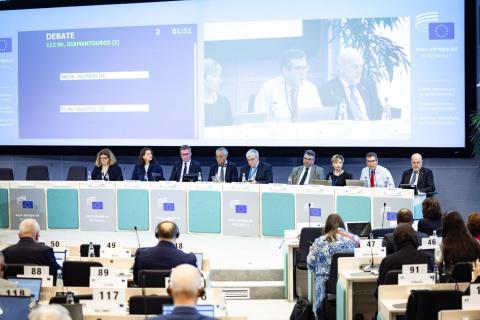
In the opinion,drawn up by Elena-Alexandra Calistru, Konstantinos Diamantouros and Stefano Palmieri, the Committee stresses that the next Multiannual Financial Framework (MFF) must be strong and ambitious, and must be seen as an investment in delivering EU priorities and European public goods.
More specifically, the EESC is in favour of a significant, real-term increase in the MFF in order to address the huge challenges facing the EU. This means that the mechanism for adjusting the MFF in line with inflation, which has traditionally capped the annual increase in contributions to the budget at 2%, should change in order to preserve the real spending power of the MFF.
Speaking during the plenary debate, EESC president Oliver Röpke said that ‘In times of transition and uncertainty, Europe needs a future-proof budget that empowers us to act, protect and transform. We need an MFF that is an investment tool for European public goods. We need to mobilise investment to foster our green, blue, digital and social transitions’.
He continued by pointing out that ‘Simplification and accessibility of EU funding is crucial. The next MFF must streamline funding instruments, harmonise rules and reduce bureaucracy to deliver real results on the ground’. (mp)
The European Economic and Social Committee (EESC) has launched work on a major package of recommendations to tackle the cost-of-living crisis, starting with four new opinions adopted at its April plenary session. This is the first block in a series of eight opinions focused on a specific aspect of the crisis — from economic fallout to social cohesion, employment, sustainability, and more.
The European Economic and Social Committee (EESC) has launched work on a major package of recommendations to tackle the cost-of-living crisis, starting with four new opinions adopted at its April plenary session. This is the first block in a series of eight opinions focused on a specific aspect of the crisis — from economic fallout to social cohesion, employment, sustainability, and more.
The goal? To propose a coordinated, cross-cutting strategy that goes beyond short-term fixes and helps build real, lasting resilience across the EU. The process will conclude in July 2025 with an umbrella opinion summarising all of the proposals in one policy message.
First set of recommendations:
The opinion ‘Measures for a resilient, cohesive and inclusive European economy’ calls for a shift from crisis response to long-term resilience, urging coordinated EU action to address inflation’s lasting impact, especially on vulnerable groups. Key proposals include a resilience monitoring system, investment in infrastructure and skills, stronger labour standards and aligning competitiveness with social and environmental goals.
The opinion ‘Phasing out fossil fuel subsidies while ensuring European competitiveness’ urges a socially fair phase-out of fossil fuel subsidies, starting with the most harmful. It calls for clear EU guidance, better reporting and strong job protection. The opinion also recommends ending support for new fossil fuel infrastructure, revising tax and State aid rules, and boosting clean energy investment and international cooperation.
The opinion ‘How single market dysfunctionalities contribute to the rising cost of living’ pushes for action to address dysfunctions in the single market that drive up prices. It targets barriers and advocates for stronger enforcement of EU law, completion of the Capital Markets Union, better labour mobility, improved infrastructure and access to healthcare. Housing market rules should also be assessed for their impact on affordability.
The opinion ‘Price hikes in transport, energy and housing: the role of quality public services in tackling the high cost of living’ underscores the importance of services of general interest in easing crisis impacts. It calls for greater public investment in social infrastructure, housing and transport; reform of State aid rules; and the repurposing of fossil fuel subsidies to fund greener solutions. It stresses the need for decisive action against energy and transport poverty, and calls for faster progress on renewables, grid expansion and permitting. (tk)
The European Economic and Social Committee (EESC) has adopted an opinion on the European Commission’s mid-term review of cohesion policy 2021-2027. In a debate with Commission Vice-President Raffaele Fitto, the EESC stressed that, while the EU must adapt to new priorities, cohesion policy must continue to focus on reducing regional inequalities.
The European Economic and Social Committee (EESC) has adopted an opinion on the European Commission’s mid-term review of cohesion policy 2021-2027. In a debate with Commission Vice-President Raffaele Fitto, the EESC stressed that, while the EU must adapt to new priorities, cohesion policy must continue to focus on reducing regional inequalities.
Cohesion policy, the EU’s main tool for promoting economic, social and territorial unity, is being reassessed to address major changes across Europe.
‘Cohesion policy has been vital in responding to both long-term structural challenges and urgent crises’, said EESC President Oliver Röpke, ‘but as we adapt to new priorities, we must keep its core mission at the forefront: supporting the most vulnerable regions and reducing inequalities. This is not just a question of solidarity, but of strengthening the Union’s long-term social and economic fabric’.
‘With the proposal on the mid-term review package, we are giving Member States and regions the opportunity to invest in new, specific areas – a voluntary choice that introduces flexibility without compromising the core principles of cohesion policy’, added Commission Vice-President Fitto.
The EESC supports aligning cohesion policy with new priorities – such as competitiveness, defence, housing, energy and water resilience – but insists these should enhance, not replace, the focus on solidarity.
A key concern is how to finance these ambitions. ‘Without a reformed and reliable funding model, the Union could find itself ill-equipped to respond to future crises or to invest adequately in long-term priorities’, explained EESC rapporteur David Sventek.
The EESC recommends:
keeping cohesion’s core mission of reducing inequalities
using a balanced mix of grants and financial tools
ensuring fair access to funding, especially for disadvantaged regions
coordinating the review with the EU’s overall budget
reforming the funding system to make it more stable
prioritising climate, digitalisation and infrastructure investment
As the EU looks beyond 2027, the EESC calls for a fair, flexible and future-ready cohesion policy for all regions. (tk)
Europe must strive to invest in its defence and security while also preserving its social model. Financial trade-offs might be needed due to geopolitical challenges that require us to rethink European priorities. The European Economic and Social Committee (EESC) can facilitate honest social dialogue on the EU’s new needs.
Europe must strive to invest in its defence and security while also preserving its social model. Financial trade-offs might be needed due to geopolitical challenges that require us to rethink European priorities. The European Economic and Social Committee (EESC) can facilitate honest social dialogue on the EU’s new needs.
The EESC’s April plenary session addressed EU foreign policy in view of the new geopolitical climate and complex and growing threats for Europe. In this context, the EESC is stepping in as a partner grounded in social and democratic dialogue.
EESC President Oliver Röpke stressed: ‘The EESC will continue to ensure that citizens’ concerns shape concrete policies that protect our social model and reinforce Europe’s role on the global stage. Europe must take greater responsibility for its own security and defence in a rapidly changing world.’
The debate incorporated input from the EESC’s ad hoc group on the new geopolitical order, which was represented by Elena Calistru, Winand Quaedvlieg and Sophia Reisecker. The group’s paper reflects on the cost of maintaining Europe’s strategic autonomy, which is imperative for strengthening the EU’s resilience.
The debate highlighted the fact that these new geopolitical challenges could lead to new opportunities and beneficial cooperation among EU Member States. The Chair of the European Parliament’s Committee on Security and Defence, Marie-Agnes Strack-Zimmermann, stressed how important it was for Member States to work together on joint defence procurement.
Iratxe García Pérez, head of the European Parliament’s Progressive Alliance of Socialists and Democrats, warned against negotiating on EU values and encouraged European citizens to defend truth and the rule of law.
In his statement, Fabian Zuleeg, Chief Executive and Chief Economist at the European Policy Centre, cautioned against ‘falling into the progress illusion’, explaining that Europe had not done enough to prevent a future war, including ‘Russian boots in the Baltic states’. To address this, Pierre Haroche, Associate Researcher of Defence at the Jacques Delors Institute, called for new defence coordination in Europe, as ‘we have no NATO to defend Ukraine’. (at)
To safeguard its democratic and social model based on freedom, equality and inclusion, the EU must resist attempts to water down its pioneering legislation regulating digital space.
To safeguard its democratic and social model based on freedom, equality and inclusion, the EU must resist attempts to water down its pioneering legislation regulating digital space.
With growing pressure from parts of the tech industry to dilute hard-won regulatory advances, EU leaders and civil society are calling for unity to protect Europe’s democratic values and digital sovereignty, as highlighted by the speakers at the debate on Democracy and Digitalisation held during the EESC plenary session on 29 April.
The debate came days after the EU fined Apple EUR 500 million and Meta EUR 200 million for breaching the EU’s digital rules – the first penalties issued under the Digital Markets Act (DMA), which regulates how tech giants operate in the EU market. Together with the Digital Services Act (DSA) and Artificial Intelligence (AI) Act, the DMA forms a digital rulebook shaping the EU’s tech governance.
‘The EU’s leadership in the digital domain is more crucial than ever – especially at a time when parts of the tech industry are beginning to push back against regulatory efforts,’ said EESC President Oliver Röpke. ‘The DSA and DMA have the potential to become historic milestones – provided that the EU, Member States, civil society and the business community remain committed to their robust implementation.'
‘With transparency and rules in the digital space, we aim to prevent the interests and profits of a few from prevailing over the public interest,’ said MEP Brando Benifei, co-rapporteur on the AI Act.
The discriminatory potential of AI is well documented. Iverna McGowan, from the Office of the UN Deputy High Commissioner for Human Rights, pointed out that there have been cases where algorithmic decision-making unfairly penalised people, such as candidates being downgraded due to maternity leave.
Udbar Tiwari, Vice-President for Strategy and Global Affairs at the Signal Foundation, warned against regulatory loopholes that weaken encryption. Encryption remains under threat from global legislative developments – such as client-side scanning – which could turn personal devices into surveillance tools.
The speakers concluded that, if used responsibly, digital technologies can create enormous opportunities. Left unchecked, they can cause lasting damage to democracy and the EU’s core values. (ll)