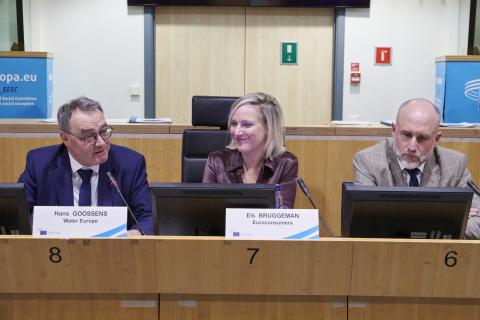
As revealed at the European Consumer Day held by the European Economic and Social Committee (EESC) on 9 December, with the price of water expected to rise by 25% by 2030, the EU will need to invest more than EUR 250 billion to meet Europe’s water needs and build a society in which everyone has access to clean, affordable water.
Water is becoming a scarce resource, even in Europe: as many as 30% of Europeans face water stress at least once a year. This means that consumers, who on average still see water as an expendable commodity, will have to change their behaviour to use it more efficiently, both by becoming more aware of their water footprint and by using smart water-saving technologies.
However, the major polluters should also pay the price and not leave consumers to shoulder their hidden expenses.
With 15 000 litres of water used to produce just one kilo of meat and 8 000 litres for one pair of jeans, big water spenders (such as manufacturing and especially agriculture, which accounts for 72% of all water withdrawals) will also have to bear the cost of their environmental impact and invest in better production facilities.
‘Water should be seen as a fundamental part of the European Commission’s forthcoming flagship policy initiatives. We would like to see the new Water Coalition launched to help implement the European Blue Deal, and we are currently working on the creation of the European Blue Deal Stakeholder Platform,’ said Milena Angelova, rapporteur for the EESC opinion on Waterefficient consumption and consumer awareness of their water footprint. She underlined the importance of the EU Blue Deal as a key initiative of the EESC, a ‘pioneering EU institution’ when it comes to water issues.
In his keynote speech, Gaetano Casale, Director of the Liaison Office of the IHE DELFT Institute for Water Education, said that water is still undervalued in Europe. In his view, a sustainable approach to water is now absolutely essential, and calls for increased awareness of the environmental costs, the challenges of a growing world population and climate change.
‘I would be glad if we all together—citizens, governments, agencies, scientists, industry, and lawmakers—seized this unique opportunity and took a comprehensive leap forward to make one of our most valuable resources, water—in the ground, in the sea, and in the sky—future-proof’, said Hildegard Bentele, the European Parliament’s shadow rapporteur on the Water Framework Directive. (ll)
The EESC held a debate to celebrate both the International Day of Persons with Disabilities and the Olympic spirit during its plenary session on 5 December in Brussels.
The EESC held a debate to celebrate both the International Day of Persons with Disabilities and the Olympic spirit during its plenary session on 5 December in Brussels.
The EESC celebrated both the International Day of Persons with Disabilities and the Olympic spirit by inviting guests from the world of Paralympic sport – including Belgian Paralympic athlete and champion Joachim Gérard.
Opening the session, EESC president Oliver Röpke said that ‘This debate highlights the urgent need to address the employment gap faced by persons with disabilities. Despite the existing legal frameworks, far too many people are excluded from the labour market due to persistent barriers. The EESC calls for action to create inclusive workplaces, break down systemic obstacles and ensure equal opportunities for all. A truly inclusive Europe must leave no one behind.’
MrGérard, a Belgian wheelchair tennis player and champion, told the plenary that when he first started playing tennis, he was often greeted with surprise and even protests that he would ‘ruin the court’ with his wheelchair. ‘In the last 10 years, we have seen huge progress in the role of people with reduced mobility in the world of sport. I have played in a number of Grand Slams around the world, and through these games and the Paralympics, I feel that I am becoming more and more accepted as a top-level athlete. Not just as a Paralympic athlete, but a top-level athlete.’
Anne d'Ieteren, president of the French-speaking Federation for Disability Sport (La Ligue Handisport Francophone), pointed out that despite the great successes demonstrated by the Paralympic Games, there were still many obstacles in the daily lives of people with disabilities. ‘A significant number of sports facilities are still inaccessible, with inadequate parking facilities or poor design. These may seem like small problems, but their cumulative effect can exclude and discourage participation.’
Aurel Laurenţiu Plosceanu, EESC Vice-President responsible for communication, welcomed Mr Gérard and Ms d'Ieteren, and said that ‘Their presence and track record remind us just how inspiring athletic excellence can be for all of us who strive to achieve our full potential, while also showing the vital role that persons with disabilities play in our society and in the sporting world in particular.’
Christophe Lefèvre, president of the EESC’s Permanent Group on Disability Rights, argued for the establishment of an EU accessibility mechanism with accessibility indicators, covering areas such as sustainable housing, sport, justice and education, while Pietro Vittorio Barbieri (a member the Permanent Group) added that ‘It is essential that all people with disabilities living in Europe have access to sport and education, so that we are all guaranteed the same privileges within society.’ (lm)
The EESC calls for a fair and inclusive transition as the EU moves towards climate neutrality. In a recent opinion, the EESC stresses the need for coordinated efforts to ensure that, when meeting ambitious climate goals, no one is left behind.
The EESC calls for a fair and inclusive transition as the EU moves towards climate neutrality. In a recent opinion, the EESC stresses the need for coordinated efforts to ensure that, when meeting ambitious climate goals, no one is left behind. These recommendations align with the European Commission’s 2024–2029 priorities, addressing jobs, skills, social welfare and regional disparities.
The EESC is advocating a comprehensive just transition policy package, allowing flexibility for Member States to address their own particular circumstances. Singling out social dialogue and collective bargaining as key tools, the EESC also proposes mapping skills gaps, inclusive training programmes, transparent company transition plans, greater worker consultation and the integration of just transition principles into EU frameworks such as the European Pillar of Social Rights.
'We want the just transition to be a story where fairness, resilience and sustainability pave the way for a greener, more inclusive future,' said Dirk Bergrath, rapporteur for the opinion.
To achieve Europe’s climate ambitions — 75% emissions cut by 2030 and net-zero by 2050 — fairness needs to be embedded into policies, the EESC stressed in the opinion. Prioritising decent work, social inclusion and poverty reduction is vital to sustain public support and ensure the success of the European Green Deal.
Furthermore, the EESC emphasises targeted support for regions disproportionately affected by the green transition. Mapping regional needs and sectoral transitions is critical, with the Just Transition Observatory monitoring progress and ensuring no community is overlooked.
To bridge funding gaps, it is essential to scale up the Just Transition Fund, leverage private investment and align EU financial instruments. Social and environmental conditionalities will ensure equitable allocation, focusing on training and protection for vulnerable groups. (ks)
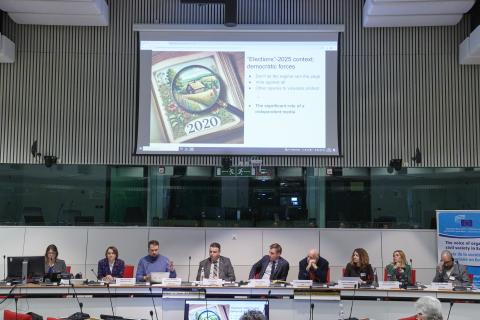
On 13 December 2024, the EESC, the European Endowment for Democracy (EED) and Press Club Belarus jointly organised a seminar on the role of Belarusian independent media in fostering a resilient and democratising society.
On 13 December 2024, the European Economic and Social Committee (EESC), the European Endowment for Democracy (EED) and Press Club Belarus jointly organised a seminar on the role of Belarusian independent media in fostering a resilient and democratising society. Being the only source of information for people in the country, Belarusian independent media need to be supported financially and involved in partnerships with western media to keep Belarus high on the international news agenda.
By taking part in the ‘Belarus Days’ initiative (9-13 December 2024), organised by the European External Action Service and the Commission’s Directorate-General for Neighbourhood and Enlargement Negotiations, the EESC demonstrated its unwavering commitment to a democratic Belarus that respects human rights and freedom of speech.
Opening the event, EESC President Oliver Röpke said: ‘Independent media are the backbone of a free and democratic society. Today, as part of Belarus Days, we reaffirm our solidarity with the Belarusian people and their courageous fight against disinformation and oppression’.
EED Executive Director Jerzy Pomianowski stressed: ‘The result of the election on 26 January is predetermined, and the regime will try to turn the page, try to legitimise itself in international affairs and whitewash the oppression. However, independent Belarusian media seem to be successful in engaging their audience’.
Hanna Liubakova, a freelance journalist in exile who was sentenced to 10 years in jail in absentia on four criminal charges, is thrilled by the Belarusian people’s motivation to stay informed and have access to independent media, highlighting that 50% of the traffic for Belarusian-run websites located outside the country comes from inside the country. She confirmed that up to 90% of the social media platform audience is inside Belarus. ‘Independent media in Belarus is the best antidote to Lukashenko’s and the Kremlin’s propaganda,’ she added.
Natalia Belikova, who works for Press Club Belarus said that the aim of the government’s new propaganda is to provide a new understanding of what elections are, so they are trying to unite people and encourage them to show their patriotism. ‘Such tactics are how they change the entire population’s perception about what democracy is,’ said Ms Belikova.
The seminar ended with the screening of the feature film Under the Grey Sky, inspired by the true story of Katsiaryna Andreyeva, a jailed Belarusian journalist, attended by the film’s director Mara Tamkovich. (mt)
At its December plenary session, the EESC hosted a debate on democracy in Africa with representatives from the African Union Economic and Cultural Council (AU ECOSOCC). Both sides agreed that civil society is the driving force for a successful EU-Africa partnership based on equality, fostering civil and social dialogue.
At its December plenary session, the EESC hosted a debate on democracy in Africa with representatives from the African Union Economic and Cultural Council (AU ECOSOCC). Both sides agreed that civil society is the driving force for a successful EU-Africa partnership based on equality, fostering civil and social dialogue.
At the plenary debate, at which it also adopted the opinion Democracy in Africa – current situation and future perspectives. What role for the EESC?, the EESC reiterated its commitment to enhancing the strategic partnership with the African Union, supporting the initiative for a joint undertaking to promote the values of democracy, inclusive dialogue and sustainable development. Earlier last year, the EESC and AU ECOSCOCC signed the Memorandum of Understanding.
Kyeretwie Osei, Head of Programs at the African Union of ECOSOCC, in his delivery statement on behalf of the Presiding ECOSOCC Officer Khalid Boudali, explained: 'We have an important job in institution-building to entrench democratic institutions around the continent, making sure that we are able to establish good governance by eliminating and reducing corruption and creating spaces for citizens' expression, among other things. Civil society is at the heart of this goal'.
Oliver Röpke, EESC President stressed: 'Cooperation with the AU ECOSOCC is key in promoting the role of civil society in Africa. Civil society should take part in the decision-making process and tackle further challenges, such as climate change, sustainable development and migration'.
In its opinion, the EESC addresses these challenges and takes the view that, together with recognised representatives of African civil society platforms, it can help promote democratic values, advocate for human rights and help defend democratic regimes in Africa.
Carlos Trindade, EESC member and rapporteur for the opinion, mentioned that the European approach to developing democracy in Africa should be based on a relationship between equals, taking into account the continent's complexity in terms of economic development, diversity and geopolitical interests.
Sifa Chiyoge Buchekabiri, Regional Director and CEO of the International Cooperative Alliance-Africa (ICA-Africa), spoke about the importance of empowering women in Africa. 'Promoting women's empowerment is key as women are often the backbone of their households. Therefore, by empowering women we are not just helping individuals, we are also empowering entire communities'. (mt)
The EESC's Permanent Group on Disability Rights concludes a visit to the Netherlands
On 9-10 December 2024, a delegation of three members from the Permanent Group on Disability Rights of the European Economic and Social Committee (EESC), accompanied by a representative from the European Disability Forum concluded a two-day visit to the Netherlands.
During the visit, the delegation had the opportunity to hear the Dutch umbrella organisation representing persons with disabilities Ieder(in) and representatives from public authorities, including the national police, about the Dutch policy on disaster risk reduction and civil protection.
You can read the report here.
Mission report from Country Visit to the Netherlands
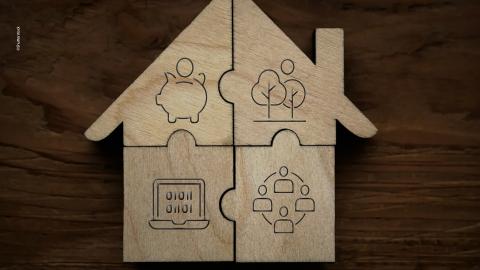
Increasing digitalisation in the construction and housing industries and involving social economy actors in housing provision services can help address current challenges related to housing affordability and sustainability in Europe.
Increasing digitalisation in the construction and housing industries and involving social economy actors in housing provision services can help address current challenges related to housing affordability and sustainability in Europe. Since housing is not just a need but also a human right, a pan-European response to the various challenges is needed, according to a recent conference at the EESC.
On 21 November, the EESC’s Civil Society Organisations’ Group organised the conference Protecting Europe’s most vulnerable through sustainable and affordable housing,where discussions centred around how the EU and its Member States could make housing conditions across Europe more inclusive, affordable and sustainable.
Séamus Boland, President of the Civil Society Organisations’ Group, stressed that access to adequate housing constitutes a human right that requires a pan-European approach. He highlighted the link between increasing housing prices and poverty levels, pointing out that ‘the provision of affordable and sustainable housing is central to poverty eradication’.
Mr Boland also underlined that ‘the EU anti-poverty strategy and European Affordable Housing Plan proposed by the European Commission President-elect must be part of a cross-sectoral policy approach to end poverty. This approach must involve civil society organisations throughout the entire process of designing, implementing and monitoring solutions. Sustainable housing must be examined from a broader perspective that encompasses resource efficiency, circularity, resilience, adaptation and economic accessibility’.
The event also showcased the new EESC studyAffordable sustainable housing in the EU, commissioned by the Civil Society Organisations’ Group. The study explores policy solutions for achieving affordable and sustainable housing across the EU. It investigates two emerging trends: digitalisation and involving social economy actors in housing provision. The study examines innovative initiatives in six Member States, assessing their potential for broader application across Europe.
You can learn more about the medium and long-term policy recommendations of the EESC studyhere.