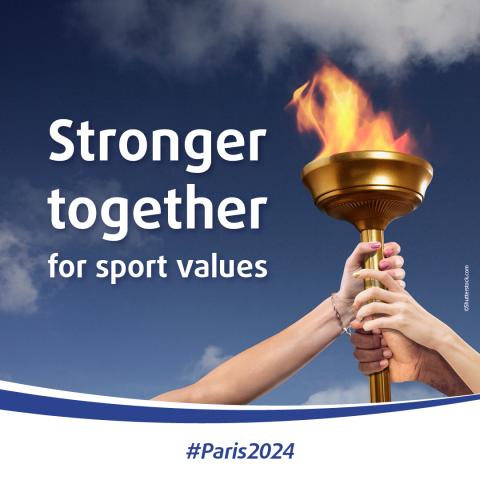
The European Economic and Social Committee (EESC) takes the initiative to endorse the values enshrined in the 2024 Olympic Games in Paris, from the civil society perspective.
The European Economic and Social Committee (EESC) takes the initiative to endorse the values enshrined in the 2024 Olympic Games in Paris, from the civil society perspective.
In today's fragile geopolitical landscape, the EESC is symbolically raising the idea of truce during the celebration of the games, reflecting the three original values of excellence, respect and friendship. Organised civil society has advocated for the spirit of building a peaceful and better world by educating youth through sport practiced without discrimination of any kind, with a spirit of friendship, solidarity and fair play.
Oliver Röpke, EESC President, said: 'The Games embody the spirit of unity and peace, transcending borders and bringing people together from all walks of life. By advocating these values, we hope to inspire a global movement towards peace and solidarity.'
Laurenţiu Plosceanu, EESC Vice-President for Communication, said: 'With this initiative we would like to endorse the sport values which remain timeless. The values we are defending have the power to change the world and unite people and countries.'
Krzysztof Pater, EESC Vice-President for Budget, said: 'The Paris Games show that everyone has the right to be part of this great sports celebration without discrimination. Persons with disabilities are a powerful example to audiences across the world, highlighting the values of courage, determination and equality.'
Dimitris Dimitriadis, former EESC President and President of the EESC's External Relations section, commented: 'The truce, or "Ekecheiria" in the original Greek, now appears more timely than ever. We need to revive and put into practice the idea of the truce as hope to inspire humanity and promote peace and dialogue.'
Giulia Barbucci, former EESC Vice-President for Budget and EESC member, said: 'For the first time in history, there will be equal participation between men and women in the Paris Games. But we must remember that parity in participation is not equality and there is still a lot to do on this objective in sport.'
Isabel Caño Aguilar, former EESC Vice-President for Communication and EESC member, said: 'My wish at the Paris Games is for all categories of disability to be fairly represented, with the right to compete and be protected, especially including people with intellectual disabilities!' (mt)
This opinion, drafted by EESC member Kęstutis Kupšys, points out that energy should remain affordable, adjustable and easy to use for consumers. Energy digitalisation does not mean ‘digital only’.
Consumers must remain the top priority and the traditional ways of doing business must be preserved. The EU needs to make progress in developing user-friendly digital tools that accommodate diverse needs and promote equal access to digital energy services.
However, users should still be able to choose prices, contracts and customer services in a ‘pre-digital’ way. ‘Energy digitalisation offers opportunities and challenges. We must work together to ensure that the digital energy transition is inclusive, secure and truly beneficial for all European consumers, turning strengths into opportunities,’ said Mr Kupšys.
The recent IT outage caused chaos for transport and businesses all over the world, and showed just how important it is not to be overly dependent on technology.
The advantages of the transition to digital energy must not overshadow the other side of the coin: risks and challenges. For this reason, protecting consumers and supporting workers must remain high on the agenda.
It is important to create dynamic consumer protection regulations adapted to the novel contexts and participants in the sector but also to offer training, re-training programmes and financial assistance to workers. (mp)
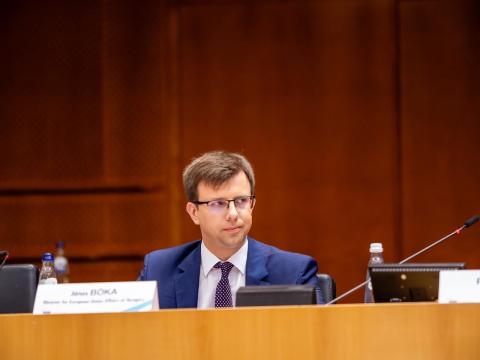
The EESC's July plenary session included a debate with the Hungarian Minister for European Union Affairs, János Bóka, who presented the main priorities of the Hungarian Presidency of the Council of the EU.
The EESC's July plenary session included a debate with the Hungarian Minister for European Union Affairs, János Bóka, who presented the main priorities of the Hungarian Presidency of the Council of the EU.
Hungary is taking up the rotating presidency at a sensitive time for Europe, a time of political transition within the institutions and extraordinary challenges for the Union. ‘The 2024 Hungarian Presidency of the Council comes at a time of multiple crises,’ said Mr Bóka. ‘We are witnessing war in our neighbourhood, declining European competitiveness, increasing tensions in the EU’s trade relations, demographic challenges, uncontrolled migration and decreasing prospects for European farmers.’
Pointing out that the Committee had a long-standing history of working well with Council presidencies, the EESC president Oliver Röpke spoke about the institution’s role as a guardian of European values: ‘Our Committee is committed to working closely with the Hungarian presidency to ensure that the EU is taking action on what Europeans feel are the most urgent priorities. We will be invaluable partners, but also outspoken and constructive critics. Civil society has a strong voice, and we will ensure that it is heard.’
Some EESC members voiced concerns about Hungary’s position on Russia’s war of aggression against Ukraine, respect for the rule of law in the EU, and the shrinking space for civil society in Hungary. Mr Bóka said that the Hungarian presidency was fully aware of its responsibilities and subscribed to both the EU’s common position on Ukraine and the rule of law and European values. The Hungarian presidency has already contacted the EESC and requested ten exploratory opinions. For more information on the EESC’s activities during the Hungarian presidency, please check the EESC website. (mp)
The finalists for the 2024 EU Organic Awards have been announced: 24 projects from 12 EU countries across eight categories. The winners will be revealed at a ceremony in Brussels on 23 September, to be held alongside the annual EU Organic Day celebrations.
The finalists for the 2024 EU Organic Awards have been announced: 24 projects from 12 EU countries across eight categories. The winners will be revealed at a ceremony in Brussels on 23 September, to be held alongside the annual EU Organic Day celebrations.
The awards, taking place for the third time, reward projects that are innovative and sustainable and add significant value to organic production and consumption. They provide winners with a platform to present their good practices to a wider audience.
The awards are organised by the European Commission, the European Economic and Social Committee, the European Committee of the Regions, COPA-COGECA and IFOAM Organics Europe, the European Parliament and the Council of the EU. The selection panel comprises seven members nominated by these bodies.
Best organic restaurant/food service: B2 Bio pur GmbH (Germany), Biohotel St. Daniel (Slovenia), Kalf & Hansen (Sweden)
Organic production in the EU covers 17 million hectares (10.5% of EU agricultural land in 2022), and the goal is to achieve the European Green Deal target of 25% by 2030. Increased public awareness and consumer demand are crucial. The EU Organic Awards, established in 2022 as part of the Action Plan for the Development of Organic Production, recognise excellence throughout the organic value chain, from farming to food services, enhancing visibility and knowledge of organic practices. (ks)
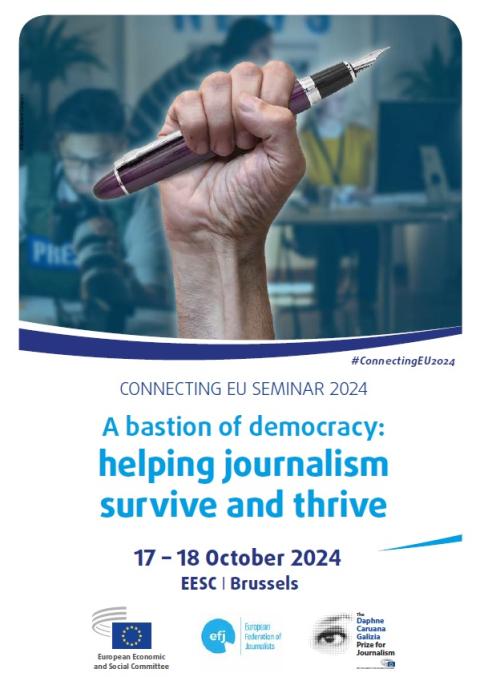
The EESC's Connecting EU seminar, which brings together communication professionals from civil society organisations every year, will take place in Brussels on 17 and 18 October 2024. It will focus on journalism and the importance of preserving its independence and relevance in the context of mounting political pressure on the media and the rapid rise of generative AI.
The EESC's Connecting EU seminar, which brings together communication professionals from civil society organisations every year, will take place in Brussels on 17 and 18 October 2024. It will focus on journalism and the importance of preserving its independence and relevance in the context of mounting political pressure on the media and the rapid rise of generative AI.
Under the title 'A bastion of democracy: helping journalism survive and thrive', the seminar will include two panels and a networking session:
Responsible journalism in the post-truth era - Democracy levels are plummeting across the world and journalists are faced with new challenges, such as the ever-craftier use of AI to spread fake news. On top of that, old challenges, such as the lack of media ownership transparency or insufficient funding, seem set to stay. What will it take for journalism to remain a cornerstone of democracy? Is responsible journalism even viable today? In a world where media outlets are competing with influencers or social media as the sources of news, will journalism have to reinvent itself to stay a public good? Can the latest EU acts help make AI an ally of press freedom?
The job of living dangerously– investigative reporting - Investigative journalism has a long history of holding power to account and providing a voice for those seeking to report abuse of position and privilege. What kinds of challenges do investigative reporters have to grapple with to bring the truth to light? What protection do they have at their disposal to shield themselves from threats? Can the new EU legislation secure more freedom and power for them?
Working as a press or communication officer in the age of Instagram, TikTok and AI – how to get your message across (networking session and workshops) – Through presentations and hands-on workshops, the session aims to offer a glimpse into the brave new world of communicating to different audiences, including young people.
The Connecting EU seminar offers a platform where press and communication professionals from civil society organisations can network and discuss current issues of common interest affecting Europe. It brings together EESC members and other EU representatives, partner organisations from Member States, journalists and researchers to debate the hot issues of the day. The full programme and the list of speakers will be available shortly on the EESC's website. For more information, please write to: pressofficers@eesc.europa.eu. (ll)
The EESC has always been at the forefront of promoting sport as a positive force for nurturing healthy values across all sections of society. The Committee has previously promoted cycling and, most recently, has advocated a focus on sport in the efforts to recover from the COVID‑19 pandemic, highlighting the role it can play in building a more resilient and sustainable society.
EESC calls on the Commission to make the topic of informal carers a political priority and to set up a platform for the exchange of best practices among Member States.
EESC calls on the Commission to make the topic of informal carers a political priority and to set up a platform for the exchange of best practices among Member States.
In July, theEESCadopted an opinion calling for additional measures to be taken, at both EU and national level, to better protect informal carers and recognise their essential contribution to society.
These measures include: the European Commission setting up a platform for the exchange of best practices among Member States, the provision of high-quality, accessible community-based services to alleviate the burden on family caregivers, and provision of respite services. It is also crucial that caregivers be able to access flexible working conditions, so that they are not forced to leave their jobs to look after family members.
Pietro Barbieri, rapporteur for the opinion, said: "The EESC is ready to give a voice to a group of people in our society who are largely invisible: the informal caregivers. These people are often forced to leave their work and, as a consequence, they lose their income and many of their rights. Informal carers carry out their activity in the shadows. Now is the time to turn the spotlight on to their efforts".
The EESC calls on Member States to take appropriate measures to guarantee that a decision to take on informal care is voluntary, that gender inequalities are tackled, and that informal carers can maintain their employment and pay through more flexible working conditions and can easily re-enter the job market if they have been forced to leave it. It is important to ensure they have an appropriate work-life balance.
Informal caregiving does not affect men and women the same way. A huge percentage of informal carers are women, of whom about 70% care for their children, spouses or siblings. In addition to being exposed to higher risks of burnout and psycho-physical disorders, these women are at serious risk of poverty. "We have one of the best welfare systems in the world, but in many cases, it relies upon the bodies, the arms and the willpower of women," Mr Barbieri said.
In order to be able to monitor the impact of the relevant rules and regulations, it is of major importance to have access to qualitative and quantitative data describing the actual living conditions of informal carers. The EESC calls for further research strategies to be adopted, in particular with the cooperation of Eurofound and the involvement of relevant stakeholders. (sg)
Nearly half of the EU’s more than three million trainees receive no compensation and almost a third have no access to social protection
TheEESCheld a high-level debate in July on improving the EU legislation on traineeships amid calls from civil society and youth organisations to stop the widespread practice of trainees working for free and having no access to social protection or other labour and social rights.
However, the EESC urged the co-legislators to bolster the proposals to prevent traineeships being misused as a source of cheap labour or a replacement for entry-level jobs. It stressed the importance of fair compensation for trainees and of covering the living expenses that they incur when taking part in a traineeship.
The EESC president, Oliver Röpke, said that ‘Traineeships are a pivotal tool enabling young people to acquire first-hand work experience. We must ensure that no young person is excluded from these opportunities due to financial constraints. That is why traineeships need to be fairly compensated. We must tackle exploitative traineeships in Europe, and I thank the Commission for its proposals to achieve this goal.’
Commissioner Schmit said that ‘Traineeships can be a great way for young people to get initial work experience, learn new skills and build their network. However, they must be good quality traineeships. This means that there must be a clear learning objective, they must be paid and trainees must receive mentoring and guidance to help them transition to the world of work.’
In its opinion on the Traineeship Directive and a Reinforced Quality Framework for Traineeships, the EESC underscored the key role played by the relevant authorities in combating regular employment relationships disguised as traineeships. The social partners can be instrumental in these efforts, in line with existing national practices.
‘Improving the Quality Framework for Traineeships across Europe, especially in terms of strengthening learning and training content, and combating the abuse and misuse of traineeships is essential. We therefore call on the Commission to improve the proposals put forward so as to ensure that these goals are met,’ said the rapporteur for the opinion, Nicoletta Merlo. (ll)
The European Economic and Social Committee (EESC) takes the initiative to endorse the values enshrined in the 2024 Games in Paris, from the civil society perspective.
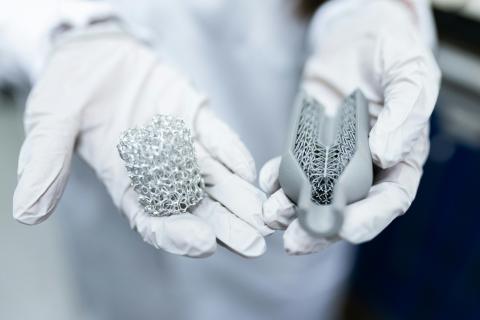
The EESC has criticised the European Commission’s current plan for advanced materials for its lack of funding, quantifiable targets and sustainability indicators. In its opinion on the relevant Commission Communication, it advocates a comprehensive strategy to position the EU as a global leader in this vital sector.
The EESC has criticised the European Commission’s current plan for advanced materials for its lack of funding, quantifiable targets and sustainability indicators. In its opinion on the relevant Commission Communication, it advocates a comprehensive strategy to position the EU as a global leader in this vital sector.
‘Advanced materials are crucial for industry, economic growth and sustainability in the EU. We need sustainability indicators in all production processes and must secure the right skills and qualified labour,’ said Anastasis Yiapanis, rapporteur for the opinion.
The Committee warns that the Commission’s plan lacks the ambition and specific targets needed to secure the EU’s industrial leadership. Co-rapporteur Gerardo Luis Arroyo Herranz emphasised the absence of quantifiable targets, deadlines and key performance indicators. The EESC calls for a bold, strategic approach to enhance the EU’s capabilities in advanced materials and proposes including healthcare as a strategic area due to its significant industrial impact.
A central recommendation is transitioning towards a circular economy to reduce reliance on raw materials. This requires enhanced cooperation between industry, academia and policymakers, substantial investment in research and development, and skills development. ‘Without adequately skilled people, any action may fail. The EU must implement upskilling and reskilling programmes and vocational education initiatives,’ said Mr Arroyo Herranz.
The EESC deems the proposed EUR 250 million for advanced materials under Horizon Europe insufficient and calls for more substantial funding, tax-based incentives and simplified bureaucratic processes to stimulate investment and innovation. Securing a stable supply of critical raw materials is also a concern.
The EESC advocates strengthening the EU’s domestic capacity and diversifying sources, including partnerships with South Korea and the United States and long-term contracts with smaller countries to mitigate supply disruptions. (gb)