
European Economic
and Social Committee
Tackling Europe’s housing shortage: faster building, smarter rules and more private investments
Access to affordable housing is an increasingly pressing challenge across the EU. Citizens and businesses alike are confronted with rising construction costs, restrictive financing conditions, and labour shortages, which contributed to a persistent mismatch between housing supply and demand. The number of housing units granted building permits in the EU fell by 25% in five years, from 2 million permits to 1,5 million. At the same time, the cost of construction materials rose by around 30%, influenced by the higher cost of energy and supply shortages. Mortgage rates more than doubled during the same period.
So how can the supply of housing be increased and barriers overcome?
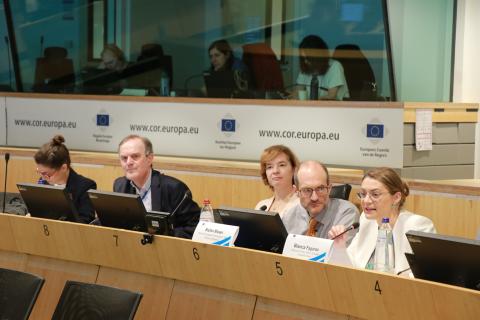
This was the focus of the debate organised by the EESC Employers' Group on 17 June 2026 which hosted representatives from the housing and construction sectors: Christine Le Forestier, Director Social Affairs of the European Construction Industry Federation (FIEC); Stefan Moser, Head of European Commission's Task Force on Housing at the Directorate-General for Energy (European Commission); Bianca Faragau Tavares, Institutional Policy Officer at the European Investment Bank (EIB); and EESC Employers' Group member Robert de Mûelenaere.
Addressing the housing crisis requires a significant increase in new construction, as current supply alone cannot meet demand. This means building faster, more cost-effectively and more sustainably by accelerating and digitalising permitting procedures, scaling up modern construction methods such as modular building, and strengthening the EU single market to achieve economies of scale. A stronger single market is indeed a prerequisite for increasing housing supply efficiently.
Speakers also highlighted that regulatory barriers across the value chain, ranging from constrained land supply, lengthy permitting processes, the cost of financing and increasing regulatory requirements. At the same time, structural challenges such as labour shortages and skills mismatches constrain the sector’s capacity to deliver.
Financing is a central pillar of the solution. To enable a more dynamic housing market we need less stringent mortgage requirements, more flexible credit assessments, attractive loan formulas and tax incentives that could boost demand and support enduring market growth with public budgets under pressure, mobilising private investment is essential. This requires regulatory stability, long-term financing frameworks, strong public-private partnerships, and effective financial instruments. It was highlighted that the EIB is stepping up its support across all Member States, increasing its lending capacity and providing advisory services to help unlock investment, including in innovative construction methods.
In addition, it was noted that housing policy must reflect territorial differences. The challenge is not uniform across Member States or regions, and particular pressure exists in high-productivity and high-demand urban areas. There is a clear need for better territorial planning and targeting of interventions.
The discussion highlighted that the solutions must tackle the root causes of rising housing prices while conserving public spending and further removing barriers to private financing in order to encourage the increase the supply of quality housing at an affordable cost.
Work organisation
Recommended for you
EESC advocates for smarter tax rules to ease compliance and boost competitiveness
News
The European Economic and Social Committee (EESC) has adopted an opinion supporting the European Commission’s ambition to simplify tax reporting obligations across the EU, reduce administrative…
EESC calls for more support and faster treatment for rare disease patients
News
In an own-initiative opinion, the European Economic and Social Committee (EESC) has called for the EU to adopt a comprehensive approach to providing more support and faster treatment for rare disease…
Expand private investment for a sustainable recovery, says EESC
News
Trillions of euros are needed for Europe's economic recovery. EU proposals for accessible investment data and long-term funding must be more flexible and promote a transparent level playing field, to…
Tackling housing scarcity through affordable, sustainable and family-oriented housing policies
News
BackgroundThe Cyprus Presidency of the Council of the European Union is interested in assessing to what extent measures on affordable housing can complement measures aimed to reduce energy costs for…
Social economy in Europe: adapt investments to drive more funding, says the EESC
News
New financial instruments are needed if the social economy is to keep growing beyond the stimulus provided by public programmes, says a newly-adopted report by the EESC, which also calls for…