
European Economic
and Social Committee
Strengthening the European Semester by putting well-being and EU values centre stage
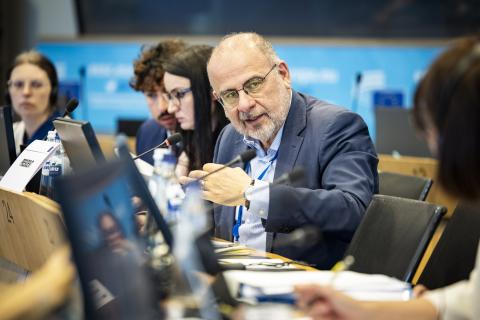
On 24 June 2025, the European Semester Group (ESG) of the European Economic and Social Committee (EESC) hosted its annual conference under the heading ‘A stronger and more inclusive European Semester that works for all: strengthening Europe’s economic resilience, sustainable growth and competitiveness’. The event gathered together EU institutions, civil society organisations, national economic and social councils, and policy experts. Together, they explored how the European Semester can adapt to today’s complex economic, geopolitical and social challenges.
Opening the conference, ESG president Luca Jahier stressed that: ‘The Semester is the cornerstone of EU economic governance and its role is only set to grow. It must be further adapted to remain an effective tool for broad coordination and adequately reinforced to better support economic resilience, sustainable growth and competitiveness. It must also become more inclusive and participatory, involving civil society, local actors and national parliaments in shaping Europe’s reform agenda.’
Mr Jahier also presented the conclusions from the ESG’s 2024-2025 consultation cycle, which gathered input from the 27 Member States. These findings fed into the EESC’s opinion of April 2025 and the information report calling for, among other things, a more transparent and citizen-focused Semester.
Towards a more resilient and inclusive Semester
Participants broadly agreed that the Semester must better reflect the EU’s shared priorities, addressing persistent challenges such as demographic shifts, low productivity, lagging innovation and the incomplete green transition.
The European Commission’s 2025 Spring Package was central to the discussions. Centred on boosting productivity and innovation, aligning national and EU policies, and implementing the revised economic governance framework, the package comprises a set of EU rules and procedures that guide how Member States coordinate their economic policies to ensure financial stability and sustainable growth. The Competitiveness Coordination Tool and the Competitiveness Compass were welcomed, though many stressed that competitiveness must not override social and environmental goals. ‘Competitiveness should support, not undermine, the green transition, social rights and inclusive prosperity,’ one speaker warned.
Country-specific recommendations (CSRs), annual recommendations issued by the EU institutions to each Member State to improve economic, social and environmental performance, were also discussed. While the 2025 CSRs have broadened in scope, participants agreed that more is needed to fully integrate well-being and sustainability.
The growing tension between increased defence spending and the protection of social investment also emerged as a key concern. While acknowledging the need for strategic autonomy, participants called for a balanced approach that protects essential services and environmental priorities.
Strengthening democratic legitimacy and ownership
Speakers, including EESC President Oliver Röpke, ECO section president Ioannis Vardakastanis and ESG vice-presidents Javier Doz Orrit and Gonçalo Lobo Xavier, underlined that wider stakeholder involvement is vital. National ownership, citizen participation and active engagement from civil society were seen as critical to ensuring reforms are socially grounded and broadly supported.
Well-being and sustainability as policy drivers
As discussions moved from governance to outcomes, many called for well-being and sustainability to take centre stage in the Semester’s priorities. A key focus was integrating the Sustainable Development Goals (SDGs) into the Semester, and the participants called for a shift away from GDP and competitiveness as the primary benchmarks.
The Joint Research Centre’s publication Measuring sustainable and inclusive wellbeing: a multidimensional dashboard approach, one of the main objectives of which is to develop a multidimensional dashboard that integrates existing tools and frameworks into a set of indicators that provide a holistic view of the well-being of people and the planet. Calls were made for a ‘sustainability scoreboard’ with clear, intuitive indicators to track progress on well-being, environmental sustainability and democratic quality.
Speakers warned that the current policy mix leans too far toward defence and competitiveness at the expense of social investment and planetary health. The EESC was urged to champion a balanced vision of sustainable prosperity that aligns with the SDGs, the Green Deal and the European Pillar of Social Rights.
A values-driven path forward
In a video message, EESC President Oliver Röpke concluded: ‘It’s time to make the European Semester more responsive, inclusive and forward-looking. Our shared goal must be a resilient, future-proof economy that works for people and the planet.’
The conference ended with a clear message: as the EU enters a new institutional cycle, the Semester must become more transparent, inclusive and anchored in fundamental values. Only then can Europe chart a path to long-term prosperity that leaves no one behind.
Work organisation
Related content
Recommended for you
Ahead of EU elections, citizens take centre stage in first ever Civil Society Week
News
On 4 March, the European Economic and Social Committee (EESC) kicks off its first ever Civil Society Week, titled 'Rise Up For Democracy!'. This week-long event brings to Brussels more than 200…
EU money is tied to EU values — EU Court of Justice strengthens the rule of law
News
The long-awaited ruling of the top European Court, issued today, confirms the legitimacy of protecting the Union budget from negative effects resulting from breaches of the principles of the rule of…
2024 Euromed Summit: The EESC puts youth involvement front and centre
News
President Oliver Röpke and EESC members participated in the 2024 Euro-Mediterranean Summit of Economic and Social Councils and Similar Institutions, a pivotal event held in Malta on June 18-19. The…
A new Pact for the Mediterranean: putting business and civil society at the centre
News
The Pact for the Mediterranean, presented by the EU Commission in October 2025, sets out an ambitious new strategy to strengthen EU relations with its Southern Mediterranean partners. Building on the…
EESC urges bold action to strengthen the EU’s economy and the European Semester
News
The European Economic and Social Committee (EESC) has adopted two important opinions in plenary outlining the priorities for the euro area economy and the European Semester in 2025. The EESC calls…