
European Economic
and Social Committee
The European Council President António Costa on competitiveness and the geopolitical context
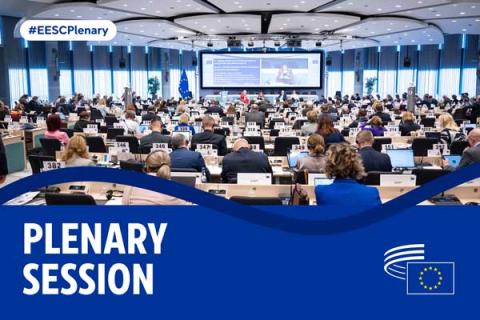
29-30 April 2026
European Commission, Charlemagne building (Alcide De Gasperi room), 1040 Brussels
Web stream click here
Debates
Wednesday 29 April 2026 at 15:00
Competitiveness and the role of the EU in the current geo-political environment
with António Costa, President of the European Council
Wednesday 29 April 2026 at 16:00
Union of Equality: Advancing LGBTIQ+ rights and banning conversion practices
with Matteo Garguilo and Caleb Stocco, representatives of the European citizens’ initiative ‘Ban conversion practices in the European Union’, European Association Against Conversion Therapy (ACT); Francesco Zoia Bolzonello, Member of the European Commissioner Hadja Lhabib’s cabinet; Béatrice Fresko-Rolfo, chair of the Committee on Equality and Non-Discrimination, Parliamentary Assembly of the Council of Europe; and Graeme Reid, United Nations independent expert on Protection against violence and discrimination based on sexual orientation and gender identity (remotely)
linked to SOC/854 - Ban on conversion practices in the EU and SOC/849 - The Union of Equality: LGBTIQ+ Equality Strategy 2026-2030
Thursday 30 April 2026 at 09:00
Supplementary pensions for a Savings and Investment Union
with Maria Luís Albuquerque, European Commissioner for Financial Services and the Savings and Investments Union; Elma Saiz Delgado, Minister for Inclusion, Social Security and Migration of Spain; and Damian Boeselager, Member of the European Parliament (remotely)
linked to ECO/695 - Supplementary pensions package
Thursday 30 April 2026 at 10:00
How to improve the ‘innovation to market’ journey and address barriers for startups in the European Union
with András Inotai, acting head of the Taskforce on Startups and Scaleups and lead for the European Innovation Act, European Commission, Directorate-General for Research and Innovation (DG RDT); Stefan Dobrev, chair of the Governing Board & Executive Committee of the European Institute of Innovation and Technology (EIT); Reinhilde Veugelers, senior fellow at Bruegel (co-author of the report Regime 0: Europe-wide incorporation for startups to kickstart innovative growth); and Agnès Mathis, director of Cooperatives Europe; and Mohammad Iranmanesh, managing director of constellr Belgium
linked to INT/1112 - The EU Startups and scale up strategy – with a focus on European Innovation Act
Thursday 30 April 2026 at 11:30
Europe for Culture – Culture for Europe
with Glenn Micallef, European Commissioner for Intergenerational Fairness, Youth, Culture and Sport; Nela Riehl, Member of the European Parliament and chair of the Committee on Culture and Education (CULT) (remotely); Tanja Hristova, member of the Committee of the Regions, vice-chair of the Commission for Social Policy, Education, Employment, Research and Culture (SEDEC) and rapporteur of the opinion on Culture Compass for Europe; and Lars Ebert, secretary-general of Culture Action Europe
linked to SOC/853 - A Culture Compass for Europe
Opinions in the spotlight
EXTERNAL RELATIONS
Civil Society's role in supporting the reform process under the growth plans for the Western Balkan, Moldova and Ukraine's Reform Path (REX/612, rapporteur: Oleg Roibu (RO-I), co-rapporteur: Andrej Zorko (SI-II))
The opinion requested by the Cyprus presidency and selected for the Enlargement Candidate Members (ECMs) initiative focuses on the implementation of the three performance-based facilities designed to support these countries’ paths towards EU membership and closer integration. More
The role of the Private Sector and Civil Society in Strengthening Economic Cooperation within the Pact for the Mediterranean (REX/613, rapporteur: Thomas Wagnsonner (AT-II), co-rapporteur: Lidija Pavić-Rogošić (HR-III))
The opinion emphasises the role of the private sector and civil society in fostering sustainable development and inclusive growth in cooperation between the EU and southern Mediterranean countries. More
DEFENCE
Programme for Agile and Rapid Defence Innovation - AGILE (CCMI/266, rapporteur: Monika Sitárová (SK-GII), co-rapporteur: Srita Heide (DE-Cat.3))
The EESC backs the proposed AGILE programme, a fast-track EU tool designed to bring new defence technologies to market quickly, especially by supporting smaller and newer players. The Committee calls for stronger safeguards, a larger budget in the next MFF and insists funding should be spread more evenly across all Member States, rather than going mainly to countries with already strong defence industries. It also believes EU funds should not support defence industries in third countries. More
INTERNAL MARKET
Single market – tackling unjustified territorial supply constraints (INT/1124, rapporteur: Antje Gerstein (DE-I))
The EESC urges Member States to remove unjustified barriers to the free movement of goods without undermining legitimate consumer protection requirements. It believes that territorial supply constraints (TSCs) harm cross-border businesses and break the single market's promise to bring choice and price competition to consumers. More
A strategic standardisation for a stronger Single Market (INT/1120, rapporteur: Angelo Pagliara (IT-II))
The EESC underlines the strategic importance of the EU standardisation framework and advocates for an inclusive, competitive and socially balanced system. It calls for clear safeguards to protect social dialogue and insists that European standards must remain technical tools supporting legislation. It also recommends for standards to be more transparent and accessible to the public. More
Evaluation of Regulation (EU) 2019/1020 on market surveillance and compliance of products (INT/1106, rapporteur: Antje Gerstein (DE-I), co-rapporteur: Anastasis Yiapanis (CY-III))
The EESC's latest evaluation of the Market Surveillance Regulation (MSR) confirms that the EU has built a robust legal foundation to ensure only compliant products enter the Single Market. However, there is a growing disconnect between regulatory intent and real-world outcomes. Rapid digitalisation, globalised supply chains and the rise of e-commerce have fundamentally reshaped the market environment, putting increasing pressure on existing enforcement mechanisms. In particular, digital trade has outpaced enforcement capacity. More
EU Startups and scale up strategy - with a focus on European Innovation Act (INT/1112, rapporteur: Paul Rübig (AT-I))
The EESC opinion focuses on the implementation of the Startups and Scaleup Strategy, with particular emphasis on the European Innovation Act. The EESC explores if the harmonisation of regulatory sandboxes can foster company growth while safeguarding the rights and interests of employees and consumers, at the same time respecting the specific circumstances in each Member State. More
LGBTIQ+
Union of Equality: LGBTIQ+ Equality Strategy 2026–2030 (SOC/849, rapporteur: Juliane Marie Neiiendam (DK-III))
The EESC welcomes the EU’s LGBTIQ+ Equality Strategy 2026–2030 but calls for stronger enforcement and accountability to address persistent discrimination, violence and exclusion, particularly affecting trans, non-binary and intersex persons. It urges binding benchmarks linked to EU funding, systematic infringement procedures and the swift adoption of the Horizontal Equal Treatment Directive. The Committee calls for a binding ban on conversion practices, legal gender recognition based on self-determination, improved access to inclusive healthcare and education, stronger protection for civil society, and integration of LGBTIQ+ equality into social inclusion, housing and anti-poverty policies. More
Ban on conversion practices in the EU (SOC/854, rapporteur: Pascal Debay (BE-II), co‑rapporteur: Ionuţ Sibian (RO-III))
The EESC strongly condemns conversion practices as violations of fundamental rights and calls on the European Commission to propose a comprehensive and legally binding EU ban covering all practices aimed at changing, suppressing or erasing sexual orientation, gender identity or gender expression. It urges that the ban apply to both children and adults, cover sex characteristics to protect intersex persons, prohibit advertising, and include effective penalties and monitoring. The Committee also calls for specialised training for professionals, adequate funding for civil society organisations supporting survivors, and EU‑wide awareness‑raising, ensuring that the ban is fully embedded in the LGBTIQ+ Equality Strategy 2026–2030. More
YOUTH
EU competitiveness and youth entrepreneurship (SOC/852, rapporteur: Giuseppe Guerini (IT-III))
The EESC considers youth entrepreneurship a strategic lever to strengthen EU competitiveness, innovation and long-term economic resilience, while addressing unemployment and generational succession in SMEs. It calls for an integrated support framework combining access to finance, mentoring, coaching, business incubation and high-quality training tailored to young entrepreneurs’ needs. The Committee urges improved access to alternative financing instruments beyond traditional bank credit, reduced administrative and regulatory burdens at all levels, and stronger financial education. It also highlights the importance of embedding entrepreneurship education across school and training systems, including dual training, to foster entrepreneurial skills and sustainable business creation. More
CULTURE
A Culture Compass for Europe (SOC/853, rapporteur: Luca Jahier (IT-III))
The EESC fully supports the Culture Compass for Europe as a transversal EU strategy to strengthen democracy, social cohesion and economic resilience through culture. It calls for strong and sustained financial support for culture in the next Multiannual Financial Framework, including consideration of allocating 2% of the EU budget to cultural objectives, and for clear implementation through flagship actions and structured stakeholder involvement. The Committee stresses the strategic importance of cultural and creative sectors as an economic ecosystem, urges better protection of artists’ working conditions and intellectual property in the context of AI, and calls for culture to be fully integrated into democracy, education, social inclusion and international relations policies. More
ENVIRONMENT
A comprehensive strategy for nature-based biodegradable materials to foster circularity and resource efficiency, strengthen the agri-food sector and scale-up the EU bioeconomy (NAT/970, rapporteur: Stoyan Tchoukanov (BG-III))
Europe stands at a turning point: we can lead the transition away from fossil fuels towards a circular, sustainable economy. With the Circular Economy Act and Bioeconomy Strategy, the focus must now be on real impact cutting waste, boosting nature-based materials, and supporting local jobs. Clear EU rules will be key to unlocking innovation and investment. More
EU Bioeconomy strategy - Towards a circular, regenerative and competitive bioeconomy (NAT/974, rapporteur: Arnaud Schwartz (FR-III))
The EESC warns that Europe’s resource dependence and global pressures require a stronger - not weaker - commitment to the Green Deal and circular bioeconomy. It calls for strict, enforceable rules on sustainable biomass use, ensuring fair competition and prioritising quality jobs, especially in rural areas. The Committee stresses that reducing resource use must come first, with a clear commitment to the waste hierarchy. Without stronger safeguards, it warns the bioeconomy risks falling into short-term, unsustainable uses instead of truly circular solutions. More
ECONOMY
Supplementary pensions package: PEPP and IORP (ECO/695, rapporteur: Maria del Carmen Barrera Chamorro (ES-II))
The EESC backs a robust multi-pillar pension system, stressing that supplementary schemes must complement, not undermine, public pensions, so that everyone in the EU can retire with dignity, security and adequate income. It calls for a more holistic approach that links stronger labour markets with pension systems that are transparent, accessible and easy to navigate. The EESC highlights the need to improve governance by involving social partners more closely, while updating EU rules, particularly the IORP Directive and the PEPP Regulation, to boost transparency, build trust and support cross-border participation. It also emphasises the importance of gender balance and maintaining public confidence in pension products. Social dialogue is seen as essential, especially when designing measures such as automatic enrolment. Looking ahead, the EESC calls for stronger EU-level monitoring, action to tackle inequality and sustainability risks, continued digitalisation of social security systems, and better financial education supported by user-friendly tools and accessible advice. More
EU Policy agenda for liveable cities (ECO/696, rapporteur: Florian Marin (RO-II), co-rapporteur: Roman Haken (CZ-III))
The EESC sees cities as central to Europe’s economic, social and territorial development, driving innovation and improving quality of life. While it welcomes the Commission’s ambition for a stronger EU Agenda for Cities, it considers the current proposal falls short. The Committee calls for the Agenda to be anchored in multi-level governance, with cities and the EESC recognised as equal partners, and with stronger involvement of social partners and civil society. It also urges a more concrete framework with clear responsibilities, better funding access, and stronger links between urban and rural areas. The EESC highlights the need for improved urban data, structured EU-level dialogue, and greater technical support. It stresses that housing must be treated as a key social issue requiring EU action, and calls for community-led local development in cities (CLLD-U) to be expanded into a fully-fledged EU instrument. More
For more information, please contact:
EESC Press Unit
E-mail: press@eesc.europa.eu
Tel: + 32 2 546 9793
@EESC_PRESS
Recommended for you
Meeting with António Costa, President of the European Council
Agenda
EESC to host debate with president António Costa on upcoming presidency of European Council
News
4-5 December 2024 - European Commission - Charlemagne building (Alcide De Gasperi room) Web stream click here AGENDADebatesWednesday, 4 December 2024 at 15:00Priorities of…
European Council President António Costa calls on the EESC to help deliver a just and competitive Europe for citizens and businesses
News
The current geopolitical context is shining a harsh spotlight on the price that Europe is paying for its dependency on third countries, as European Council President António Costa said at a plenary…
Speech by President Séamus Boland, EESC plenary debate with António Costa, President of the European Council
News
EESC plenary debate on the 'Priorities of the upcoming presidency of the European Council' with António Costa, President of the European CouncilDear Mr Costa,I would like to…
Meeting with Mr António Costa, President-elect of the European Council
Agenda