
European Economic
and Social Committee
Delivering Europe’s Technological Sovereignty: from political ambition to market reality
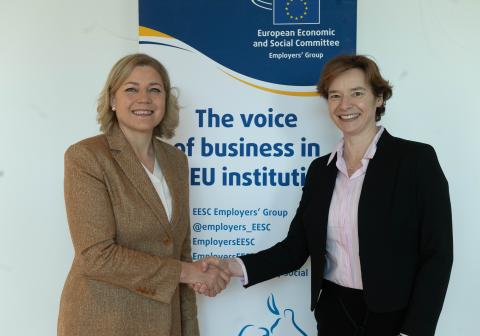
On 26 March 2026, the EESC Employers’ Group hosted the high-level debate “Delivering Europe’s Technological Sovereignty”, with the participation of Executive Vice-President Henna Virkkunen.
As Sandra Parthie, EESC Employers’ Group President, remarked, there is a growing gap between Europe’s political ambition on technological sovereignty and the realities faced by businesses on the ground. Closing this gap will require not only strategic vision, but concrete improvements in framework conditions, particularly in relation to market integration, regulatory coherence, and the ability of firms to scale across borders—while noting that Europe’s technological choices carry wider strategic implications beyond the economic sphere.
Building on this framing, EC Executive Vice-President Henna Virkkunen emphasised that “technological power has become geopolitical,” and that developing European technologies is “a matter of sovereignty, security and democracy.” While reaffirming Europe’s ambition to lead in artificial intelligence, she acknowledged concerns over regulatory complexity and stressed that “European regulation should act as an enabler rather than a constraint.” Alongside simplification efforts such as the Digital Omnibus and the EU Business Wallet, she announced a forthcoming Digital Sovereignty Package, including a Chips Act 2.0 and an EU Cloud and AI Development Act. “Europe already has the key assets to lead globally,” she concluded, “but must now act with greater speed and determination.”
The panel brought together Stéphane du Boispéan, Head of Digital & Payments at Schwarz Group; Cassi Welling, Managing Director and Chief Strategy Officer at constellr, a deep-tech company in the space sector; and Antonio Grasso, Public Affairs Director at the European DIGITAL SME Alliance, each offering a complementary perspective on the structural constraints facing European technology.
On dependencies, Mr du Boispéan highlighted that the gap between political ambition and market behaviour is rooted in both operational and structural factors. “Migrating critical workloads is costly and requires significant time and resources,” he noted, while the absence of credible alternatives reinforces lock-in effects. He further pointed to concrete cases where non-European providers increased licence fees “by up to 30% without negotiation,” illustrating the asymmetry of power in current market structures and the need to better map vulnerabilities in critical infrastructures.
Ms Welling provided a deep-tech perspective, emphasising that reliance on non-European providers directly constrains Europe’s ability to scale. In sectors such as space, “reliance on external providers directly affects both innovation and deployment speed,” with last-minute requirements from launch providers exposing the lack of operational independence. More fundamentally, she argued that without autonomous access to key infrastructures—including launch capabilities and trusted computing—Europe cannot fully control strategic assets or ensure continuity of operations.
From an SME perspective, Mr Grasso stressed that the issue is less the absence of European solutions than their limited uptake. “European alternatives already exist, but they often lack visibility,” he observed, arguing that insufficient demand remains the central constraint. In this context, public procurement was identified as a critical lever to create market opportunities, support scaling, and strengthen the European technological ecosystem.
The discussion also highlighted broader business environment bottlenecks, pointing to the need for a more coherent and enabling regulatory and policy framework. Welling cautioned against replacing external dependencies with national ones, noting that this risks “creating new single points of failure” in an already fragmented landscape. She emphasised that for innovative companies, “speed and access to cash are critical,” requiring a more agile role for the state—not only as a regulator, but as an architect capable of ensuring rapid deployment of funding and reducing administrative delays.
Grasso similarly underlined that cross-border scaling and access to capital remain key structural constraints, as fragmentation across the Single Market continues to limit growth opportunities. He called for a stronger demand-side orientation in the next Multiannual Financial Framework, stressing that funding instruments should be more closely aligned with sovereignty objectives and designed to actively create markets for European solutions, rather than merely supporting their development.
Du Boispéan added that technological sovereignty must be understood “first and foremost as a competitiveness issue,” requiring not only investment in infrastructure but also greater regulatory clarity and predictability. In this context, permitting procedures, compliance requirements and overlapping frameworks were identified as areas where simplification could have a direct impact on firms’ ability to scale. He also emphasised the strategic role of public procurement, noting that its more targeted use could help reduce dependency risks, avoid market lock-in, and provide credible demand signals for European technologies.
Conclusions
Across the debate, four key conclusions emerged. First, dependencies were widely recognised as reflecting underlying asymmetries of power, limiting the negotiating capacity of European firms and reinforcing structural vulnerabilities that cannot be addressed through regulation alone. Second, Europe’s central constraint lies in its ability to scale rather than to innovate; without sufficient demand, market integration and growth opportunities, European technologies risk remaining structurally marginal. Third, there was strong convergence on the need to move beyond a binary understanding of technological sovereignty. Rather than pursuing blanket preference for European solutions, participants emphasised a more calibrated approach—ensuring control over critical infrastructures while preserving openness where it remains economically and strategically advantageous. Finally, achieving technological sovereignty will require clear prioritisation and strategic choices, including sustained investment, more effective use of public procurement, and a coherent policy framework capable of aligning market incentives with political objectives. Simplification, while necessary, was not considered sufficient on its own.
Overall, the debate underscored a consistent message: Europe’s challenge is not technological capability, but the conditions required to translate it into scale, resilience, and global competitiveness.
Work organisation
Recommended for you
Delivering Europe’s Technological Sovereignty
Event
Europe stands at a critical moment for its technological sovereignty. The coming policy choices will reveal whether the European Union can turn political ambition into tangible technological and…
Internal Market: From Ambition to Action
News
Over a year ago, the Letta and Draghi reports sounded the alarm bell about the state of the European internal market. The findings were clear: our single market — the cornerstone of European…
Cities need real support to deliver Europe’s ambitions
News
The European Economic and Social Committee says Europe’s cities are central to economic growth, social cohesion and the green and digital transitions. In its response to the European Commission’s…
The EU’s ambitions cannot be delivered on the cheap
News
The European Economic and Social Committee (EESC) warns that a weak long-term EU budget would undermine competitiveness, cohesion, agriculture and democracy. In a set of eight newly adopted opinions,…
Closing the gap between rules and reality: rethinking EU market surveillance
News
The European Economic and Social Committee’s latest evaluation of the Market Surveillance Regulation (MSR) confirms that the EU has built a robust legal foundation to ensure only compliant products…