
European Economic
and Social Committee
Autonomy through competitiveness: SMEs at the core of Europe’s strategic preparedness
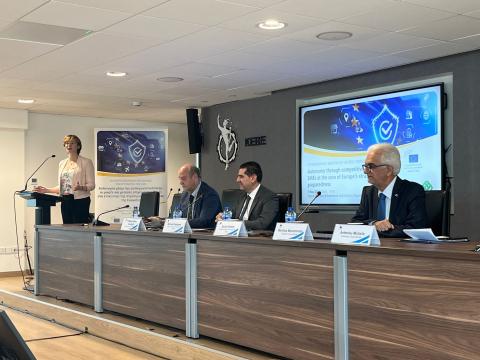
In the framework of the Cyprus Presidency of the Council of the EU 2026, the EESC Employers' Group held a conference on "Autonomy through competitiveness: SMEs at the core of Europe’s strategic preparedness" in Nicosia on 7 May 2026.
The conference discussed how SMEs can be the key to Europe’s strategic preparedness with Michael Damianos, Minister of Energy, Commerce & Industry of Cyprus; Professor Nikos Varsakelis from Aristotelian University of Thessaloniki; Demetris Georgiades, Chairman of the Cyprus Economy and Competitiveness Council; Michalis Persianis, President of the Fiscal Council of Cyprus; and Maria Heracleous, Former Representative of IMF in Cyprus, Former Board Member of Central Bank of Cyprus.
The discussion examined how the EU’s evolving focus on strategic autonomy and preparedness is reshaping the meaning of EU competitiveness, positioning it as a prerequisite for resilience, security, and sustainable growth. Embedding preparedness into competitiveness policy requires enhancing SMEs’ capacity not only to withstand shocks but to adjust and reposition quickly.
SMEs play a central role both as key drivers of employment, innovation, and value creation, and as actors exposed to structural constraints such as regulatory complexity, energy costs, financing gaps, and skills shortages. Ensuring that they can invest & grow is essential to translate strategic autonomy into economic reality.
In this context, the Industrial Accelerator Act can help restore competitiveness and increase productivity but, as EESC Employers' Group President Sandra Parthie underlined, we need to make sure it does not turn into an administrative act for industry, but that it remains a true industrial accelerator.
At the same time, we are approaching a critical moment on public debt. The debate should not focus only on how much governments spend, but on what they spend on. We should incentivise, if not fully exempt, investments that strengthen economic resilience, such as innovation, infrastructure and skills.
Europe also faces a talent and ambition gap. Too few students pursue STEM, and too many of our brightest minds leave. Encouraging entrepreneurship must become as attractive as traditional employment, especially if we want to retain and grow innovation capacity.
Access to finance remains a core bottleneck. European venture capital lags far behind the US, pushing startups to relocate where funding is available. If we want growth, we need to rethink incentives, including how taxation affects return on investment. A single, unified capital market, with accessible retail entry points, could help redirect savings into European businesses.
Finally, competitiveness and resilience are now inseparable. Energy, water, and broader emergency preparedness are no longer side issues, they are economic fundamentals. And with rising defence spending, sustaining Europe’s welfare model will depend on one thing: growth. Unlocking SME potential is not one reform: it’s a systemic shift.
Work organisation
Recommended for you
Autonomy through competitiveness: SMEs at the core of Europe’s strategic preparedness
Event
The EU has entered a phase in which strategic autonomy and preparedness have become central organising principles of economic policymaking. Recent shocks, including geopolitical tensions, energy…
Circular economy at the heart of Europe’s strategic autonomy
News
Accelerating the transition to a circular economy is not only about making Europe cleaner and more competitive, but also about achieving strategic autonomy. The European Circular Economy Stakeholders…
Circular skills: the workforce test for Europe's strategic autonomy
News
The circular economy has moved from environmental ambition to industrial strategy. As the Circular Economy Act takes shape, one of the questions that will decide whether it delivers is who will do…
Europe’s competitiveness depends on strategic foresight
News
The European Economic and Social Committee (EESC) hosted a debate today to explore how Europe can maintain its industrial edge. Policymakers, industry leaders and civil society discussed the…
Industrial policy: sustainability must go hand in hand with competitiveness and strategic autonomy
News
The EU needs to reassess the priorities of its industrial policy in light of the pandemic and the conflict on Europe's eastern border: this is what emerged from a conference hosted by the European…