
European Economic
and Social Committee
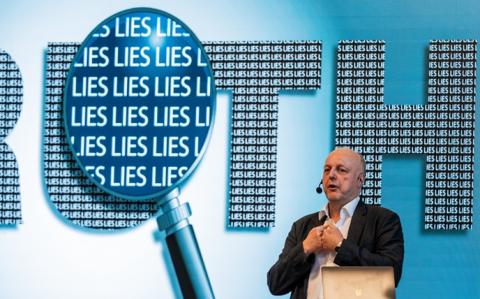
As fabricated images and videos become easier to create, the greatest threat may not be that people believe every falsehood, but that they stop believing anything at all. At the Connecting EU seminar, Deutsche Welle’s Jochen Spangenberg argued that journalism’s strongest defence lies in fact-checking and verification, transparency and practices as old as the profession itself.
A photograph appears to show a scene from Gaza. It looks authentic because it is authentic – but it was taken in Syria in 2016. The image itself has not been manipulated; its context has. For Jochen Spangenberg, Deputy Head of Research & Cooperation Projects at Deutsche Welle, that distinction captures one of today’s most persistent information problems.
‘We’re seeing footage, images in this case, that are taken out of context, that are taken from somewhere else, pretending something that they are not,’ he told participants at the Connecting EU seminar in Sofia. Such deception, he stressed, remains more common than fully AI-generated content.
Yet generative AI is rapidly changing the scale and sophistication of the challenge. Images, video, audio and text can now be produced cheaply and convincingly by almost anyone. This complicates the use of material posted by eyewitnesses and other people on the ground – content that can be indispensable when professional journalists cannot reach a location.
‘There is a huge value in so-called user-generated content,’ Mr Spangenberg said. ‘But we are having the downside … that technology is getting more and more sophisticated, and anybody these days, without hardly any cost on the consumer side, can produce fairly sophisticated digital material that is completely made-up.’
The consequences reach far beyond whether a single image is true or false. News fatigue, news avoidance and declining trust create fertile ground for those seeking not simply to persuade, but to exhaust. Mr Spangenberg invoked Hannah Arendt’s warning from an interview broadcast in 1974: ‘If everybody always lies to you, the consequence is not that you believe the lies, but rather that nobody believes anything any longer.’
The aim of some disinformation actors is precisely to create that sense of overload and helplessness. In an information space saturated with conflicting claims, doubt itself becomes a weapon.
But resignation is not an answer. Journalists, communicators and citizens each have a part to play in bringing facts to their audiences and resisting the idea that truth is unknowable.
For all the novelty of artificial intelligence, the first line of defence is strikingly traditional: ask who, where, why, when and what. If those questions can be answered, then you’re on the right track, regardless of whether the content is AI-generated or not.
Verification may begin with footage, maps, satellite images or specialised software, but it can also begin with a phone call. ‘Just picking up the phone, ideally, and talking to somebody on the ground is another very useful way of investigating something,’ Mr Spangenberg said.
The crucial next step is to show the audience the evidence. ‘Make transparent to your audiences how you work and what conclusions you reach on what basis, because then they can re-check. They can challenge you if you make mistakes,’ he said. Acknowledging errors and explaining them is better than quietly removing problematic material. Transparency protects credibility precisely because it does not pretend that newsrooms are infallible.
Deutsche Welle’s team at the Research and Cooperation Projects unit has worked on free resources that train users to look and listen more closely (e.g., Sharpen Your Senses), guide them through the basic verification questions and provide access to tools for examining text, images, audio and videos (e.g., How to Verify). The InVID-WeVerify-vera.ai verification plug-in, in turn, developed in collaboration with European partners in several EC co-funded projects, now counts more than 160 000 active users (freely accessible for all in the Chrome store as a browser plug-in).
Still, tools are aids, not arbiters. When Deutsche Welle fact-checkers tested the same AI-generated image with different detection services, the results ranged from strong evidence of manipulation to claims that it was probably real. ‘Technology does not solve all your problems,’ Mr Spangenberg said. ‘It can be supportive, it can be useful, but we are not at a stage where we can fully rely on AI tools or tools that detect manipulations.’
Detection systems also tend to lag behind creation tools: whenever a new generative model appears, detection models must be retrained. Access raises further questions. Who can use the best tools? Are they free, or reserved for those able to pay? And can researchers investigate the major platforms with meaningful access to their data? Although the EU’s Digital Services Act includes provisions on platform data access, the reality still falls short overall.
Keeping pace requires more than buying software. News organisations need strategies that define how AI may be used, what is off limits and how experimentation fits with editorial standards. Above all, they must give staff the time, resources and training to adapt.
There is a human cost too. Fact-checkers and journalists may spend their days examining disturbing material from wars, attacks and abuse. This work requires preparation and coping strategies just as field reporting does. ‘What you don’t want is to suffer from PTSD, post-traumatic stress disorder, or any other mental illnesses, because you’re … exposed to really horrific, awful material,’ Mr Spangenberg said.
The contest is also moving into chatbots and large language models. Disinformation actors can flood the systems’ underlying information environment with a particular bias or worldview, influencing the answers users receive. ‘That is a new form of propaganda,’ Mr Spangenberg said. Compared with traditional propaganda, it is remarkably cheap. ‘It’s all about controlling the knowledge space.’
This makes regulation and enforcement unavoidable questions. Europe has rules, but their force depends on whether authorities are willing to apply them to powerful platforms and providers. Free speech matters, he said, but ‘there are, that’s my personal view, certain limits’.
Can trust be restored in such an environment? Mr Spangenberg offered no simple formula. His answer was instead a call for persistence: verify carefully, explain the evidence, support the people doing the work and refuse to surrender the information space. And don’t give up.
He closed with another line from Hannah Arendt: ‘Freedom of opinion is a farce unless factual information is guaranteed and the facts themselves are not in dispute’. His own conclusion was more direct: ‘Facts are facts, and they are not a matter of opinion.’
Jochen Spangenberg is a media and communication expert working as Deputy Head of Research and Cooperation Projects at Deutsche Welle.