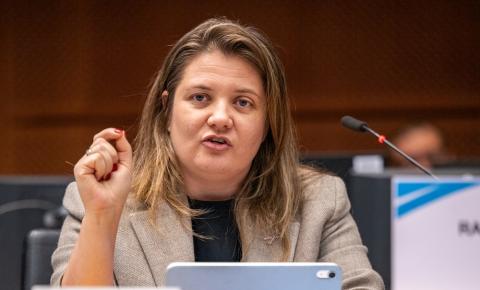
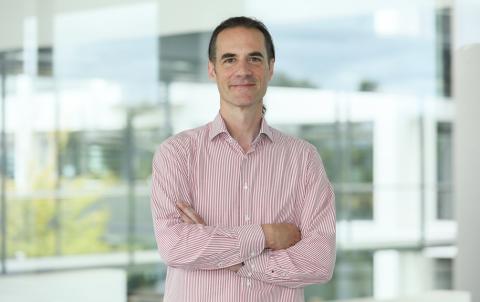
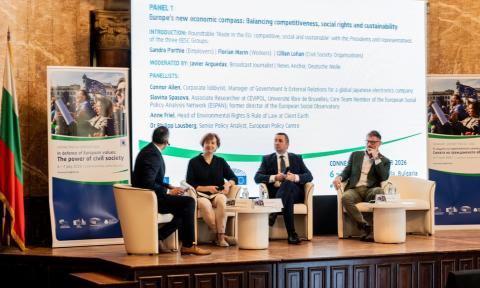
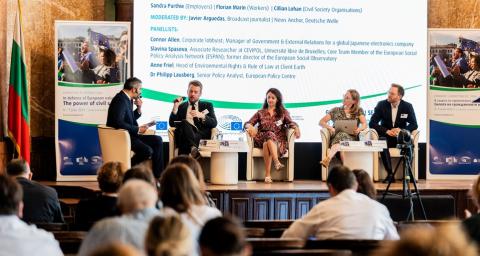
Connecting EU 2026 included a panel on Europe’s new economic compass: Balancing competitiveness, social rights and sustainability. Our panellists Connor Allen, Slavina Spasova, Anne Friel and Dr Philipp Lausberg discussed how the EU can better align its economic and social objectives in a global context that is evolving at an unprecedented pace. Here are the highlights from the panel that was moderated by Deutsche Welle journalist and anchor Javier Arguedas.
Competitiveness has become one of the defining themes of the EU’s current policy agenda. From your perspective, what do the data tell us about the state of European industry today, and why do you think competitiveness has become such a priority?
Connor Allen, corporate lobbyist: You cannot build a house without a foundation, and you cannot build social protections without prosperity. Without a competitive Europe, there is no social Europe. It does not exist.
We are in a crisis and we need to be raising the alarm.
The share of the world market that Europe occupies has fallen from 25% in 1992 to 13% today. We are a smaller and less important market, relatively. The average European has gone from having 80% of the purchasing-power-adjusted output of the average American in 1992 to about 68% today. So we’re also a poorer market, relatively. And Europe is constantly outpaced by its competitors in the United States and China across every metric that deals with innovation. We have 110 unicorns compared to the USA’s 680. Our R&D spending is a fraction of Chinese and US spending. One million jobs disappeared between 2019 and 2023. And the European Commission itself says that 27 000 jobs per month are now being lost. Many factories are closing, while those that remain open are not working at full capacity across every sector. Take the automotive sector: this accounts for 10% of Europe’s economic output and the average factory is operating at 33% capacity. You’ve asked me what the data tell us about the state of European industry. It’s very clear that those numbers, quite frankly, are apocalyptic. And that is why competitiveness has risen so high on the agenda. That’s why it is receiving all the political attention.
What, in your view, are the main obstacles preventing European industry from competing on the same level as its global competitors? And what kinds of policy changes would you advocate for?
Connor Allen, corporate lobbyist: The lowest-hanging fruit is deregulation, deregulation, deregulation. But there is not just one obstacle. There are the three main evils that are affecting our industry: over-regulation, over-taxation and high energy costs. And one that started to emerge as a fourth evil in the last year or so is geopolitical risk, which we are all very aware of. Ultimately, we have historically high energy costs, labour costs and taxes. That’s not a great combination.
By deregulation, I don’t mean a race to the bottom. I mean fewer duplicative reporting obligations, fewer overlapping audits, fewer rules that measure process rather than output and fewer situations where compliance becomes an industry in itself. Each company in Europe has to comply with hundreds of pieces of legislation at the EU level alone, not to mention the regulation at national level. Most of that regulation has been passed in the last 10 years and that is why the Japanese call it a regulatory tsunami.
For example, the combined cost of complying with the Corporate Sustainability Reporting Directive, the Working Time Directive and the Pay Transparency Directive totals around EUR 1.5 million in upfront costs, with annual costs of a further EUR 1 million. How many workers can you employ? How many machines can you buy? How much innovation can you fund with that money? Quite a lot, actually. It is not sustainable by any metric.
State of Play 2025, a report published by the European Trade Union Institute, argues that competitiveness has become too narrow a lens for thinking about economic success. If that is the case, what indicators should policymakers be looking at instead?
Slavina Spasova, ULB, Core Team Member of the European Social Policy Analysis Network (ESPAN): The macroeconomy and people’s lived experiences sometimes move in opposite directions. Macroeconomic indicators are improving: employment is up and GDP is recovering, but real wages in several Member States remain below pre-pandemic levels, child poverty is even rising in some countries and housing is increasingly out of reach, especially for younger generations.
There are four indicators we should be looking at.
The first is job quality. We need to look not only at employment rates, as high employment figures can mask very precarious situations, such as precarious contracts, unpredictable working hours, psychosocial risks or young people not in education, employment or training. And we also need to look even more at indicators such as real wage growth, in-work poverty and the gender pay gap, as well as at the gender pension gap and bargaining coverage.
The second very important area is social investment across the life course. What is really reassuring is that this paradigm remains central to the EU. It is visible in the Union of Skills, in the anti-poverty strategy, the housing plan and, more generally, through the life-course approach of the European Pillar of Social Rights. It is also visible now in EU governance, especially through the newly established social convergence procedure. However, once again, there is a risk that the social investment approach has been narrowed down solely to skills and labour supply.
Third, we should be looking into the three main transitions happening now at the EU level – the green, digital and demographic transitions – in an integrated way. And fourth, let us not forget gender policy, as all these transitions have been largely gender-blind.
It is very important to have the overall narrative right, meaning that the European Pillar of Social Rights should remain the main narrative. Let us see what happens with its revised action plan.
What concerns you most about the EU simplification agenda?
Slavina Spasova, ULB, Core Team Member of the European Social Policy Analysis Network (ESPAN): Nobody, including the trade unions, is arguing against clearer, simpler and more workable rules. Simplification is legitimate and can even support social and environmental goals. But when simplifying, it is very important to first conduct proper impact assessments and then involve all stakeholders, including trade unions and civil society.
ClientEarth has been highly critical of the Commission’s recent simplification agenda. What are your organisation’s main concerns?
Anne Friel, Head of Environmental Rights & Rule of Law at ClientEarth: We have two concerns: how these changes are being made, but also what the changes mean in practice and what is at stake.
Over the last two years, we have seen about 10 omnibus legislative proposals being fast-tracked under the banner of simplification, competitiveness and urgency. And the Commission has completely departed from its own better regulation rules, which require robust impact assessments and public consultation. And these are not just nice-to-haves: they really guarantee that EU legislation is based on solid evidence of the long-term impacts on people, businesses, human rights and climate goals, and that they are informed by the lived experience and the opinions of Europeans. But not one of the last 10 omnibus proposals has followed these rules.
Climate consistency checks and impact assessments were omitted, public consultations bypassed and a lot of the key decisions made by the Commission in putting together these legislative proposals were really influenced by certain business interests and excluded civil society voices.
The Corporate Sustainability Due Diligence Directive (CSDDD) was gutted through the first omnibus proposal. The CSDDD was a landmark Green Deal law. It required large companies to identify, prevent and address human rights abuses and environmental harms throughout their value chains. It also required companies to adopt and implement climate transition plans.
The first omnibus radically reduced the pool of companies that this applies to and it completely eliminated climate transition plans. And the justification for that in the Commission’s proposal was that this was administration and red tape. This is a core obligation and a core component of the Green Deal. What does this mean for Europe? If companies are no longer required to account for the environmental and human rights harms linked to their supply chains, then the risks are actually borne by others: by workers who are facing exploitation, by the communities who are affected by pollution and deforestation and then, ultimately, by all of us and our children and our children’s children, who are all facing the impacts of climate change. If we really need to change legislation, let us do it in the European way, based on democracy and supported by robust evidence and inclusive participation.
What would you propose in order to make European companies more competitive in the global economy without compromising the environmental protections that the EU has put in place?
Anne Friel, Head of Environmental Rights & Rule of Law at ClientEarth: Slashing environmental and social safeguards is not the answer. Democracy, transparency and evidence-based policymaking are not barriers to competitiveness. They are what make European regulation credible and durable. We should really be thinking about energy resilience, food resilience and how we can sustain our way of producing into the future. And this definitely cannot be done without regulation.
A healthy environment and a safe climate are the bedrock for business and for doing business well in the future. While the costs of keeping global warming below two degrees and avoiding ecosystem collapse seem extremely high now, if we don’t do so, the costs of inaction will be much, much greater.
How do you assess the state of Europe’s economy and its prospects in this very competitive environment?
Dr Philipp Lausberg, Senior Policy Analyst at the European Policy Centre: Europe remains the world’s second-largest economic bloc. It is the largest trading power. It has a highly skilled workforce, strong manufacturing capabilities, excellent research, and global leadership in many green and industrial technologies. It has a strong rule of law, predictability and a strong social model. And these are assets in an increasingly unstable, unpredictable world. But the world has changed fundamentally. And Europe’s growth model rests basically on assumptions that no longer hold, such as cheap energy from Russia, open export markets based on free global trade and a rules-based international order guaranteed by a US security umbrella. All of that is basically gone. We are now facing geopolitical fragmentation and wars and the weaponisation of economic relations.
If it does not adapt its economic model to these new realities, Europe really risks a slow agony. It can only do that if it can leverage its size. This means it needs to integrate its single market better, it needs to invest more and it needs to build strong infrastructure while also investing in skills and reducing energy prices.
One of the reasons why the USA is ahead in productivity, which is the main measurement that Draghi uses to explain the difference in competitiveness, is that the USA has large tech companies. And that is something they have because of their size and their large market but also because of their large investment power. We also see our single market as a great asset, but it is too fragmented. Strategic sectors, energy, digital, defence, services, capital markets, professions: none of them are completely integrated. We are facing single market barriers that the IMF estimated at 44% between EU countries for goods and more than 100% for services. That makes it harder for businesses to scale across the EU, which would enable them to compete with the USA and China. And the single market could also increase demand in the EU and make us less dependent on export markets like China.
In addition, we need to make large-scale public investment in industrial policy that is coordinated, long-term and well targeted, as China does, for example, and increasingly the United States. Finally, we need to have a stronger trade defence.
Is simplification the right diagnosis and also the right remedy?
Dr Philipp Lausberg, Senior Policy Analyst at the European Policy Centre: Simplification is only part of the answer. It is an important obstacle to competitiveness. The European Commission has said that the costs of complying with administrative and regulatory requirements amount to over EUR 100 billion annually. That is equivalent to around 0.9% of European GDP. That is significant but it is not going to do the trick alone. There is a Bloomberg study that said that Germany’s current economic problems are attributable to Chinese overcapacity (40%), energy prices (40%) and the regulatory burden (only 20%). So, while it is important, we shouldn’t overstate its importance compared to the other factors that I mentioned.
What is even more important is more investment in innovation, in key technologies, in industry and in infrastructure. This should be combined with public procurement, alongside made-in-Europe provisions and a robust trade policy.
You can watch the short interviews and the recording of the full panel on our web page. More information about the panellists can be found here.