
European Economic
and Social Committee
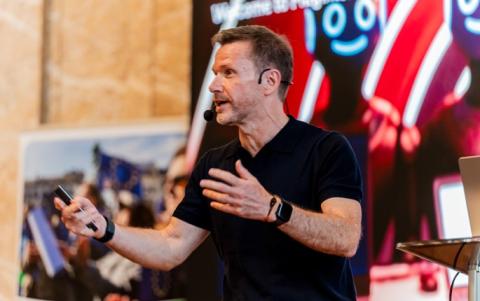
David Grunewald, AI strategist and trainer, delivered a session entitled ‘From Chatbot to AI Agent: how AI is transforming the way we communicate’ at Connecting EU. He explored the rapid development of AI reasoning models and AI agents, which are set to profoundly change how we organise our work. While these tools can make us more efficient, our choice of technology carries wider consequences. Relying on American AI models raises questions not only about data sovereignty and the future of work, but also about the future of Europe’s economic model. Below are extracts from his presentation, in which he outlined the risks Europe faces if it continues to rely on American AI models.
Choosing European might be a good approach because data sovereignty is not secured when working with American software solutions, even if they claim that their servers are located on European territory for GDPR compliance. The CLOUD (Clarifying Lawful Overseas Use of Data) Act now enables the US government and the FBI to search for or obtain information passing through the servers of any US company, even if those servers are outside US territory. That is a big change.
We have developed the AI Act, which is great: we have created a kind of vault that protects citizens. But with the CLOUD Act, the Americans have the key to enter that vault and obtain the data. They can compel disclosure even if the servers are on European territory. They can also impose a gag or secrecy order, so the company is prohibited from informing its clients that a request was made to obtain information from its servers. That is even worse. Currently, this is a no man’s land: there is no agreement to arbitrate this kind of conflict. In delicate situations involving ministries of defence or national guards, for example, a migration is already taking place in a number of European administrations. They are moving from Microsoft operating systems to Linux, leaving behind PowerPoint and Word and choosing European open-source solutions. I expect this trend to grow in the coming years.
Shouldn’t we consider Mistral as the only player and AI system that the European Commission and everyone working here should choose? Mistral also has an AI co-worker and an AI operating system. Everything I have shown today could be developed with Mistral.
The choice between American and European AI models affects not only data sovereignty but also the macroeconomy. In the future, most companies will invest 10-15% of their salary expenditure in tokens – that is, the computing units used and charged for by AI systems. At European level, this could mean EUR 1 trillion leaving Europe rather than being reinvested in the European workforce. Instead, it would be invested in American AI solutions. This could undermine our economy because, rather than reinvesting that money here, we would replace some people with tokens – that is, with AI systems performing their work. That is another challenge. It is not just about data security; it is even worse. We should be aware of this and talk about it.
But the media are silent on this. I do not see much discussion about it, so for me it is a real threat. My final point is that the debate – or the battle – will not be about who has the best AI. It will be about electricity, because these AI players are effectively transforming electricity into tokens. What will electricity cost in Europe? EDF, the French energy company, and other electricity suppliers are currently making 10-year deals with the big players – the giant hyperscalers that have enormous servers in Europe and the United States – to secure sufficient electricity. If we accelerate the development of more Mistral-like AI systems and larger servers in Europe, how are we going to power them if we have already committed our electricity to US-based AI? That is the challenge.
David Grunewald is the founder of Pluginto.ai and a recognised AI expert with over 28 years of experience in digital strategy and business leadership. Certified by the Massachusetts Institute of Technology (MIT) Sloan School of Management in Artificial Intelligence: Implications for Business Strategy (2023), he specialises in AI transformation through training, strategic consultancy and organisational audits, with a focus on prompt engineering, AI agent creation and automated workflows.
You can watch the whole session ’From Chatbot to AI Agent: how AI is transforming the way we communicate’ here.