
European Economic
and Social Committee
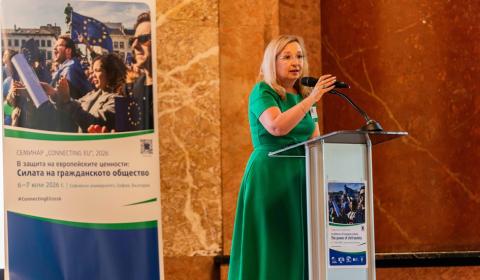
The Economic and Social Council of Bulgaria was a co-host and co-organiser of the EESC’s Connecting EU seminar, held in Sofia this July. One of the topics in the spotlight was the threat that disinformation poses to democracy. In her article for EESC Info, Zornitsa Rousinova, President of the Bulgarian Economic and Social Council, and EESC member, draws on Bulgaria’s euro-area debate to explain how organised civil society, reliable information and media literacy can help counter manipulation and protect public trust.
It was a great honour for the Economic and Social Council of Bulgaria to co-host this year’s edition of Connecting EU 2026 together with the European Economic and Social Committee. Hosting the event in Sofia was a recognition of the active role of organised civil society and of the importance of cooperation between European and national institutions in safeguarding our shared democratic values.
For my generation, democracy and peace seemed unshakeable in Europe. Yet today, we see wars around us and hear voices challenging democratic values. As representatives of organised civil society, our role is therefore to support and advocate for government economic and social policies that uphold those values.
Today, disinformation is among the most serious challenges facing European societies. It is no longer an abstract concept, but a phenomenon that we increasingly encounter across Europe. It has a growing impact on public opinion and on citizens’ perceptions of key issues, deepens social divisions and undermines trust in institutions. In today’s digital environment, false or misleading information often spreads faster than verified facts, making it increasingly difficult for citizens to distinguish truth from manipulation. This is why we need reliable sources of information and institutions that consistently uphold facts, evidence and truth.
Organised civil society plays a vital role in this process. The Economic and Social Council of Bulgaria demonstrates how dialogue between employers, trade unions and civil society organisations can lead to balanced positions based on expertise, scientific evidence and European experience. Such cooperation is not only a contribution to public debate; it is an investment in public trust. Trust remains our strongest defence against disinformation.
This approach was particularly important during the public debate on Bulgaria’s accession to the euro area. At a time when the discussion was accompanied by misconceptions, speculation and conflicting claims, the Council provided citizens with reliable, evidence-based information. Our aim was not to engage in political controversy, but to help people make informed decisions based on facts rather than fear or misinformation.
At the same time, education and critical thinking are essential tools in building resilient societies. Citizens who can evaluate information, identify trustworthy sources and recognise manipulation are better prepared to resist disinformation. Media literacy is no longer an optional skill; it is a fundamental requirement for modern democracies.
People in Bulgaria and across Europe are primarily concerned about issues that directly affect their lives: rising living costs, climate change, security and the consequences of war. They expect practical solutions and clear answers. Therefore, institutions, media, experts and civil society organisations must work together to ensure that reliable information reaches citizens in an accessible, timely and evidence-based way.
I firmly believe that dialogue, transparency and trust across society are the foundations of an effective response to disinformation. Through cooperation based on expertise, facts and shared responsibility, we can protect European values, strengthen public confidence and ensure that Europe remains close to its citizens. Reliable information is not simply a means of communication — it is a cornerstone of democracy and a prerequisite for informed decisions in the public interest.
Zornitsa Rousinova is President of the Economic and Social Council of the Republic of Bulgaria. Between 2012 and 2020, she served in three governments as Deputy Minister for Labour and Social Policy, and from 2016 to 2017 as Minister for Labour and Social Policy. She was responsible for labour market policies, social inclusion, labour law, European affairs and international cooperation, and for managing European funds. She has been a member of the EESC Civil Society Organisations’ Group since September 2025.