
European Economic
and Social Committee
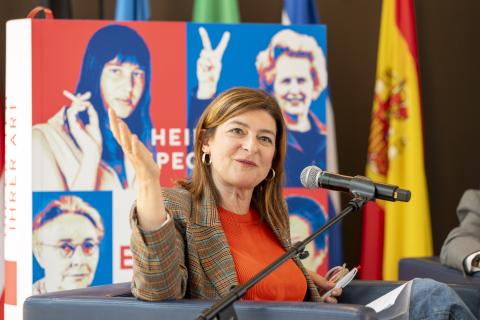
By Heike Specht
History loves its 'firsts' but breaking barriers means standing alone. Every woman in power knows this, and lately it's been getting even harder.
Kamala Harris has spoken again and again about walking into rooms where no one looked like her. That is the essence of being 'the first'. Yes, it's a triumph – a crack in the glass ceiling – but it is also an exhausting act of endurance. Every man who came before her in the White House had dozens of look-alikes in the history books. Harris did not. In the list of her predecessors, we find five Johns, three Thomases and three Charleses, but not one woman.
To be the first is to be conspicuous. To have no blueprint. To blaze a trail while constantly explaining yourself and defending your right to even be there.
Men in suits are rarely asked why they want power. 19th-century historian and unabashed misogynist Heinrich von Treitschke declared that 'authority is male. That goes without saying,' and this way of thinking lingers. As historian Mary Beard notes, the default image of power remains male. As Pierre Bourdieu put it, male dominance endures precisely because it never has to explain itself.
For women, the price of entry is steeper. Along with the grit and talent needed for any extraordinary career, 'firsts' endure relentless scrutiny of their very presence. The bar is higher, the patience thinner, the margin for error smaller. Faith Whittlesey's old line still rings true: 'Ginger Rogers did everything Fred Astaire did, but she did it backwards and in high heels.'
For decades, women's politics was patronised, treated as a niche of 'soft issues'. However, it was women such as Elisabeth Selbert, Käte Strobel and Simone Veil who planted the seeds of modern democracy: gender equality, public health, inclusive marriage laws and bodily autonomy. Far from marginal, these policies shaped the societies we live in. Still, even in the 1990s, German Chancellor Gerhard Schröder could wave off the Ministry for Family Affairs as 'all that fuss' ('Gedöns').
The common argument against gender quotas is that 'lawmakers represent everyone'. But women are not a 'special interest', they are half the population. And history shows that when women hold office, there are advances in women's rights – maternity protections, gender equality clauses, legalised abortion, criminalisation of marital rape. The record is clear.
Christine Lagarde once quipped: 'If it had been the Lehman Sisters, not the Lehman Brothers, the world might look different today.' She wasn't arguing that women are better, but that diversity is. Different voices disrupt groupthink. Excluded from male networks, women built new strategies – and with them, new possibilities.
That's why 'firsts' still matter. We still have not seen a female German Bundespräsidentin, no female US president, no female French president.
And right now, it feels as though women's way of doing politics is being shoved aside by a return to broad-shouldered bravado – embodied, not least, by the new occupant of the White House. In the fall of 2024, Kamala Harris – America's first female vice-president – ran against Donald Trump to become its first female president. She lost.
The question now is not just what comes next, but who. Harris's mother put it best: 'Kamala, you may be the first to do many things, make sure you're not the last.'