
European Economic
and Social Committee
The European Economic and Social Committee (EESC) calls for a renewed partnership between the European Union and southern Mediterranean countries – one that places people, sustainability and shared responsibility at its core.
The opinion The role of the private sector and civil society in strengthening economic cooperation within the Pact for the Mediterranean, adopted at the EESC’s April plenary, outlines how organised civil society and the private sector can strengthen economic cooperation under the EU’s Pact for the Mediterranean. The proposed pact represents a strategic opportunity to reshape relations between the European Union and its southern neighbours.
At the heart of the EESC’s recommendations lies a clear message: economic cooperation must deliver for people, not just markets. Ongoing wars and instability are causing severe human suffering and damaging economies, hindering the pact’s progress. The EESC calls on the EU to support a just peace under the UN and to uphold international law. At the same time, it calls for respect for human rights, stressing the EU’s key role in promoting dialogue and peace.
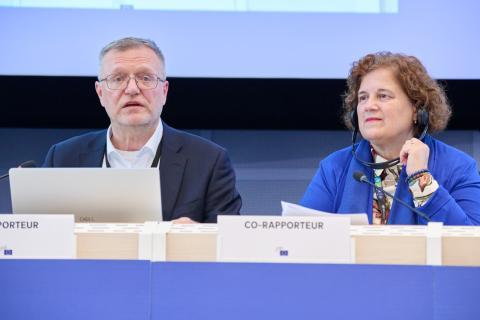
EESC member Thomas Wagnsonner, rapporteur for the opinion, emphasised: ‘The Pact for the Mediterranean will be successful only if peace and stability are guaranteed. Strengthening civil society involvement and supporting micro-, small and medium-sized enterprises, social entrepreneurs and cooperatives are crucial for the process. Innovation and social fairness need to go hand in hand’.
The structured and permanent involvement of organised civil society is central to this vision. Trade unions, employers’ organisations and civil society organisations should not be limited to occasional consultations, but formally integrated into governance, implementation and monitoring processes.
Nonetheless, environmental protection and sustainable practices must be integrated into economic development, ensuring that growth respects natural resources and contributes to long-term resilience in the region.
EESC member and co-rapporteur, Lidija Pavić-Rogošić, also underlined the importance of empowering young people and women by increasing their participation in governance structures and entrepreneurship programmes. ‘Social and solidarity economy actors, including cooperatives, are powerful engines of inclusive development. Often led by young people and women, these organisations contribute to job creation, social cohesion and local resilience. The EESC calls for dedicated funding and supportive legal frameworks to strengthen their role across the region,’ she said. (at)