Newsletter Info

EESC info

European Economic and Social Committee A bridge between Europe and organised civil society

JUNE 2026 | EN

GENERATE NEWSLETTER PDF

Available Languages:

  • EN

For other languages, please click on the title of each article. Translation is provided by the European Commission's eTranslation service.

Editorial

EDITORIAL

Dear readers,

There's a line from my favourite Irish poet Patrick Kavanagh which I find myself returning to: 'No one loves you for what you have done, but for what you might do.' At this moment, it certainly rings true for the current phase of the EU's next long-term budget, the Multiannual Financial Framework.

Read more in all languages

Dear readers,

There's a line from my favourite Irish poet Patrick Kavanagh which I find myself returning to: 'No one loves you for what you have done, but for what you might do.'

At this moment, it certainly rings true for the current phase of the EU's next long-term budget, the Multiannual Financial Framework. There's a real desire and expectation that this MFF meets the moment with real ambition – and the money required to tackle our priorities in our increasingly destabilised world, from competitiveness to security, the green transition to social cohesion and inequality.   

This is not just a negotiation over figures, but a negotiation over the future direction of our Union and our shared capacity to act. I'm proud that our numerous Opinions on various aspects of the MFF have brought the voices and expertise of citizens, workers and employers across Member States into EU policymaking on this issue. Finding compromise across our three groups on such a seismic topic is not easy. But this is the strength of the EESC and why we play such an indispensable role in Brussels. 

In addition to ambition and the protection of key budgets like CAP and cohesion, the MFF must include civil society and regional actors in its design and execution. This is a precondition for success.   

These are messages I conveyed in highly productive meetings last month with European Commission President Ursula Von der Leyen and Agriculture and Food Commissioner Christophe Hansen. It was encouraging to hear the Commission President's endorsement of our work in this space, as well as the Civil Society Strategy and Platform and on affordable housing. 

Housing and stewarding the MFF process are two major areas of focus for the upcoming Irish Presidency of the Council of the EU, which kicks off on 1 July. The Taoiseach (Prime Minister) Micheál Martin launched the priorities of their EU Presidency – competitiveness, security and values – on 10 June in Dublin. 

I'm heartened that civil society engagement is not only an integral element to the values priority but is a thread throughout their whole Presidency programme. This was powerfully articulated by the Taoiseach and Minister of State for European Affairs Thomas Byrne earlier that day in Dublin Castle at our Extraordinary Bureau. 

The EESC has been requested by the Irish government to work on eight Exploratory Opinions on several joint priorities, including housing, competitiveness, digital regulation, tackling poverty, and the EU's approach to livestock, to ensure that the voices and expertise of civil society, employers and workers are heard in EU policy making during their Presidency. 

On a personal level, as the first Irish EESC President during Ireland's EU Council Presidency, I'm looking forward to this work and to representing the EESC at high-level events and informal council meetings on topics including social rights, farming and consumer policy in the months ahead. The aim is to build on our strong collaboration with the Cypriot EU Presidency who've been working with on topics including water resilience, poverty eradication, sustainable farming, and humane migration. 

This will begin on 5-6 July in Ballina, County Mayo, at the Informal Meeting of Employment and Social Policy Ministers where I will join discussions on tackling poverty, worker protections and addressing disability employment gap. 

As I outlined in a recent bilateral with Executive Vice President and Commissioner for Social Rights Roxana Mînzatu, now we have an EU Anti-Poverty Strategy, we must keep up the momentum in this space. The EESC will have a concrete role in its implementation, through the cooperation agreement to be signed with the Commission. 

Tackling poverty is not a nice to have. And it's not clashing with the drive to improve competitiveness. The two must go hand in hand – in the present, and in the next EU long-term budget.  

Séamus BOLAND

President of the European Economic and Social Committee

Diary Dates

24 June

The role of volunteering for European Population Preparedness

30 June

Annual European Semester Group Conference 2026

6 July

The Path to the Digital Euro – Shaping Policy Choices for Successful Implementation

6-7 July

Connecting EU - In defence of European values: The power of civil society

8 July

Ending Forced Sterilisation: Advancing the Rights of Women with Disabilities

9 July

Info session on the UN Convention on Biological Diversity process

15-16 July

EESC plenary session

TO THE POINT

A circular economy is not just about recycling more. It is about using fewer resources, cutting dependence and making the transition work for people and businesses, writes Cillian Lohan, president of the EESC’s Civil Society Organisations’ Group and rapporteur for the opinion Circular Economy Act - Circular economy and responsible resource consumption within planetary boundaries.

Read more in all languages

A circular economy is not just about recycling more. It is about using fewer resources, cutting dependence and making the transition work for people and businesses, writes Cillian Lohan, president of the EESC’s Civil Society Organisations’ Group and rapporteur for the opinion Circular Economy Act - Circular economy and responsible resource consumption within planetary boundaries

EUROPE’S PATH TOWARDS A GENUINE CIRCULAR ECONOMY FOR THE BENEFIT OF ALL

By Cillian Lohan

One of Europe's biggest challenges today is tackling the 'triple planetary crisis' – climate change, pollution and biodiversity loss – which is largely driven by increased resource consumption. Despite years of policy effort, the European Union remains off track to meet its circularity targets.

Read more in all languages

By Cillian Lohan

One of Europe's biggest challenges today is tackling the 'triple planetary crisis' – climate change, pollution and biodiversity loss – which is largely driven by increased resource consumption. Despite years of policy effort, the European Union remains off track to meet its circularity targets.

The forthcoming Circular Economy Act offers a unique opportunity to change direction. It must go beyond fine‑tuning and implementing existing rules and instead set a clear course towards an economy that respects planetary boundaries while strengthening Europe’s resilience and competitiveness. Circularity should no longer be viewed as solely environmental policy, but must be considered as economic and geopolitical strategy.

A necessary shift: reducing demand, not just waste

For too long, policy has focused on efficiency: recycling more and producing better. These efforts are necessary, but they are no longer sufficient. If overall consumption continues to increase, efficiency gains will simply be outweighed.

The EESC therefore calls for a fundamental shift: reducing resource use must become a central objective. This means complementing recycling with strong demand‑side measures that directly address overconsumption.

In other words, Europe must move from 'using resources better' to 'using fewer resources'.

Setting clear limits

This transition requires clear direction. The Committee recommends introducing material footprint targets aligned with planetary boundaries, providing a framework similar to climate targets. 

Such targets would offer predictability for businesses, guide investment and ensure accountability — anchoring Europe’s economy within ecological limits.

Making circularity economically viable

Circular solutions will only scale if markets support them. Today, recycled materials often struggle to compete due to price gaps, fragmented regulation and quality concerns.

The Circular Economy Act must create a genuine single market for secondary raw materials. Removing barriers and establishing clear standards will allow circular business models to thrive and deliver both environmental and economic value.

Putting people at the heart of circularity

This transition must work for everyone. Workers, consumers and SMEs will experience the shift differently, and their concerns must be addressed from the outset. This is why the EESC positions civil society as a key actor in designing and implementing circular solutions on the ground.

A circular economy is not just about materials; it is about people. It must create opportunities, support adaptation and ensure that no group is left behind.

A strategic choice for Europe

Ultimately, the Circular Economy Act is about more than sustainability. It is about Europe’s ability to reduce dependence on imported resources, strengthen its competitiveness and build resilience in an uncertain world.

The EESC’s message is clear: the transition must be systemic, ambitious and fair. With the right choices now, Europe can lead the way towards an economy that thrives within planetary boundaries — and delivers lasting benefits for its citizens.

ONE QUESTION TO…

The European Commission plans to modernise and simplify State aid rules under the General Block Exemption Regulation (GBER), allowing Member States to grant support more quickly and with fewer administrative hurdles, while safeguarding competition. We asked Giuseppe Guerini, rapporteur of the EESC opinion Revision of GBER on State Aid, for the Committee’s key recommendations. 

Read more in all languages

The European Commission plans to modernise and simplify State aid rules under the General Block Exemption Regulation (GBER), allowing Member States to grant support more quickly and with fewer administrative hurdles, while safeguarding competition. 

We asked Giuseppe Guerini, rapporteur of the EESC opinion Revision of GBER on State Aid, for the Committee’s key recommendations. 

GBER REFORM SHOULD BOOST ENTREPRENEURSHIP AND THE SOCIAL ECONOMY

By Giuseppe Guerini

The European Commission is finalising its revision of the General Block Exemption Regulation (GBER), set to enter into force in January 2027. The new regulation aims to simplify State aid rules, reduce administrative burdens and align with evolving economic realities. In its opinion, the European Economic and Social Committee (EESC) places a strong emphasis on ensuring that the GBER actively supports European entrepreneurship and the social economy.

Read more in all languages

The European Commission is finalising its revision of the General Block Exemption Regulation (GBER), set to enter into force in January 2027. The new regulation aims to simplify State aid rules, reduce administrative burdens and align with evolving economic realities. In its opinion, the European Economic and Social Committee (EESC) places a strong emphasis on ensuring that the GBER actively supports European entrepreneurship and the social economy.

By Giuseppe Guerini

A major step forward for social enterprises

One of the most significant innovations welcomed by the EESC is the long-awaited recognition of social enterprises within the revised GBER framework. This development is fully consistent with the Commission’s Social Economy Action Plan and the Letta report’s recommendations. By explicitly acknowledging social enterprises in the definitions section and as potential beneficiaries of support, the new regulation reflects their specific role in addressing market failures and promoting inclusive growth.

However, the EESC has a critical recommendation: to maximise the potential of this innovation, the definition of ‘social enterprise’ should be aligned precisely with the wording used in the Social Economy Action Plan. This would ensure legal consistency and allow social economy entities to benefit fully from the regulation’s exemptions. Furthermore, the Committee welcomes the explicit recognition of structural ‘market failures’ that affect social enterprises’ access to finance, a persistent barrier to their development.

Supporting disadvantaged workers and work integration

The EESC strongly supports increased provisions for disadvantaged workers and persons with disabilities. To truly foster an inclusive entrepreneurial environment, the Committee proposes amending Article 48 of the Commission’s proposal for the new GBER. Alongside sheltered employment, the article should explicitly include ‘work integration social enterprises’ where at least 30% of permanent employees come from disadvantaged groups. This change would harness the proven potential of social economy actors in job reintegration and aligns with the principles of a social market economy.

Balancing innovation, scale-up, and fair competition

For mainstream entrepreneurship, the EESC sees the revised GBER as striking an appropriate balance between innovation and continuity. The increased use of ‘simplified cost options’ (flat rates and lump sums) is praised for cutting red tape and compliance costs, particularly for SMEs with limited administrative capacity.

Nevertheless, the Committee identifies a critical gap: while the draft GBER remains strong in supporting early-stage R&D, it is weaker in financing technology scale-up, such as pilot plants and first-of-a-kind industrial facilities. To bridge this ‘valley of death’ for innovative enterprises, our opinion recommends creating a specific category or expanding existing ones to finance industrial demonstration projects.

Finally, the opinion insists that State aid must ensure fair competition while protecting quality employment and workers’ rights. It specifically calls on the Commission to re-evaluate measures on share options and warrants (Article 24) to ensure full consistency with national labour legislation and social security rules, grounding entrepreneurship in a framework of social responsibility.


SURPRISE GUEST

The next EU budget is not just about money, but about whether Europe has the means to match its ambitions. Our surprise guest Jarosław Pietras, Visiting Fellow at the Wilfried Martens Centre for European Studies and former Polish State Secretary for Finance, looks at the choices shaping the next multiannual financial framework and what they could mean for the future of EU policies.

Read more in all languages

The next EU budget is not just about money, but about whether Europe has the means to match its ambitions. Our surprise guest Jarosław Pietras, Visiting Fellow at the Wilfried Martens Centre for European Studies and former Polish State Secretary for Finance, looks at the choices shaping the next multiannual financial framework and what they could mean for the future of EU policies.

THE FUTURE OF THE EU BUDGET: FINANCING EUROPE'S COMMON AMBITIONS

By Jaroslaw Pietras

Designing the multiannual financial framework is not only a negotiation over numbers. It is, in essence, a discussion about the future of European integration, about the extent to which Member States are prepared to allocate resources enabling the EU to achieve collective objectives. As geopolitical tensions intensify, technological competition accelerates, and Europe seeks to strengthen its resilience, competitiveness and security, the question is whether its current financial architecture is capable of supporting its ambitions.

Read more in all languages

Designing the multiannual financial framework is not only a negotiation over numbers. It is, in essence, a discussion about the future of European integration, about the extent to which Member States are prepared to allocate resources enabling the EU to achieve collective objectives. As geopolitical tensions intensify, technological competition accelerates, and Europe seeks to strengthen its resilience, competitiveness and security, the question is whether its current financial architecture is capable of supporting its ambitions.

By Jaroslaw Pietras

The European Union is expected to deliver solutions to new problems such as climate change, migration, energy security, defence capabilities, digital transformation, research and innovation, public health, external border management and support for Ukraine. The rationale for a common European budget lies precisely in the capacity to finance activities that create benefits for all. Pooling resources reduces duplication, creates economies of scale and allows Europe to achieve outcomes that exceed the sum of individual national efforts. However, despite the increasing demand for collective action, the European budget remains unchanged and remarkably modest. This structural imbalance has become increasingly evident over the last decade. This raises an unavoidable question: should the European Union continue relying on extraordinary instruments whenever major crises arise, or should its permanent budget address these responsibilities?

The answer is far from straightforward. The EU budget differs from national budgets. It is not designed to finance welfare systems, pensions, healthcare, education, culture or security. Although the EU finances common policies, the overwhelming majority of public investment even in these areas continues to be carried out by Member States. European funding acts primarily as a catalyst, supporting national expenditure rather than replacing it. 

The proposal for the next multiannual financial framework is based on the recognition that the European Union cannot continue expanding its responsibilities while it is unable to substantially increase its budget. Therefore, the Commission proposes that a significant share of EU funding be brought together within integrated national and regional partnership plans. Inspired partly by the experience of the Recovery and Resilience Facility, these plans would combine several existing policies under a single strategic framework agreed between the Commission and each Member State. Such an approach would simplify implementation, reduce administrative burdens, improve coordination between different policy areas and allow resources to be redirected more rapidly when unforeseen circumstances arise. 

However, the very features that make the proposal attractive to its authors also explain considerable reservations. Governments generally welcome simplification but are cautious about expanding the Commission's role in assessing reforms, monitoring milestones and deciding on the release of financial resources. Even stronger concerns have emerged from the European Parliament. Members of Parliament have consistently argued that the EU's budget should continue to be based on clearly identifiable European policies rather than becoming a collection of national financial envelopes. From the Parliament's perspective, the proposed architecture risks weakening the genuinely European dimension of common policies.

These institutional debates are particularly visible in the case of cohesion policy. Until now it has been based upon a partnership principle involving the European Commission, national governments, regional authorities, municipalities, economic and social partners and civil society organisations. Regions themselves possess detailed knowledge of local needs and investment priorities. Nevertheless, many regional authorities fear that their role could gradually diminish if programming decisions become increasingly centralised at national level. 

A similar discussion surrounds the future of the common agricultural policy. The Commission proposes maintaining substantial financial support while allowing greater flexibility for Member States to tailor implementation to national circumstances, yet many stakeholders fear that excessive decentralisation could undermine the common character of agricultural policy itself. 

Behind these sectoral debates lies a broader constitutional question regarding the distribution of responsibilities within the European Union. Should the Commission evolve towards a strategic executive managing broad investment frameworks while Member States assume greater responsibility for implementation? Or should the EU preserve more detailed common programmes that ensure greater uniformity across Europe? The answer will shape not only the next financial framework but potentially the future institutional balance within the EU itself.

Jarosław Pietras is currently a Visiting Fellow at the Wilfried Martens Centre for European Studies and Visiting Professor at the College of Europe in Bruges, Belgium. He served as Director General in the Council of the European Union from 2008 to 2020. His professional career started in 1980 at the University of Warsaw Faculty of Economics, teaching international economy and trade policy. 

After 1990, he worked for consecutive Polish Governments, serving as Secretary of State in the Ministry of Finance, Secretary of State for Europe and Head of the Office of the Committee for European Integration.  He obtained his PhD in Economics in 1986 at the Faculty of Economics of the University of Warsaw. He is also the author of a number of publications on EU and trade issues. He was a Fulbright Foundation scholar at Duke University in North Carolina, USA, a board member of the Bruegel think-tank devoted to international economics in Brussels, and ACE Programme scholar at the Centre for European Policy Studies in Brussels.

THE PUBLIC SQUARE

THE 2026 EDITION OF THE DAPHNE PRIZE IS OPEN

The European Parliament is inviting journalists to apply for the 2026 edition of the Daphne Caruana Galizia Prize for Journalism, which is awarded annually to outstanding journalistic work promoting EU values and principles.

Read more in all languages

The European Parliament is inviting journalists to apply for the 2026 edition of the Daphne Caruana Galizia Prize for Journalism, which is awarded annually to outstanding journalistic work promoting EU values and principles.

The 6th edition of the Daphne Caruana Galizia Prize for Journalism, with support of the European Parliament, was launched on 4 May 2026, the year that marks the 9th anniversary of the Maltese journalist’s assassination.

Endorsed by the Parliament in October 2020, the annual Prize recognises outstanding journalism promoting EU values and principles, including democracy, rule of law, human rights, and freedom.

Journalists (individually or in teams) of any nationality, who have published in-depth reports in EU-based media, may submit their work at https://daphnejournalismprize.eu/ by 31 July 2026, midnight (CET).

Laureates will be announced at an Award Ceremony – preceded by a Seminar on Press Freedom – during Parliament’s plenary session of October II, as a symbolic reminder of the date when Daphne Caruana Galizia was assassinated.

Past winners of the Prize include “The Pegasus Project” (coordinated by the Forbidden Stories); a documentary on “The Central African Republic under Russian Influence” by Clément Di Roma and Carol Valade (ARTE/France24/Le Monde); a joint investigation on the Pylos migrant boat shipwreck (Solomon, in collaboration with Forensis, StrgF/ARD, and The Guardian); an investigation on missing unaccompanied child migrants (Lost in Europe); and a joint investigation on the Russian shadow fleet, coordinated by Follow the Money.

You can find additional information on Parliament’s website, where you may also check the highlights of the 2025 Daphne Caruana Galizia Press Seminar.

Daphne Caruana Galizia exposed corruption, money laundering, organised crime, the sale of citizenship, and the Maltese government’s connections to the Panama Papers, amongst other topics. She was killed in a car bomb attack on 16 October 2017, an event that led to mass protests, and paved the way for a resurgence of investigative journalism inspired by her work.

EESC News

EUROPEAN COUNCIL PRESIDENT ANTÓNIO COSTA CALLS ON THE EESC TO HELP DELIVER A JUST AND COMPETITIVE EUROPE FOR CITIZENS AND BUSINESSES

The current geopolitical context is shining a harsh spotlight on the price that Europe is paying for its dependency on third countries, as European Council President António Costa said at a plenary debate with the European Economic and Social Committee (EESC). The EU must boost its competitiveness to be able to deliver tangible results in terms of jobs, income and affordable housing.

Read more in all languages

The current geopolitical context is shining a harsh spotlight on the price that Europe is paying for its dependency on third countries, as European Council President António Costa said at a plenary debate with the European Economic and Social Committee (EESC). The EU must boost its competitiveness to be able to deliver tangible results in terms of jobs, income and affordable housing.


The European Council President described 2026 as a decisive year for Europe’s economic agenda. He argued that strengthening competitiveness is necessary to reduce Europe’s dependence on external developments and safeguard Europe’s social model, economic security and ability to act in a more hostile global environment.

He pointed in particular to the recent agreement by the European Council on the One Europe, One Market roadmap. This initiative aims to remove remaining barriers within the single market, improve conditions for businesses across the EU and deliver on three closely interconnected agendas: competitiveness, sovereignty and trade.

The EESC President Séamus Boland stressed that ‘Europe’s competitiveness and global role cannot be separated from its core democratic values. Respect for the rule of law, fundamental rights, social dialogue and an inclusive social market economy are not constraints: they are our comparative advantage.’

Mr Costa stated that the EESC plays a key role in bringing citizens’ and businesses’ concerns into the EU decision-making process. ‘The EESC is personifying the roots of the European model, of the European institutional architecture.’


Diverse views from EESC members on Europe’s competitiveness path

The debate reflected a broad range of views among EESC members on how Europe should move forward while balancing competitiveness, social rights and inclusiveness. 

Sandra Parthie, president of the EESC Employers’ Group said that ‘while Europe speaks of sovereignty and innovation, the market buys elsewhere and EU companies scale elsewhere. If Europe is to remain an economic power, it needs to move from ambition to action as a matter of urgency. It must fully enforce the single market, mobilise capital and design regulation for growth, not for compliance.’

Lucie Studničná, president of the EESC Workers’ Group, said that ‘competitiveness cannot be built by lowering labour standards, environmental protections or consumer rights. Quality jobs, fair wages and strong social dialogue are part of Europe’s economic strength, not a cost to be reduced.’ 

Cillian Lohan, president of the EESC Civil Society Organisations’ Group, said that ‘it is essential that the EU remains firmly committed to the 17 Sustainable Development Goals set out by the United Nations. They constitute the compass for the EU’s future and for future generations.’ (ll)

SUPPLEMENTARY PENSIONS SHOULD COMPLEMENT, NOT REPLACE, PUBLIC PENSION SYSTEMS

The EESC warns that expanding supplementary pensions must not weaken public pension systems and calls for a balanced approach that strengthens both systems.

Read more in all languages

The EESC warns that expanding supplementary pensions must not weaken public pension systems and calls for a balanced approach that strengthens both systems.

In its opinion on the European Commission’s supplementary pensions package, which aims to improve retirement income while channelling more private savings into the economy, the EESC throws its support behind these goals but insists that adequacy, security and trust must come first. 

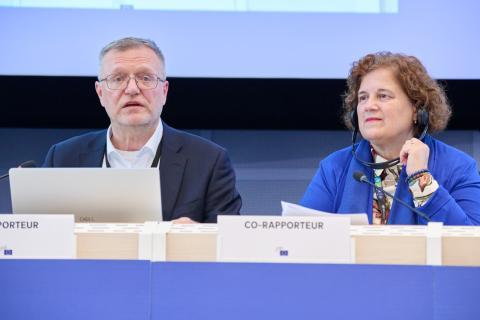
‘Supplementary pensions can play an important role, but they must complement, not weaken, public systems,’ said the opinion’s rapporteur, María del Carmen Barrera Chamorro. ‘The priority must remain clear: ensuring that everyone can retire with dignity, security and an adequate income.’

The opinion was adopted and discussed at a high-level plenary debate in April, with European Commissioner for Financial Services and the Savings and Investments Union Maria Luís Albuquerque, Spain’s Minister for Inclusion, Social Security and Migration Elma Saiz Delgado and MEP Damian Boeselager.

In the opinion, the EESC calls for supplementary pensions to be easier to access and understand, especially for people who are currently not covered. It recommends clearer rules, better information for savers and stronger safeguards. This includes clearer advice when choosing pension products and stronger supervision at EU level. Financial education and simple tools are also needed to help people understand their rights and make informed decisions.

The EESC highlights major gaps in supplementary pensions, especially between men and women, with women sometimes receiving up to 40% less from private schemes. It calls for targeted measures developed through social dialogue to improve fairness and reduce poverty risks.

While recognising the role of supplementary pensions in supporting investment and economic growth, the EESC warns against excessive risk-taking with people’s savings. It also stresses that reforms must respect the diversity of national pension systems and ensure the full involvement of employers and trade unions in the design, implementation and monitoring of workplace pension schemes.

Ms Albuquerque explained that ‘supplementary pensions are the way to help people build additional security over the long term and to support them in retirement. This is the idea behind the European Commission’s supplementary pensions package. We fully respect Member States’ competences and the central role of social practices. Our objective is to support shared practices and to help create conditions or solutions that work for people.’

Ms Saiz Delgado said that ‘Any supplementary pension schemes must be based on the principle of complementarity. Under no circumstances should they replace the state pension system. A balance must be struck here so that the development of supplementary pension schemes does not replace our responsibility to ensure adequate provision for pensioners.’ (tk)

EESC FIRMLY REJECTS CONVERSION PRACTICES, SEEN AS HATE CRIMES, AND FULLY BACKS EU LGBTIQ+ EQUALITY STRATEGY

Despite recent progress, discrimination, violence and harassment continue to affect many LGBTIQ+ people across the EU, with particularly severe impacts on trans, non-binary and intersex individuals. An EESC plenary debate in April heard that so-called conversion practices – aimed at changing or suppressing a person’s sexual orientation or gender identity – persist in some parts of Europe and are widely condemned as harmful and incompatible with fundamental rights.

Read more in all languages

The European Economic and Social Committee (EESC) placed fundamental rights, dignity and equality at the centre of its April plenary session, holding a high-level debate on advancing LGBTIQ+ rights and banning conversion practices. The debate was followed by the adoption of two opinions calling for stronger enforcement of the EU’s LGBTIQ+ Equality Strategy 2026-2030 and a comprehensive EU-wide ban on conversion practices.

Setting the tone, EESC President Séamus Boland firmly rejected any justification for such practices: ‘These so-called conversion practices or therapies are not only harmful, they are a profound violation of human dignity and fundamental rights. Let us be absolutely clear: there is nothing to fix or cure.’

The debate brought together representatives from EU institutions, civil society and international organisations. Caleb Stocco from the European Association Against Conversion Therapy highlighted the lasting harm caused by these practices and called for decisive EU action. From the European Commission, Francesco Zoia Bolzonello outlined efforts to advance equality through the LGBTIQ+ Equality Strategy 2026-2030, stressing the importance of EU leadership in the face of a growing backlash.

International perspectives reinforced the urgent need for action. Béatrice Fresko-Rolfo from the Council of Europe and UN Independent Expert Graeme Reid both emphasised that banning conversion practices was a matter of fundamental human rights and dignity.

Participants pointed to persistent inequalities across Member States, including discrimination, hate speech and barriers to healthcare, housing and employment. The recent Court of Justice of the EU ruling in Commission v Hungary was cited as reaffirming the EU’s obligation to protect LGBTIQ+ rights and uphold fundamental freedoms.

The two EESC opinions adopted translate these concerns into concrete recommendations. Regarding conversion practices, the EESC calls for a comprehensive, legally binding EU-wide ban covering both minors and adults, including effective penalties and support for survivors. On the Equality Strategy, it urges stronger monitoring, binding benchmarks linked to EU funding and decisive action to counter the anti-LGBTIQ+ backlash.

The EESC, as the voice of organised civil society, reaffirmed its commitment to advancing equality and ensuring that all people in Europe can live freely and safely, without fear of discrimination. (lm)

EESC HIGHLIGHTS CULTURE AS A CORNERSTONE OF EUROPEAN DEMOCRACY AND RESILIENCE

The European Economic and Social Committee (EESC) has held a high-level debate underlining that culture is not a luxury but a strategic asset for democracy, social cohesion and Europe’s economic resilience. Speakers stressed the need for greater political recognition and sustained investment to turn goals into action.

Read more in all languages

The European Economic and Social Committee (EESC) has held a high-level debate underlining that culture is not a luxury, but a strategic asset for democracy, social cohesion and Europe’s economic resilience. Speakers stressed the need for greater political recognition and sustained investment to turn goals into action.

During its April plenary session, the EESC hosted the Commissioner for Intergenerational Fairness, Youth, Culture and Sport, Glenn Micallef, who highlighted the strategic aims behind the Culture Compass and welcomed the EESC’s contribution.

The debate brought together Nela Riehl, Chair of the European Parliament’s Committee on Culture and Education (CULT); Tanja Hristova, vice-chair of the Committee of the Regions’ SEDEC commission and rapporteur for the Culture Compass; and Lars Ebert, Secretary-General of Culture Action Europe.

EESC President Séamus Boland stressed that culture must remain at the heart of EU action even in times of geopolitical uncertainty. He said that culture embodies European values, safeguards freedom and underpins a resilient democratic project.

Commissioner Micallef noted that the cultural sector generates EUR 200 billion in profit and supports eight million jobs, while also holding Europe together in ways that go beyond economic impact. He drew attention to the structural vulnerabilities faced by many cultural and creative workers, who often operate under precarious conditions without stable income or full access to social protection. The Culture Compass aims to address these challenges through measures on artistic freedom, working conditions and access to culture.

Speakers agreed that culture should no longer be treated as a secondary sector but embedded across EU policy frameworks as a strategic driver of Europe’s future, identity and global influence.

A key focus of the discussion was how to translate the Culture Compass into concrete action. The EESC opinion calls for strong, cross-cutting financial support in the next Multiannual Financial Framework (2028–2034), ensuring that cultural objectives are reflected in areas such as competitiveness, skills, research, cohesion and external action.

Through the debate and the adoption of its opinion, the EESC confirmed its role as a key partner in implementing the Culture Compass. Rapporteur Luca Jahier said: 'The Culture Compass sends out a strong political message: culture is not a peripheral part of the European project but sits right at its heart. Culture is a key tool for defending and strengthening democracy, countering populist and authoritarian narratives and increasing preparedness, sustainable development, social cohesion and a sense of belonging.'

EESC DEBATES ECI THAT PROTECTS RIGHTS OF EUROPE’S VIDEO GAMERS

The European citizens’ initiative (ECI) Stop Destroying Videogames calls for measures to stop publishers from remotely disabling video games that consumers have already purchased.

Read more in all languages

The European citizens’ initiative (ECI) Stop Destroying Videogames calls for measures to stop publishers from remotely disabling video games that consumers have already purchased

On 19 May, the European Economic and Social Committee’s (EESC) Section for the Single Market, Production and Consumption held a debate on the ECI Stop Destroying Videogames which places pressure on the EU institutions to address consumer rights in digital gaming.

Submitted to the European Commission on 26 January this year, the ECI gathered 1.3 million verified signatures, reflecting the widespread popularity of video games across the EU. According to recent figures, some 130 million Europeans play video games, representing 29% of the population.

The ECI calls for measures to stop game publishers from remotely disabling video games that consumers have already purchased. Currently, this can often happen at any time and without justification, leaving buyers unable to play the game and not entitled to any compensation. There is also no right to repair applicable to video games.

‘If designed responsibly, most games that connect to the internet can operate indefinitely without publisher support. Major publishers in the video game industry ignore consumer rights and spoil the market for both consumers and good faith actors. We, EU citizens, are asking the European Commission to address this critical consumer issue,’ said Pavel Zálešák, organiser of the ECI and deputy director of the NGO Stop Killing Games, at the EESC debate.

Participants in the EESC debate said that the current EU legislation and consumer agencies were poorly equipped to protect customers from the ‘killing’ of video games. 

Moreover, the licence agreements required to run a game often bypass many existing consumer protections. ‘When a game is functional, it should not cease to function as a result of deliberate and avoidable decisions,’ stressed Alberto Hidalgo Cerezo, ECI signatory and law professor at CEU San Pablo University in Spain.

He gave examples such as planned digital obsolescence or products rendered unusable although technically viable – ‘consumers are defenceless’.

Wytze Koppelman, curator at the Netherlands Institute for Sound & Vision, one of the world’s largest media archives collecting digital media before it disappears, said games must remain functional if they are to be preserved for research, education and future access. 

Representatives of the European Commission said the Commission would consider whether the requested measure is proportionate and whether the objectives of the initiative could be addressed, at least partly, through better enforcement or adaptation of existing rules. 

To be considered by the Commission, an ECI – a tool that allows EU citizens to propose legislation – must collect at least one million signatures and reach minimum signature thresholds in at least seven EU countries. (ll)

EU IS FACING A ‘SCALING-UP GAP’ ─ EESC DEBATE CALLS FOR REFORM IN INNOVATION-TO-MARKET PIPELINE

Europe produces strong research and a growing number of start-ups, but too few companies successfully scale up into global players.

Read more in all languages

Europe produces strong research and a growing number of start-ups, but too few companies successfully scale up into global players. 

EU policy-makers, industry leaders and innovation experts took part in a debate at the European Economic and Social Committee (EESC) on improving the ‘innovation to market’ journey and on addressing barriers for start-ups in the EU, calling for sweeping reforms.

‘Europe needs to reinforce innovation and research and catch up with commercialising the products of these efforts through spin-offs, start-ups and scale-ups. We must also retain talent in Europe and free start-ups from the need to search for financing outside the EU to address the traditional risk-averse culture and to celebrate entrepreneurship in all its forms,’ EESC president Séamus Boland said opening the debate.

In its opinion on the EU Start-up and scale-up strategy – with a focus on the European Innovation Act, adopted at the plenary, the EESC called for decisive action to strengthen Europe’s innovation field, where fragmented rules, slow administration and regulatory complexity are holding back start-ups and scale-ups across the EU.

Andrea Ticheru, from the European Commission's Task Force on Startups and Scaleups and lead for the European Innovation Act, said that the EU had record levels of company creation in 2025 and a solid research base. However, different barriers were slowing down the transition to the market stage. Also, funding was often concentrated at the research stage, leaving a critical gap later in the development process.

Public procurement remains an underutilised tool. 'Basically, we are investing five times less than the US and South Korea in the public procurement of research and development,' she said. At the same time, only one third of university patent applications are successfully commercialised.

Mohammad Iranmanesh, Managing Director of constellr Belgium, argued that 'In Europe we don’t really have an innovation problem… what we have is a scaling problem,' emphasising that speed and simplification should be central policy goals.

Stefan Dobrev, from the European Institute of Innovation and Technology (EIT), stressed that fragmentation across markets and regulations continues to hinder innovation, making it difficult for start-ups to operate seamlessly across borders. 

Reinhilde Veugelers, senior fellow at Bruegel, warned of a 'long-standing innovation gap on private spending' and argued that Europe lacks fast-scaling companies capable of challenging global competitors. Her proposed 'Regime Zero' framework would include fully digital company incorporation, simplified bankruptcy rules, and improved equity compensation systems to attract talent.

Agnès Mathis, Director of Cooperatives Europe, called for stronger investment in education and cross-disciplinary skills, alongside greater recognition of diverse business models, including cooperatives. She pointed out that cooperative start-ups can have higher survival rates but often struggle to access funding due to limited understanding among investors. (ll)

EU MUST STRENGTHEN CIRCULAR ECONOMY TRANSITION WITH BIODEGRADABLE MATERIALS

Nature-based biodegradable materials could become a key pillar of Europe’s circular economy, helping to reduce pollution, decrease dependence on fossil resources and support rural industries. To unlock their potential, the European Union needs a clear and coherent regulatory framework, according to a European Economic and Social Committee (EESC) opinion adopted at its last plenary.

Read more in all languages

Nature-based biodegradable materials could become a key pillar of Europe’s circular economy, helping to reduce pollution, decrease dependence on fossil resources and support rural industries. To unlock their potential, the European Union needs a clear and coherent regulatory framework, according to a European Economic and Social Committee (EESC) opinion adopted at its last plenary.

In its own-initiative opinion, A comprehensive strategy for nature-based biodegradable materials to foster circularity and resource efficiency, strengthen the agri-food sector and scale-up the EU bioeconomy, the EESC calls on the EU to use the forthcoming Circular Economy Act and Bioeconomy Strategy to turn sustainability ambitions into concrete action.

Rapporteur Stoyan Tchoukanov stressed that innovative nature-based biodegradable materials can help tackle pollution, including microplastics, while creating new opportunities for farmers, fishers and rural and coastal communities.

‘To make this work, we need clear, coherent and enabling regulatory frameworks that actively support sustainable solutions. If we get this right, we can scale up innovation, attract investment, and position Europe as a global leader,’ Mr Tchoukanov said.

The EESC believes that biological and technical cycles should complement each other and that EU policies should better support innovation while ensuring genuine environmental benefits. Agricultural, forestry and fishery residues should be used more effectively, and regulatory approaches should move beyond a narrow focus on technical recycling systems towards a lifecycle-based framework that recognises different circular pathways.

The EESC also highlights the importance of applying the waste hierarchy established in the Waste Framework Directive and prioritising prevention, reuse and material efficiency. It supports a technology-neutral approach that delivers the best environmental outcomes while recognising the contribution of both biological and technical cycles.

By creating the right conditions for sustainable solutions, the EU can strengthen the bioeconomy, support local communities and reinforce its position as a global leader in circularity. (ks)

EESC CALLS FOR TOUGHER EU ACTION TO CURB SINGLE MARKET FRAGMENTATION

In a series of recent opinions, the European Economic and Social Committee has called for stronger EU action to modernise the rules underpinning the single market.

Read more in all languages

In a series of recent opinions, the European Economic and Social Committee has called for stronger EU action to modernise the rules underpinning the single market.


EUR 14 billion a year: the hidden cost of single market fragmentation

In its opinion on the Single market – tackling unjustified territorial supply constraints, the EESC urged the EU to crack down on territorial supply constraints (TSCs), which cost European consumers around EUR 14 billion annually, with identical products sometimes being sold at prices more than 100% higher in one Member State than in a neighbouring country. 

'Ultimately, it is the European consumers who pay the price,' said rapporteur for the opinion Antje Gerstein. 'The EESC warns that allowing the single market to remain thus fragmented is unsustainable. As Mario Draghi has underlined, internal market fragmentation is even more damaging to the EU economy than external trade barriers.'

The TSCs are practices through which multinational manufacturers restrict where retailers and wholesalers can find and buy products within the EU, which results in higher prices, reduced product choice and distorted competition across the Member States.

The EESC is asking the Member States to avoid introducing new national barriers that further 'renationalise' sourcing markets and instead remove unjustified restrictions on cross-border trade. 

A strategic rethink of European standards

Europe’s standards system must remain inclusive, transparent and firmly anchored in EU values, the EESC said in its opinion entitled Strategic standardisation for a stronger single market. This opinion is a proactive contribution ahead of the revision of the EU's standardisation framework announced by the European Commission.

European standards increasingly shape everything from industrial competitiveness and digital technologies to workplace organisation and consumer protection. In the EESC's view, the current system faces mounting challenges linked to geopolitical tensions, rapid technological development and the growing internationalisation of standards.

'Standards should support innovation, sustainability and high levels of protection for workers, consumers and the environment,' rapporteur for the opinion Angelo Pagliara said.

But small businesses, trade unions and civil society groups still struggle to participate effectively in standardisation processes due to financial and administrative barriers. To counter this, the EESC is calling for stronger support mechanisms, improved access and greater representation in technical committees. 


Stronger enforcement for a changing market

The EESC is also calling for a major overhaul of EU market surveillance and enforcement systems in response to growing digital trade flows and the rise of AI-enabled products.

In its evaluation report entitled Evaluation of the Market Surveillance Regulation, the EESC has warned that EU rules designed to stop unsafe products from entering the single market are not keeping pace with the rapid growth of online shopping and direct imports from outside Europe.

The main problem is not the law itself, but weak and uneven enforcement across the Member States, the EESC said.

Online marketplaces and third-country sellers are a particular concern. Non-compliant products can be removed from websites after being flagged but often reappear quickly under new listings. This makes enforcement slow and reactive, while compliant European businesses face unfair competition from cheaper non-compliant goods. (ll)

ONE EUROPE, ONE MARKET: FROM STRATEGY TO DELIVERY

Insufficient enforcement of common EU rules, threats to consumer confidence, excessive complexity for SMEs and a loss of competitiveness in the digital sector are among the greatest challenges facing the single market.

Read more in all languages

Insufficient enforcement of common EU rules, threats to consumer confidence, excessive complexity for SMEs and a loss of competitiveness in the digital sector are among the greatest challenges facing the single market

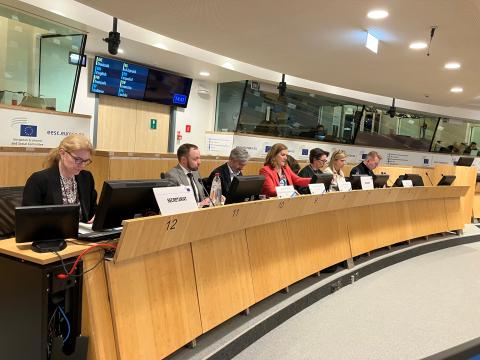
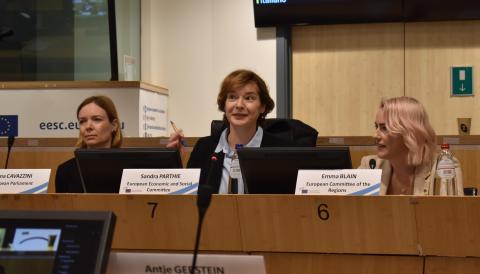
On 3 June, the European Economic and Social Committee (EESC), the  Committee of the Regions (CoR) and the European Parliament jointly organised a conference entitled ‘One Europe, One Market: From Strategy to Delivery’. The event focused on how to turn the EU’s new One Europe, One Market roadmap – launched by EU leaders in April – into concrete results for citizens and businesses.

The conference brought together EESC and CoR members, MEPs, civil society stakeholders and experts to discuss the future of Europe’s single market, which, despite being one of the pillars of European integration, remains heavily fragmented, hampering Europe’s competitiveness and economic growth.

‘The single market is under pressure. We at the EESC hear the concerns directly from businesses, workers and civil society – the very people who should benefit fully from the single market, but still do not,’ said Antje Gerstein, President of the EESC’s Section for the Single Market, Production and Consumption.

‘There is no magic law that you can implement to create the single market. It is much more difficult and much more nitty-gritty. We have to take concrete examples of where things are not functioning,’ said Anna Cavazzini, chair of the Parliament’s IMCO Committee.

‘In the context of the next multiannual financial framework and future EU funding programmes, it should be recognised that cohesion policy and the single market are not competing priorities; rather, they are mutually reinforcing. One cannot succeed sustainably without the other,’ said Emma Blain, Dublin City Councillor and CoR member.

The panel on ‘Product safety and compliance: enhancing market surveillance for better products and consumer protection’ focused on unsafe or non-compliant products entering the EU market through online marketplaces, many originating from China. Panellists stressed that the current liability regime does not reflect digital commerce, undermining consumer confidence and causing significant financial losses.

The discussion on ‘Public procurement, sustainability and circular economy goals’ highlighted the need for simpler, faster and more accessible procurement rules, particularly for SMEs. Speakers noted that complex, price-driven procedures often deter small operators from bidding and can exclude citizen-led projects.

During the panel on ‘Building a smarter and simpler single market for the digital era’, speakers underlined the need for predictable rules, interoperable systems and practical support for SMEs. Businesses still face barriers linked to incompatible national systems, fragmented data rules and insufficient interoperability, while the question of more or less regulation remained open. (ll)

HOW THE EESC WANTS YOUTH ENTREPRENEURSHIP TO BOOST EUROPE’S COMPETITIVENESS

Youth entrepreneurship is not only a response to labour market challenges but also a strategic tool for strengthening Europe’s competitiveness and innovation capacity.

Read more in all languages

Youth entrepreneurship is not only a response to labour market challenges but also a strategic tool for strengthening Europe’s competitiveness and innovation capacity.

At its April 2026 plenary session, the European Economic and Social Committee (EESC) adopted an exploratory opinion on EU competitiveness and youth entrepreneurship, requested by the Cyprus Presidency of the Council of the EU. The opinion highlights the role of young entrepreneurs in driving innovation, fostering sustainable growth and supporting the long-term renewal of Europe’s SMEs.

To unlock the potential of youth entrepreneurship, the Committee calls for a comprehensive approach that enables young people to transform entrepreneurial ambitions into sustainable businesses.

The opinion identifies several persistent barriers faced by young entrepreneurs, including limited access to finance, regulatory complexity and skills gaps. Addressing these challenges requires coordinated action at EU, national and local level, combining financial support, education, mentoring and regulatory simplification.

Rapporteur Giuseppe Guerini emphasised the importance of entrepreneurship as a driver of competitiveness and renewal: 'Support for youth entrepreneurship is a strategic tool for strengthening the EU's competitiveness and innovation capacity, which may also prove decisive in addressing the challenge of generational renewal in many SMEs.'

The EESC considers youth entrepreneurship a key lever for boosting innovation, tackling productivity challenges and supporting demographic renewal in Europe's business landscape. However, it underlines that entrepreneurship should be a genuine choice rather than a substitute for decent employment opportunities. Young people should have access to adequate support, realistic expectations and alternative career pathways.

Access to finance remains a major obstacle. The Committee therefore calls for stronger support for alternative financing instruments and financial tools tailored to the needs of youth-led businesses, particularly innovative start-ups, social enterprises and cooperatives. At the same time, funding should be complemented by mentoring, coaching, business incubation programmes and evaluation tools that help young entrepreneurs develop resilient and sustainable projects.

The opinion also highlights the importance of fostering an entrepreneurial mindset from an early age. The EESC recommends integrating entrepreneurship education into different levels of education and training, including vocational and dual-learning systems. Financial literacy, digital skills and knowledge related to artificial intelligence are identified as increasingly important for future entrepreneurs.

To encourage business creation, the Committee calls for further efforts to reduce administrative burdens and simplify regulations at all levels of governance. It also stresses the value of business networks and entrepreneurial ecosystems, which can provide access to markets, partners, investors and good practices.

Finally, the EESC underlines that competitiveness and social inclusion must go hand in hand. Support measures should promote equal opportunities for women, people with disabilities and other underrepresented groups, while recognising failure as a learning experience and safeguarding the right to a second chance. (lm)

DELIVERING SHARED PROSPERITY IN THE EURO-MEDITERRANEAN REGION

The European Economic and Social Committee (EESC) calls for a renewed partnership between the European Union and southern Mediterranean countries – one that places people, sustainability and shared responsibility at its core.

Read more in all languages

The European Economic and Social Committee (EESC) calls for a renewed partnership between the European Union and southern Mediterranean countries – one that places people, sustainability and shared responsibility at its core. 

The opinion The role of the private sector and civil society in strengthening economic cooperation within the Pact for the Mediterranean, adopted at the EESC’s April plenary, outlines how organised civil society and the private sector can strengthen economic cooperation under the EU’s Pact for the Mediterranean. The proposed pact represents a strategic opportunity to reshape relations between the European Union and its southern neighbours.

At the heart of the EESC’s recommendations lies a clear message: economic cooperation must deliver for people, not just markets. Ongoing wars and instability are causing severe human suffering and damaging economies, hindering the pact’s progress. The EESC calls on the EU to support a just peace under the UN and to uphold international law. At the same time, it calls for respect for human rights, stressing the EU’s key role in promoting dialogue and peace.

EESC member Thomas Wagnsonner, rapporteur for the opinion, emphasised: ‘The Pact for the Mediterranean will be successful only if peace and stability are guaranteed. Strengthening civil society involvement and supporting micro-, small and medium-sized enterprises, social entrepreneurs and cooperatives are crucial for the process. Innovation and social fairness need to go hand in hand’.

The structured and permanent involvement of organised civil society is central to this vision. Trade unions, employers’ organisations and civil society organisations should not be limited to occasional consultations, but formally integrated into governance, implementation and monitoring processes. 

Nonetheless, environmental protection and sustainable practices must be integrated into economic development, ensuring that growth respects natural resources and contributes to long-term resilience in the region.

EESC member and co-rapporteur, Lidija Pavić-Rogošić, also underlined the importance of empowering young people and women by increasing their participation in governance structures and entrepreneurship programmes. ‘Social and solidarity economy actors, including cooperatives, are powerful engines of inclusive development. Often led by young people and women, these organisations contribute to job creation, social cohesion and local resilience. The EESC calls for dedicated funding and supportive legal frameworks to strengthen their role across the region,’ she said. (at)

WINNING THE HEARTS AND MINDS OF EU CITIZENS ON ENLARGEMENT

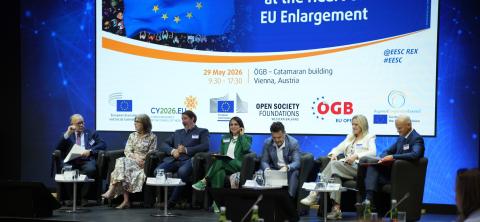
On 29 May, the European Economic and Social Committee held a conference in Vienna ─ just a few days before the EU-Balkan Summit ─ sending a clear message: civil society is key for building trust between institutions and citizens and between the European Union and the region.

Read more in all languages

On 29 May, the European Economic and Social Committee held a conference in Vienna ─ just a few days before the EU-Balkan Summit ─ sending a clear message: civil society is key for building trust between institutions and citizens and between the European Union and the region.

Under the auspices of the Cyprus Presidency of the Council of the EU, the conference brought together more than 100 participants: Western Balkan stakeholders and representatives from the EU institutions and Austria’s civil society and government. It was organised in cooperation with the European Commission, the Open Society Foundation – Western Balkans (OSF-WB) and the Regional Cooperation Council (RCC).

Speakers pointed out that it is a communication challenge, not just a political one, because according to Eurobarometer, two thirds of EU citizens say they do not feel well informed about enlargement. Ulrike Hartmann, the Special Envoy for Southeast Europe and EU Enlargement at the Federal Ministry for European and International Affairs of the Republic of Austria, emphasised the role of reciprocal communication between Member States and candidate countries as a crucial way to rebuild trust and demonstrate the benefits of enlargement both ways.

Furthermore, the Eurobarometer showed that 53% of EU citizens are in favour of further EU enlargement, with support particularly high among young people. However, the support varies significantly by country. For example, even though the political authorities in Austria strongly support enlargement, only 38% of its citizens are in favour. That is why Vienna was chosen as the host city for the conference to raise awareness of the benefits of EU enlargement among the Austrian public. 

‘EU enlargement is a geopolitical imperative for a stronger, more secure and more prosperous Europe, but we can’t take the support of citizens in the EU or the Western Balkans for granted,’ said EESC President Séamus Boland. ‘Civil society must be at the heart of this process, building bridges between the EU and the Western Balkans and helping deliver the reforms and prosperity that enlargement can bring.’


Thomas Waitz, Member of the European Parliament, said: ‘Civil society is one of the most crucial pillars of the EU enlargement process and an important partner for me as a politician. Civil society must be firmly embedded in the reform process through a genuine and inclusive exchange and be trusted to hold politics accountable.’

Andi Dobrushi, Director of OSF-WB, explained that enlargement should not be seen as a charity project but as a contribution from the Western Balkans to the EU. He added that civil society organisations should be involved before the accession arrangements are finalised and not after.

The conference conclusions were sent to European Council President António Costa and the Cyprus Presidency ahead of the EU-Western Balkans Summit which took place in Montenegro on 5 June.(at)

2026 OPEN DAY: EESC MARKS #EUROPEDAY WITH A UNIQUE OPPORTUNITY TO EXPERIENCE THE SPIRIT OF ENGAGEMENT FIRST HAND

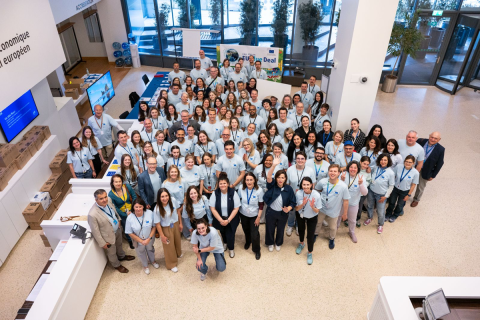
Thousands of people visited the EESC headquarters in Brussels on Saturday 9 May 2026, when the EU’s oldest consultative body opened its doors for the traditional Open Day.

Read more in all languages

Thousands of people visited the EESC headquarters in Brussels on Saturday 9 May 2026, when the EU’s oldest consultative body opened its doors for the traditional Open Day.

9 May, Europe Day, marks the 76th anniversary of the Schuman Declaration, the historic speech by French foreign minister Robert Schuman in 1950 which paved the way for European integration. Europe Day is a chance to acknowledge the achievements of the European project and celebrate the community of values that the EU represents and that we, as Europeans, protect and nourish every day.

‘Europe Day is a really important day for taking stock and celebrating the achievements of the European project, including peace, democracy and inclusion,’ Séamus Boland, the EESC President, said. ‘It was a genuine pleasure to host visitors to our open day today and celebrate this spirit of participation.’

‘I am very happy that the EESC could host an open-door and festive celebration for Europe Day,’ added Marija Hanževački, the EESC Vice-President for Communication. ‘Europe Day is a celebration of joy and unity for people of all ages to share European values and build a Europe for all. The Open Day offers a unique opportunity to experience the spirit of engagement first hand, discover the workings of the Committee and learn how complex debates are turned into opinions.’

During the EESC Open Day, visitors were able to step inside the Committee building and find out how it gives a voice to organised civil society across the EU and thus contributes to European democracy. They had the opportunity to meet the people behind the work, explore how EESC opinions are drawn up and experience personally how inclusive dialogue helps to shape Europe’s future and build a stronger Union. (mp)

EXHIBITION CELEBRATING CYPRUS’ UNESCO-LISTED WINE OPENS AT THE EESC

The EESC will celebrate the cultural heritage of Cyprus with the exhibition Cypriot Nama: Commandaria, launching at 6.30 p.m. on Wednesday 17 June, in Foyer 6 (JDE building, Rue Belliard 99), and coinciding with the end of the Cyprus Presidency of the Council of the EU. 

Read more in all languages

The EESC will celebrate the cultural heritage of Cyprus with the exhibition Cypriot Nama: Commandaria, launching at 6.30 p.m. on Wednesday 17 June, in Foyer 6 (JDE building, Rue Belliard 99), and coinciding with the end of the Cyprus Presidency of the Council of the EU. 

The exhibition, organised in collaboration with the Press and Information Office of the Republic of Cyprus, with the support of the Permanent Representation of the Republic of Cyprus to the EU, will shine a light on ‘Commandaria’, the historic Cypriot sweet wine.

Commandaria, named ‘the world’s oldest wine’, is far from a simple beverage; the wine was hailed as ‘the most precious gift granted by the Gods to mankind’ by the Greek philosopher Plato and as ‘the wine of kings and the king of wines’ by Richard the Lionheart. 

Officially included on the Representative List of the Intangible Cultural Heritage of Humanity of UNESCO in 2025, it has a symbolic place in the rich cultural tapestry of Cyprus and remains a point of pride for the Cypriot people.

The exhibition’s official opening will be followed by a musical performance by the Michalis Kouloumis Quintet, which will present a unique artistic programme of melodies inspired by the distinctive musical style and traditions of Cyprus.

The exhibition will be open to visitors and runs until Tuesday 30 June.

For more information please contact: events@eesc.europa.eu. (dp)

CONNECTING EU 2026: THE EESC’S TOP COMMUNICATION EVENT TO DEBATE EUROPE’S PROSPECTS IN A SHIFTING GLOBAL ORDER

The EESC’s annual gathering of civil society communicators, the Connecting EU seminar, will take place in Sofia on 6 and 7 July. This year’s edition will ask how Europe can uphold its core values as economic priorities shift, democratic trust weakens and civic spaces come under pressure – and what civil society can do to defend them.

Read more in all languages

The EESC’s annual gathering of civil society communicators, the Connecting EU seminar, will take place in Sofia on 6 and 7 July. This year’s edition will ask how Europe can uphold its core values as economic priorities shift, democratic trust weakens and civic spaces come under pressure – and what civil society can do to defend them.

Entitled ‘In defence of European values: The power of civil society’, the seminar will include two panels and an interactive programme with two breakout sessions and a workshop.

•             Europe’s new economic compass: Balancing competitiveness, social rights and sustainability

As the old global order frays, Europe is doubling down on security, defence and competitiveness, while adjusting its social and environmental ambitions. Can Europe build an economic model that delivers both competitiveness and social fairness? How can the EU secure long-term growth, strengthen its global position and protect what makes Europe distinctive: quality jobs, a resilient social model and democratic stability?

•            Europe’s democratic compass: Can trust and resilience be restored? 

Democracy is taking hits from all sides: civil society is being squeezed, confidence in institutions and independent media is eroding and populist narratives, often boosted by foreign influences, are making it harder for citizens to know whom to trust. Can tools like the EU Democracy Shield fight back fast enough against disinformation and malign influence to restore trust in Europe’s democratic model? Or does the EU have to rethink its social contract to remind people that democracy is not a given, but must be actively defended?

•            AI as a friend, not a foe

Two breakout sessions will look at how AI can help communicators spot fake news, sharpen their message and work faster. The event will wrap up with a LinkedIn crash course for professional communicators on how to sharpen their voices, build visibility and reach the right audiences.

The keynote speech will be delivered by Dave Keating, European affairs journalist and author of the book The Owned Continent.

The programme and information about all speakers can be found on the 2026 Connecting EU website.

The event will take place at the Sofia University ‘St. Kliment Ohridski’ and is organised in partnership with the Bulgarian Economic and Social Council and with the support of the European Parliament Liaison Office and the European Commission Representation in Bulgaria.

The seminar is part of the ‘Connecting EU’ series, now in its 18th year. Every year, this event brings together civil society press and communication professionals, EESC members, EU representatives, partner organisations, journalists and researchers to network and discuss key issues affecting Europe. (ll)

News from the Groups

EUROPE’S NEXT BUDGET: WHAT WORKS AND WHAT NEEDS FIXING

By Konstantinos Diamantouros, EESC Employers' Group member

The MFF remains a key tool to support EU priorities, especially at a time when Europe’s investment needs are growing.  While the majority of funds will come from mobilising private investment, public resources will also be crucial.

Read more in all languages

The MFF remains a key tool to support EU priorities, especially at a time when Europe’s investment needs are growing.  While the majority of funds will come from mobilising private investment, public resources will also be crucial.  

By Konstantinos Diamantouros, EESC Employers' Group member


Against this backdrop, the MFF proposal marks an important step forward. First, it places a stronger emphasis on competitiveness, especially through the creation of the European Competitiveness Fund and the reinforcement of Horizon Europe, which can help position industry, research and innovation at the heart of EU growth. Second, the expansion of the Connecting Europe Facility has the potential to enhance transport and energy networks and contribute to lowering energy costs.

In addition, the performance-based approach for national and regional plans is welcomed, provided that the ‘reforms for investments’ logic is aligned with cohesion policy objectives and does not introduce macroeconomic conditionality. On external action, the increase in funding for Global Europe is also a positive step, as it can strengthen the EU’s global role, diversify value chains and enhance security.

At the same time, there are areas of concern. As outlined in the EESC opinion on the next Multiannual Financial Framework (MFF) 2028-2034, we oppose the idea of merging cohesion policy, ESF+, agriculture, fisheries, migration and security into a single fund, as this risks creating competition between priorities which could undermine the long-term planning needed for the seven year period of the MFF. We therefore call instead for a clearer structure, with predictable funding for each policy area.

The proposed Corporate Resource for Europe (CORE) as a new EU own resource also raises concerns: first, because further taxation may run counter to the EU’s competitiveness agenda; and second, because it is a levy based on turnover rather than profit.

Overall, the proposal moves in the right direction, but the final budget must safeguard cohesion, involve social partners, avoid harmful conditionality and ensure fair financing that supports competitiveness.

EESC CALLS FOR A PEOPLE-CENTRED APPROACH TO EUROPE’S COMPETITIVENESS

By the EESC Workers’ Group

As discussions on the European Commission’s 2027 Work Programme gather pace, the European Economic and Social Committee (EESC) has underlined the need for a competitiveness agenda that delivers both economic strength and social progress. 

Read more in all languages

As discussions on the European Commission’s 2027 Work Programme gather pace, the European Economic and Social Committee (EESC) has underlined the need for a competitiveness agenda that delivers both economic strength and social progress. 

By the EESC Workers’ Group


‘Europe’s competitiveness cannot be built at the expense of workers. The digital, green and energy transitions must be fair transitions, based on quality jobs, skills, social dialogue, equal opportunities and strong workers’ rights’, the EESC states in its contribution to the 2027 Work Programme.

The EESC argues that Europe’s resilience and sustainable growth depend on a strong industrial base, innovation, investment and a deeper single market. At the same time, it stresses that people must remain at the heart of Europe’s transformation, with quality jobs, social dialogue and workers’ rights forming essential pillars of future policy.

The Committee calls for the European Pillar of Social Rights to be implemented in full and supports measures to strengthen fair labour mobility, digital workers’ rights, skills development and social conditionality in EU funding and public procurement. It also highlights the importance of the forthcoming Quality Jobs Act, stronger protection against risks linked to algorithmic management, and greater investment in vocational education and training. 

Alongside social priorities, the EESC advocates a modern industrial policy focused on affordable energy, secure supply chains, critical raw materials and strategic infrastructure. It also calls for adequate resources in the next multiannual financial framework (MFF), ensuring that competitiveness, cohesion, social progress and the green transition receive balanced support. 

The Committee further emphasises that tackling poverty, improving access to housing and essential services, as well as strengthening health, care and mental well-being are crucial to Europe’s democratic resilience. According to the EESC, sustainable prosperity will only be achieved if economic growth goes hand in hand with social inclusion and a better quality of life for all Europeans.

EESC CALLS FOR MORE AMBITIOUS, INCLUSIVE AND GLOBALLY COHERENT EU LONG-TERM BUDGET

By the Civil Society Organisations' Group

The European Economic and Social Committee (EESC) adopted its opinion on the next Multiannual Financial Framework (MFF) 2028-2034 in January 2026, delivering a clear message to the EU institutions: Europe’s strategic, social and geopolitical ambitions require a stronger and better-designed long-term budget. Read the interview with Luca Jahier, the EESC rapporteur from the Committee's Civil Society Organisations' Group.

Read more in all languages

The European Economic and Social Committee (EESC) adopted its opinion on the next Multiannual Financial Framework (MFF) 2028-2034 in January 2026, delivering a clear message to the EU institutions: Europe’s strategic, social and geopolitical ambitions require a stronger and better-designed long-term budget. Read the interview with Luca Jahier, the EESC rapporteur from the Committee's Civil Society Organisations' Group.

By the Civil Society Organisations' Group


What are the main findings and recommendations of this opinion?

The EESC’s first key finding concerns the overall volume of the MFF. While acknowledging the European Commission’s proposed nominal increase, the Committee stresses that, once inflation and the repayment of NextGenerationEU debt are taken into account, real resources would remain largely unchanged. This falls short of what is needed to close persistent investment gaps in strategic autonomy, competitiveness, social cohesion, climate action, security and defence. Drawing on recent institutional reports, the EESC calls for a substantial increase in real resources relative to gross national income and for stronger EU-level investment in European public goods, which cannot be delivered effectively by Member States alone.

A second major concern relates to the structure and governance of EU funding. The EESC strongly opposes the proposed reductions to cohesion policy and the Common Agricultural Policy, underlining their proven contribution to economic, social and territorial convergence. It also raises serious reservations about the planned merger of several major policy areas into a single National and Regional Partnership Plan, as is currently proposed, warning that this risks excessive centralisation and weaker stakeholder involvement. The Committee therefore calls for a reinforced partnership principle, mandatory participation mechanisms, adequate support for capacity-building and safeguards where effective involvement is lacking.

The opinion also addresses revenues, competitiveness and democratic resilience. While welcoming the introduction of new EU own resources, the EESC calls for greater ambition and closer alignment with EU policy objectives. It supports EU emissions trading system ETS- and Carbon Border Adjustment Mechanism CBAM-based revenues, subject to transitional support for energy-intensive sectors, but expresses strong reservations about the proposed Corporate Resource for Europe, recommending instead the reintroduction of a digital services tax. 

On competitiveness, the Committee stresses that this must go hand-in-hand with social fairness, equal access to funding and substantial investment in research, innovation, skills and infrastructure. Adequate financing for civil society and media programmes is highlighted as essential democratic infrastructure.

Finally, the EESC welcomes the reinforced Global Europe pillar, stressing that increased funding for external action must support strategic autonomy, enlargement and neighbourhood stability, while strengthening the Global Gateway as a coherent instrument for multilateral engagement.

After the adoption of this opinion, what will you do to promote it?

Following the adoption of the opinion, the EESC will actively promote its recommendations through dialogue with the European Commission, the European Parliament, the Council and key stakeholders, ensuring that organised civil society contributes meaningfully to the negotiations on the EU’s next long-term budget.

Watch the video statement by the rapporteur Luca Jahier.

IN FOCUS: THE MULTIANNUAL FINANCIAL FRAMEWORK

EUROPE CAN'T AFFORD A BUDGET ON THE CHEAP, SAYS THE EESC

In its opinion on the new MFF 2028-2034, adopted in January 2026, the EESC warned that the Commission’s proposed increase falls short of what is needed, calling instead for a substantial boost in real resources. EESC Info spoke to the three rapporteurs for the MFF opinion ─ Konstantinos Diamantouros, Dominika Biegon and Luca Jahier ─ about the key political priorities for ensuring a sound EU budget that will secure Europe’s strategic autonomy, while remaining decentralised and strongly anchored at regional level.

Read more in all languages

In its opinion on the new MFF 2028-2034, adopted in January 2026, the EESC warned that the Commission’s proposed increase falls short of what is needed, calling instead for a substantial boost in real resources. EESC Info spoke to the three rapporteurs for the MFF opinion ─ Konstantinos Diamantouros, Dominika Biegon and Luca Jahier ─ about the key political priorities for ensuring a sound EU budget that will secure Europe’s strategic autonomy, while remaining decentralised and strongly anchored at regional level.


The Committee’s message is clear: the EU’s ambitions cannot be delivered on the cheap, and the MFF is ultimately a political choice about Europe’s future. What should be the guiding political priorities to ensure that the next EU budget strengthens cohesion, competitiveness and citizens’ trust in the European project?

Konstantinos Diamantouros (EESC Employers' Group): According to the Draghi report, achieving the goals of the digital and green transitions requires an additional EUR 750-800 billion of investments per year. While most of this will come from the private sector alongside improvements to the framework conditions for businesses operating in Europe, public investment will nevertheless play an important role.

At a time when Europe is facing growing geopolitical and economic headwinds — and when new priorities such as defence have emerged alongside traditional ones — the EESC is convinced that the next MFF must be significantly strengthened for the 2028–2034 period.

This means, amongst other things, preserving the central role of cohesion policy in the next MFF, with a dedicated budget, and ensuring that the conditionalities linked to the disbursement of funds under the National and Regional Partnership Plans are strictly aligned with the objectives of regional policy, rather than being macroeconomic in nature.

It is also paramount to maintain the focus on competitiveness by safeguarding the proposed budget increases for industrial development (European Competitiveness Fund), research and innovation (Horizon Europe) and cross-border energy and transport interconnections (TEN-T and TEN-E).

And finally, new own resources must strike the right balance: increasing revenues without undermining the EU’s competitiveness.


The EESC stresses that cohesion, good governance, and strong social rules are essential to making EU funding effective and future-proof. How can the next MFF be designed to strengthen these principles, while avoiding the risk that simplification leads to centralisation and weaker regional involvement?

Dominika Biegon (EESC Workers' Group): We must ensure that public funding serves public purposes. Social conditionality is a key tool in achieving this. The EESC suggests introducing provisions to ensure that only companies meeting social criteria are eligible for EU funding. These could include site retention and employment guarantees, education and training measures, and respect for collective agreements. Good examples already exist in some Member States. The EU should lead by example. The future EU budget should uphold social dialogue and create quality jobs. This is how we can increase acceptance of the green and digital transitions.

Another key aspect of making EU funding more effective is the partnership principle. The European Commission is proposing a more centralised structure for cohesion funds, giving Member State governments greater control over cohesion policy. This represents a fundamental departure from the previous bottom-up approach, under which regions and the social partners played a leading role in designing and implementing cohesion funds.

Together with the Committee of the Regions, the EESC strongly criticises this shift in power from the regional to the national level. To ensure that the EU budget delivers on the ground and remains visible in the regions, the partnership principle must be strengthened. The EESC calls for its genuine application at all stages — from drafting NRPP chapters to project selection, management and monitoring — as well as increased resources for social partner capacity-building and binding co-determination rights, including veto rights on key decisions in monitoring committees.


The EESC warns that the EU cannot respond to global competition, climate change and security challenges with a budget designed for the past. In your view, what specific steps are needed to ensure that the next MFF provides sufficient real investment capacity to turn the EU’s strategic autonomy from a slogan into reality?

Luca Jahier (EESC Civil Society Organisations' Group): The proposed next MFF is clearly not fit for the many and growing challenges Europe is facing.  The EESC was the first to say this — a position now echoed by the European Parliament.

The Draghi report, published one year before the MFF proposal, called for an additional EUR 800 billion in investment per year over ten years, with 60% coming from private capital. One and a half years later, Draghi revised this figure to EUR 1.2 trillion per year over the next decade, with at least 60% now expected to come from public funding and investment instruments. This is mainly due to rising crisis-related costs, the acceleration of the energy and technological transitions, and increased defence spending.

We consider it unacceptable that, once inflation and NGEU repayments are taken into account, the marginal increase in the Commission’s proposal amounts to only around +0.1–0.2%, while significant cuts are made to traditional policies (CAP, cohesion, social funds and others) to free up resources for competitiveness and global Europe priorities. Pending the Council's 'negotiating box', a group of so-called ‘frugal’ capitals is even pushing for further reductions, while still failing to agree on crucial own resources. That we welcome, but resources need to be increased.

The first priority must be to transform what is currently a survival budget into a genuinely political one. This could be achieved through several concrete measures:

  • Exclude the EUR 149 billion allocated to NGEU repayments (0.11% of EU GNI) from heading 1, placing it above the budget ceiling and financing it through dedicated new own resources, as originally foreseen under the RRF regulation.
  • Adopt a comprehensive and ambitious set of new own resources, replacing the most contested ones (such as the CORE proposal) with alternatives, including a digital services tax.
  • Use part of the budget to leverage private capital, building on the success of the Juncker Plan (EFSI I and II).
  • Resort to specific new EU borrowing to finance EU common goods, mainly linked to competitiveness and security priorities, thus significantly increasing the final budget.
  • Accelerate the Capital Markets Union to increase the volume of EU private capital invested in the EU and attract new placements and investments from abroad, as a secure option in times of high turbulence. The creation of a solid EU fiscal space, through a stable market for EU bonds, could accelerate this process.

A BUDGET PEOPLE CAN NO LONGER SEE

By Elena Calistru

Everybody seems to be talking about the next long-term budget, but one question is missing: who will still be able to see where the money goes and whether it works? For Elena Calistru, president of the EESC’s Section for Economic and Monetary Union and Economic and Social Cohesion (ECO), the real story of the next MFF is not just about figures or priorities, but about a shift that could make EU spending less transparent, less accountable and further removed from the people it is meant to serve.

Read more in all languages

Everybody seems to be talking about the next long-term budget, but one question is missing: who will still be able to see where the money goes and whether it works? For Elena Calistru, president of the EESC’s Section for Economic and Monetary Union and Economic and Social Cohesion (ECO), the real story of the next MFF is not just about figures or priorities, but about a shift that could make EU spending less transparent, less accountable and further removed from the people it is meant to serve.


By Elena Calistru

Most of the conversation about the next MFF has been about numbers – how big it should be and who gets what slice of defence, cohesion, competitiveness or climate. Fair enough; that’s where the money is. But underneath those arguments is a change I find more interesting, and that I hear almost no one discussing: how far the decisions about this money will sit from the people it is meant to reach.

The proposal folds fourteen funds into national plans, with money released as governments hit targets they’ve agreed with the Commission. It is pitched as a turn toward results and on paper it does look tidier – fewer programmes, cleaner reporting, more or less a finance minister’s dream. What it also does is pull the centre of gravity upward, away from regions and local actors and toward national capitals, and further from the places where a renovated school or a retrained worker is the only evidence most people will ever have that Europe did anything for them.

That distance has a cost we tend not to name. The people closest to a project – a city hall, a local NGO, a trade union branch – are usually the only ones who can say whether a target met actually ‘achieved’ or changed anything in real life, or just produced a very persuasive report. Their presence is what keeps the system honest, which matters rather more than the ‘consultation’ box it normally gets filed under. Take them out of the room and Europe doesn’t end up with a clearer view of its own spending; it ends up more sure of itself.

And this should worry the whole Committee, not only those of us who stand for organised civil society. The European project runs on consent – on people half-believing it does something for them where they actually live. A budget that’s harder to see, and harder to check, can be perfectly efficient and still disappear from view in exactly the places that decide whether Europe holds together. By all means, let’s fight over the numbers. I’d just rather we didn’t win that argument and lose the point of it.

Elena Calistru is the president of the European Economic and Social Committee’s Section for Economic and Monetary Union and Economic and Social Cohesion (ECO) and a member of the EESC’s Civil Society Organisations’ Group.

A FUTURE EU BUDGET THAT PROMISES A LOT BUT MISSES THE POINT

By Ioannis Vardakastanis

The European Commission says its proposal for the next long-term EU budget will make EU funding simpler, more flexible and better equipped for the future. But for people with disabilities and other vulnerable groups, it raises a fundamental concern: that simplification is becoming a cover for weakening disability rights and removing elements of social protection, writes EESC member Ioannis Vardakastanis.

Read more in all languages

The European Commission says its proposal for the next long-term EU budget will make EU funding simpler, more flexible and better equipped for the future. But for people with disabilities and other vulnerable groups, it raises a fundamental concern: that simplification is becoming a cover for weakening disability rights and removing elements of social protection, writes EESC member Ioannis Vardakastanis.


By Ioannis Vardakastanis

On 16 July 2025, the European Commission proudly launched its proposal for the EU’s next long‑term budget: the Multiannual Financial Framework. It came with bold claims: a record-breaking EUR 2 trillion for 2028–2034, a simplified budget structure, streamlined funding rules, and the promise of keeping the EU competitive and secure in an unstable world.


The promises aren’t quite all that they seem

It didn’t take long for the public to question these claims. The supposed generosity of this 'record-breaking' budget quickly showed itself to be misleading. Eight percent of the entire budget will go towards repaying COVID‑related debt. And because the EUR 2 trillion figure is expressed in current prices after years of high inflation, the real purchasing power of the budget is essentially unchanged from the previous cycle.

The promised simplification has been delivered, but at a cost. Several long‑standing pillars of EU cohesion policy, such as the European Social Fund, the Regional Development Fund and the Common Agricultural Fund, have been merged into one giant fund. Member State allocations will be planned through new National and Regional Partnership Plans. Meanwhile, the legal texts themselves have been stripped back, raising serious concerns for marginalised groups, including people with disabilities.


What does this simplification mean for people with disabilities?

The first casualties of simplification have been the Enabling Conditions. These currently set out clear eligibility criteria for using EU funds, including the obligation to implement the UN Convention on the Rights of Persons with Disabilities (UNCRPD). In the new proposal, Enabling Conditions have been replaced by a lighter set of Horizontal Principles. And while reference to the EU Charter of Fundamental Rights has been retained, reference to the UNCRPD is no longer explicitly included.

This omission is baffling in view of the EU’s own data. Eurostat shows a decade of stagnation in outcomes for people with disabilities in employment, education and poverty reduction. Eurofound research also highlights a worsening trend of institutionalisation, an area where EU funds could be transformative.

We are already facing the problem of EU money flowing into segregating settings, particularly residential institutions, often due to overly flexible interpretation of the rules. The disability movement has long called for clearer, more explicit safeguards to ensure that EU funds promote inclusion and respect rights. Instead, the new simplified text risks opening the door to even looser controls.


What changes for EU spending on social objectives?

Merging the European Social Fund into the Partnership Plans raises further issues. The Commission has been inconsistent in explaining how much money will actually go towards social objectives. While the regulation states that at least 14% of funding should support social actions, it remains unclear from what amount this 14% will be taken. The Commission has struggled to provide a definitive figure.

The scope of what counts as social investment has also widened. The current ESF+ clearly defines eligible measures, but the new rules allow broader interpretation. Social spending may now include infrastructure projects with a social element, such as housing. While valuable, such projects can absorb large amounts of funding. A social budget that is, in real terms, no larger than today’s ESF+ will now be expected to cover costly building projects previously funded by the Regional Development Fund.

There is a real risk that infrastructure could consume almost the entire social envelope. This is because earmarking – i.e. protected minimum shares for specific objectives – has been removed. Under ESF+, at least 25% of social spending must support social inclusion, including for the most marginalised groups. People with disabilities have relied heavily on this guarantee.

The Commission has now removed these protections, giving Member States far more freedom. Countries already committed to disability inclusion will likely continue to invest, but those lagging behind will likely further underinvest. The gap between Member States will widen, undermining the very purpose of EU cohesion policy.


What are we asking for?

The European disability movement is clear about this: simplification cannot come at the expense of our rights. EU policymakers in the Parliament and Council, who now hold the pen, must reverse the Commission’s decision to downgrade disability rights in the legal texts.

EU funding regulations must provide precision and clarity. There must be no ambiguity about ensuring sufficient investment in the inclusion of people with disabilities, and no doubt that this investment must fully respect the rights set out in the UN Convention.


Ioannis Vardakastanis is a member of the EESC's Civil Society Organisations' Group. He is president of the National Confederation of Disabled People of Greece (ESAMEA) and former president of the European Disability Forum (EDF).

ERADICATING POVERTY IS A BUDGETARY CHOICE

In July 2025, the European Commission unveiled its proposal for the Multiannual Financial Framework (MFF) 2028-2034, setting out the EU’s spending priorities for the coming years. For the European Anti-Poverty Network (EAPN), this proposal fails to reflect the reality faced by the 92.7 million people experiencing poverty across the EU. Rather than prioritising poverty eradication and social investment, it places competitiveness, defence and security at the heart of the EU budgetary agenda.

Read more in all languages

In July 2025, the European Commission unveiled its proposal for the Multiannual Financial Framework (MFF) 2028-2034, setting out the EU’s spending priorities for the coming years. For the European Anti-Poverty Network (EAPN), this proposal fails to reflect the reality faced by the 92.7 million people experiencing poverty across the EU. Rather than prioritising poverty eradication and social investment, it places competitiveness, defence and security at the heart of the EU budgetary agenda.

by Jessica Machacova, European Anti-Poverty Network

Following the launch of the first-ever EU Anti-Poverty Strategy by the European Commission on 6 May 2026, EAPN stresses that proper funding is essential for any policy to deliver meaningful results. Poverty cannot be effectively eradicated, or even, reduced, if the policies designed to tackle it are not backed by sufficient financial resources. While the strategy is an important step forward, its potential impact is seriously undermined by the absence of dedicated funding to support its implementation.

The MFF is a crucial instrument for translating the EU’s political commitments into lasting, tangible improvements in people’s lives. Yet without a budget explicitly focused on protecting social rights and reducing inequalities, how can the EU realistically achieve its objective of eradicating poverty by 2050?

This objective was first announced by European Commission President Ursula von der Leyen in her 2025 State of the Union address and later confirmed in the EU Anti-Poverty Strategy. However, it is still not supported by adequate budgetary resources or a clear policy roadmap outlining how poverty eradication will be achieved. 

From EAPN’s perspective, the European Commission’s proposal for the MFF moves in the opposite direction: social rights and social justice barely feature while competitiveness, security and defence are the priorities that dominate the political debate.

These priorities are also reflected in the proposed budget allocations. A threefold increase on the 2021–2027 MFF in funding for migration and border management is proposed, with a fivefold increase in the budget for defence and space.

By contrast, the level of investment dedicated to poverty eradication remains uncertain. No standalone budget has been identified for the European Social Fund (ESF). Moreover, the proposed minimum earmarking of 14% for social objectives within the National and Regional Partnership Plans (NRPPs) is not linked to achieving either the 2030 Porto poverty reduction target or the 2050 poverty eradication objective. It also fails to guarantee targeted support for marginalised groups.

Recent experience shows why such safeguards are necessary. During the mid-term review of the MFF 2021-2027, Member States were allowed to reallocate unused cohesion funds to other priorities. More than three-quarters of these reallocated funds were channelled into competitiveness and defence-related objectives while less than a quarter supported housing, access to water and sanitation and decarbonisation. This illustrates the fact that, when given flexibility, Member States tend to prioritise competitiveness and defence over social investment.

EAPN's analysis shows that marginalised groups will bear the cost of these political choices. Existing earmarking requirements for social inclusion and material deprivation have been removed from the proposed ESF for 2028–2034. The ESF, which currently represents one of the few reliable guarantees of dedicated support for those most at risk of poverty and exclusion, would allocate very little space to targeted funding for marginalised groups. Homeless people, women and Roma communities are mentioned solely in the recitals while undocumented people, migrants, single-parent families, racialised communities and LGBTIQA+ people do not feature at all. Without stronger commitments and robust safeguards, there is a real risk that these groups will receive little or no support from the NRPP funding allocated to Member States.

In short, the MFF 2028–2034 challenges the dominant narrative that the EU can both prioritise competitiveness, defence and security and adequately fund poverty eradication and social investment at the same time. While the former continue to dominate the political agenda, the latter are becoming increasingly invisible.

As negotiations continue, EAPN is engaging with both the European Parliament and the Council of the EU to ensure that sufficient resources are dedicated to poverty eradication, including through stronger ESF earmarking and safeguards for marginalised groups.

Ultimately, how the EU chooses to spend its money in the coming years is a political decision. That decision must place poverty eradication, social rights and the wellbeing of all people at the heart of the European project.

Jessica Machacova is Senior Policy and Advocacy Officer at the European Anti-Poverty Network (EAPN). For the past 14 years, she has worked to advance human rights and social justice at EU level, in both civil society organisations and the EU institutions. Her experience includes roles at Equinet – European Network of Equality Bodies, the Red Cross EU Office, the European Commission and the European Parliament.

TRUST THE ARTIST, NOT THE SPREADSHEET

Culture contributes to democracy, social cohesion, health and the economy. But these wider benefits happen only if we support culture for its own sake, Luiza Moroz - Head of Policy at Culture Action Europe - told EESC Info. In the next EU budget, culture must have a clear place, visible identity and dedicated funding.

Read more in all languages

Culture contributes to democracy, social cohesion, health and the economy. But these wider benefits happen only if we support culture for its own sake, Luiza Moroz - Head of Policy at Culture Action Europe - told EESC Info. In the next EU budget, culture must have a clear place, visible identity and dedicated funding.


EU funding in the cultural sector often favours large, well-established institutions with the capacity to handle complex applications. To support emerging artists and first-time applicants, the Culture Action Europe proposal suggests introducing a 'micro-grant fast-track'. How can the next MFF help lower these barriers and ensure that the next generation of European cultural talent can access funding?

First, the issue is one of resources. The Commission has proposed a budget of EUR 1.8 billion for the Culture strand of AgoraEU over seven years. This corresponds to approximately EUR 260 million per year — roughly equivalent to the annual budget of the French National Library. Culture Action Europe is calling for an increase with a concrete proposal: top up AgoraEU with digital fines imposed on big tech under EU digital legislation. For example, the EUR 120 million fine imposed on X for breaching the Digital Services Act could be channelled towards supporting creators.

Second, funding needs to be made more accessible. The European Parliament's draft report on AgoraEU proposes useful tools: operating grants (support the organisation itself rather than a single project), two-stage applications (a full application is developed only after the concept note has been accepted, which saves applicants' resources), more cascading grants redistributed among smaller organisations, and a the possibility of a 100% co-funding rate, under which EU funds would cover the full cost of a project. At present, the requirement for co-financing often disadvantages smaller organisations with limited resources.

Finally, AgoraEU should also make greater use of private funding from foundations and other third parties, as envisaged in Article 12 of the proposal.


A major structural change is the merging of Creative Europe into the new 'AgoraEU' programme, with the aim of increasing efficiency. However, there are concerns that culture could lose its distinct identity or be overshadowed by other priorities. How can the EU ensure that culture remains a visible, standalone priority in future MFFs?

The Culture strand within AgoraEU must be autonomous and clearly visible. In practice, this means a strand with a fixed percentage of the budget for culture (we are calling for at least 25%), its own work programmes, indicators and logo.

The visibility of culture also depends on artistic freedom: the freedom to be unconventional, radical, experimental and uncomfortable. In many Member States, this freedom is being restricted, often under austerity arguments. Culture Action Europe is part of a civil society coalition drafting a Blueprint for the European Artistic Freedom Act. In addition, we are calling for EU funding to national governments to be made conditional on respect for artistic freedom.

Underpinning both demands is a call to support culture's intrinsic value. Of course, culture contributes to democracy, social cohesion, health and the economy. However, these wider benefits can only materialise if culture is supported for its own sake. Only then can culture create space for the unconditional imagination that allows societies to rethink themselves and envision new futures. At Culture Action Europe, we say: Ask, Pay, Trust the Artist. Embrace the unpredictability of the arts. We deliver results, even if we do not always tick every box.


Your analysis highlights that culture is often mentioned only marginally in other major funds. What specific structural changes would you propose to ensure these broader funds actively support the cultural sector, rather than treating it as an afterthought?

We should recognise that the current EU budget includes some good examples of culture mainstreaming: Horizon Europe has a dedicated space for culture under Cluster 2, and the EU  intends to allocate around EUR 5.3 billion for culture from cohesion funds. The first priority is to keep and strengthen these entry points in the next budget.

To make this structural, culture needs a clear place: dedicated policy windows, pillars, calls, budget lines. If culture appears only as a horizontal principle, it is too easy to overlook. This is why our current campaign on Horizon Europe and the European Competitiveness Fund is called ‘Name, Place, Fund’: culture should be named, placed in the architecture, and backed by funding.

Governance is key to achieving this. Culture sector representatives need to be involved in designing and monitoring broader funds. Take the bodies set up under the AI Act: the Scientific Panel, the Advisory Forum, the EU AI Board. Culture has no strong presence in any of them. Nor were cultural experts part of the high-level group shaping the future of Horizon Europe. Perhaps this is why culture is often neglected in AI and research policies. The answer is to include culture in decision-making early on!


The new National and Regional Partnership Plans will determine local spending, yet there is no mandatory requirement to fund culture in these plans. If this remains voluntary, what mechanism would you recommend to guarantee that every region invests in its cultural future?

During the pandemic, the European Parliament and cultural networks called for at least 2% of each national recovery plan to be allocated to culture. While this target was never included in the official regulation, in practice it was met. This time we should not rely on political goodwill. The target needs to be in the National and Regional Partnerships legal base.

If the Commission already proposes to earmark 14% for social objectives, why not 2% for culture? Regional funding is important because it reaches communities directly and makes culture more accessible for Europeans, through local cultural infrastructure and socially engaged arts.

For that to happen, we need pressure from the local level: cultural organisations, communities, mayors, all making the case that culture belongs in these plans. At Culture Action Europe, we are encouraging our members to write to their ministries and municipalities to push for exactly that. 


Luiza Moroz is Head of Policy at Culture Action Europe, a major Brussels-based European cultural advocacy network. She leads the organisation’s advocacy on EU funding for culture, the Culture Compass and artists’ working conditions. Previously, she worked at Ukraine’s Ministry of Culture, where she helped introduce the concept of creative industries into the government agenda and establish the sector’s analytical and statistical framework. A philosophy graduate of Taras Shevchenko National University of Kyiv, she also holds an MA from the College of Europe and has worked on European integration in culture.

A BIGGER ERASMUS+ BUDGET MAY NOT MEAN BETTER SUPPORT FOR STUDENTS

Erasmus+ may be one of the EU’s most loved programmes, but its success is starting to stretch its budget. As more students want to take part and living costs rise, universities warn that the Erasmus+ funding proposed for the next EU long-term budget may not go far enough. Joachim Wyssling of the European University Foundation told EESCInfo what this could mean in practice: smaller grants, heavier paperwork and fewer opportunities for those who need support most.

Read more in all languages

Erasmus+ may be one of the EU’s most loved programmes, but its success is starting to stretch its budget. As more students want to take part and living costs rise, universities warn that the Erasmus+ funding proposed for the next EU long-term budget may not go far enough. Joachim Wyssling of the European University Foundation told EESC Info what this could mean in practice: smaller grants, heavier paperwork and fewer opportunities for those who need support most.


Erasmus+ is often described as the most tangible way young people experience Europe, yet recent discussions highlight a disconnect between its popularity and its current funding reality. With the next MFF negotiations underway, how would you characterise the current state of the higher education sector in the EU?

Higher education in the EU is in a paradoxical position: it is central, socially popular and strategically important, but still under-resourced relative to both its mission and the expectations placed on it. Erasmus+ remains one of Europe’s most visible and valued programmes, with more than half a million students participating each year, yet the current funding debate shows that demand is growing faster than the financial envelope.

That gap matters because, when engaging in Erasmus+, universities are being asked to deliver on multiple fronts at once: mobility, inclusion, skills, digital transition, green transition, international cooperation and support for democratic resilience. The Commission’s current proposal is important because it preserves the programme’s scale in nominal terms. Yet the real concern is whether it can sustain the sector’s ambitions once inflation, new actions, rising participation, the Commission’s own mobility target of 23% by 2030 and the further development of the European University Alliances are taken into account.

In that sense, the sector is not in crisis, but it is under pressure. The real risk is gradual erosion: more objectives, more complexity and more expectations, without a corresponding increase in the resources needed to deliver them well.


The EUF has released a set of recommendations for the 2028-2034 period, including major structural changes like extending interinstitutional agreements to cut administrative red tape and introducing city-level cost-of-living adjustments for grants. Beyond just increasing the budget, how do these specific reforms change the experience of Erasmus+ for students and universities?

The EUF’s recommendations are not just technical fixes; they are changes that would make Erasmus+ fairer, less bureaucratic and more accessible in everyday practice. Extending interinstitutional agreements would reduce recurring administrative work to avoid repeatedly restarting the same paperwork. We argue that this could save hundreds of thousands of hours and let institutions focus more on quality and less on bureaucracy.

City-level cost-of-living adjustments would have an equally practical impact on students. Today, a grant based solely on broad country categories can leave students under-supported in expensive cities; a city-based model would better align grants with actual living costs. This would be a giant step towards improving inclusion in a targeted and effective way.

Taken together, these reforms would change Erasmus+ from a programme that is merely available into one that is genuinely workable for a wider range of students and universities. In other words, they not only improve administration; they improve access, predictability and trust in the programme. 


The European Commission has proposed a EUR 41 billion budget for Erasmus+, which represents a 50% nominal increase. However, your analysis suggests that, once you account for inflation, the addition of new actions and rising participation, the real purchasing power might not increase at all. If the current proposal is effectively a ‘status quo’ budget in real terms, what are the immediate risks for the sector?

If the proposed budget ends up being ‘status quo’ in real terms, the first risk is that Erasmus+ will quietly stop matching its own political ambition. The Commission’s proposal is around EUR 40.8 billion, a nominal rise of about 50%, but we, together with stakeholders from the higher education sector, argue that inflation, expanded programme scope and rising participation will absorb much of that increase.

The immediate consequence would be pressure on mobility volumes and on inclusion measures. If more actions are added without a genuine increase in budget, something has to give: grant levels, the number of participants, institutional support, bottom-up cooperation or excellence initiatives like the European University Alliances. In practice, that means fewer students benefiting, tighter competition and a higher chance that participation remains easier for those already well-resourced – a reality both at the individual level for students from lower socioeconomic backgrounds and at the institutional level for smaller higher education institutions.

For universities, a status quo real budget also means instability. They are expected to deliver more transnational cooperation, more integrated digital systems and stronger inclusion support, but with resources that do not keep pace with the cost of delivery. That creates administrative strain and limits the programme’s ability to meaningfully expand access.


If you could make one definitive recommendation to the negotiators in the European Parliament and the Council to ensure the next MFF truly secures the future of European higher education, what would it be?

Our single recommendation would be this: lock in a budget and allocation model that protects the real value of Erasmus+ and the higher education share, rather than relying on a nominal increase that looks larger on paper than it is in practice. That means negotiators should restore the sector’s budget share to a level that reflects the programme’s central role in European higher education and mobility, and index the envelope to actual needs rather than to political symbolism.

If I had to make it even more concrete, I would say: preserve ambition by matching funding to participation, inflation and programme scope, and by ring-fencing the higher education pillar so that mobility and cooperation are not crowded out by new priorities. Without that, the EU risks keeping Erasmus+ popular but less effective, which would be a strategic loss for the European Education Area and for Europe’s social cohesion.


Joachim Wyssling serves as Deputy Executive Manager of the European University Foundation (EUF) and has expertise in the internationalisation of higher education, international student mobility, the digital transformation of higher education and the management of large-scale, multicultural EU-funded projects. He has coordinated numerous initiatives funded under the Erasmus+, Horizon Europe and Connecting Europe Facility EU funding programmes. Historically, Joachim has co-founded the French branch of the Erasmus Student Network (ESN) and served as the Vice-President of ESN International.

THE DEVIL IS IN THE BUDGET

The next EU budget is shaping up to be one of the most contested in years, with growing pressure on priorities and funding. In an interview with EESC Info, Anna Heckhausen, EU budget expert at Bertelsmann Stiftung, breaks down the key trade-offs – and why they matter for people and policies across Europe.

Read more in all languages

The next EU budget is shaping up to be one of the most contested in years, with growing pressure on priorities and funding. In an interview with EESC Info, Anna Heckhausen, EU budget expert at Bertelsmann Stiftung, breaks down the key trade-offs – and why they matter for people and policies across Europe.


In your paper The Devil is in the Budget - A Comprehensive Guide to the MFF Negotiations, you show that the next MFF cycle is facing unusually tight political and fiscal constraints. When looking at the five battlegrounds you identify: budget size, priorities, structure, conditionality, and revenues, which one do you see as the most decisive for determining whether this MFF succeeds or fails?

The battlegrounds EU institutions face in the MFF negotiations are deeply intertwined. Priorities depend on budget size; size depends on new revenues; and the more constrained the overall budget is, the more important structural reform becomes.

If I had to single out one battleground, I would therefore point to the budget’s architecture. The chances of a substantially larger budget are very slim – that makes structure crucial: it will determine whether the EU can spend its limited resources more strategically, effectively and flexibly. This is the logic behind the proposed National and Regional Partnership Plans and the European Competitiveness Fund: to simplify and target spending, reduce bureaucracy, increase synergies across policy areas, and respond better to crises and emerging priorities. 

But structural changes can only go so far. New priorities still need to be backed by sufficient money. Ultimately, the question remains who pays – and how much?


Your policy brief Fund or Fumble – How to Make the European Competitiveness Fund Work argues that the EU currently spreads its industrial funding across too many small, complicated programmes, making it hard to focus on big strategic goals. The new proposal tries to fix this by merging 14 different programmes into one large ‘European Competitiveness Fund.’ Do you view this merger as a transformative solution that will make Europe more competitive, or is it merely a rebranding of existing challenges?

At present, EU industrial spending is highly fragmented, complex and rigid. The European Competitiveness Fund (ECF) is the Commission’s response to these weaknesses. More than just adding money, it introduces three reform levers.

The first is consolidation. Replacing silos and overlapping instruments with a more coherent framework could reduce administrative costs. This could make it easier for smaller businesses to access funds, including those in less developed regions.

The second is focus. Rather than dispersing support across too many small envelopes, the ECF would organise funding around strategic priorities through four policy windows. Maintaining a clear strategic focus within these windows should be a central priority in the negotiations.

The third is governance. Funding in the ECF could be more easily adjusted to shifting priorities over time. Moreover, the ECF would bring together different funding modes, such as loans and grants, in a single toolbox to better target industry needs at different stages of the innovation pipeline.

So, yes – the ECF has real transformative potential.


Given that a significant portion of the next budget is already committed to repaying pandemic-era debt, leaving little room for new initiatives, your research suggests major cuts are likely. If the EU must choose between protecting traditional spending on agriculture and cohesion versus investing in strategic priorities like defence and the green transition, which trade-offs do you consider politically feasible?

Both new and traditional spending have their part to play. Europe needs to invest heavily in security, competitiveness and the green and digital transitions. At the same time, cohesion and agricultural support remain important for regional development and the EU’s perceived legitimacy, especially in less developed regions.

Politically, deep cuts to cohesion and agricultural funds are unlikely. They are strongly entrenched, based on pre-allocated national envelopes and backed by powerful interest groups. However, there is scope to make cohesion policy more effective. 

The most feasible compromise will therefore be to change what this money is expected to deliver: linking cohesion and agriculture more strongly to reforms and investment in competitiveness, skills, and climate resilience.

In the end, the divide between old and new priorities is less clear-cut than it may seem. Funding for infrastructure, industrial capacity and the economic transition can also support regional development. The key is to think these objectives together: using the ECF for excellence-based industrial support, while relying on cohesion instruments to ensure that less developed and transition regions can also benefit from Europe’s competitiveness agenda.


If you could make one recommendation to negotiators entering the final phase of MFF talks that would most improve outcomes for European citizens five years from now, what would it be?

My advice would be to make choices – you cannot spend the same euro twice. The EU budget is too small to fund every priority at meaningful scale. Synergies, leverage effects and efficiency gains can help, but they only go so far. 

Negotiators should therefore resist the temptation to give every constituency, programme and objective a small envelope and instead focus resources where EU-level spending can make the biggest difference – for instance, on cross-border infrastructure, international research projects, or a coordinated EU industrial policy. If the EU wants – or needs – to take on new responsibilities in security, competitiveness and the dual transition, it also needs to decide what should give way – or who pays.


Anna Heckhausen works in the Europe’s Future programme at the Bertelsmann Stiftung, focusing on issues relating to the EU budget. Her research focusses on negotiations on the next Multiannual Financial Framework (MFF 2028-34), budget sustainability and the green transformation of Europe’s economy. The Bertelsmann Stiftung is a German non-profit foundation focused on strengthening democracy, society and public policy.

JOINT BORROWING MOVES FROM CRISIS TOOL TO BUDGET FEATURE

The EU’s pandemic recovery fund was meant to be a one-off. Yet as the next long-term EU budget takes shape, joint borrowing appears set to become a more permanent feature of the Union’s finances. Lukas Spielberger and David Howarth of the University of Luxembourg, authors of the paper The future of joint borrowing under the next Multiannual Financial Framework, look at what the Commission’s latest MFF proposal reveals about the future of EU debt, and the political choices still ahead.

Read more in all languages

The EU’s pandemic recovery fund was meant to be a one-off. Yet as the next long-term EU budget takes shape, joint borrowing appears set to become a more permanent feature of the Union’s finances. Lukas Spielberger and David Howarth of the University of Luxembourg, authors of the paper The future of joint borrowing under the next Multiannual Financial Framework, look at what the Commission’s latest MFF proposal reveals about the future of EU debt, and the political choices still ahead.


By Lukas Spielberger and David Horwath

When the European Commission was empowered to borrow up to EUR 750 billion to fund the EU’s response to the COVID-19 pandemic, Member States made it clear that this authorisation was supposed to be temporary. By the end of 2026, the final loans and grants of the Recovery and Resilience Facility (RRF) are set to be disbursed. 

Still, NextGenerationEU (NGEU) has opened the door to further debt-funded facilities. Since 2022, the EU has borrowed over EUR 50 billion to provide financial assistance to Ukraine; and in May 2025, EU Member States agreed on the EUR 150 billion SAFE instrument, which will finance the joint procurement of military equipment. Both the Draghi and Letta Reports have called for additional EU borrowing to finance ‘European Public Goods’.

Against this backdrop, the Commission unveiled its proposal for the forthcoming 2028–2034 Multiannual Financial Framework (MFF) last summer. The proposal shows that the Commission is indeed planning further debt-funded facilities. It also reveals how the Commission is seeking to align the role of borrowing operations in the EU’s budgetary architecture, based on the experience of borrowing under the current MFF.

Specifically, the proposal includes four borrowing-related items. First, a new facility called ‘Catalyst Europe’ will offer loans to support strategic investments. Second, an as-yet unnamed crisis mechanism will be able to provide up to EUR 400 billion in emergency loans to EU Member States. Third, the Commission proposed to set aside EUR 100 billion for further loans to Ukraine until 2034. And finally, the EU will have to start repaying the debt-funded grants extended under NextGenerationEU in 2028, at a rate of EUR 24 billion each year.

The two new instruments indicate that the Commission is seeking to leverage its strengthened borrowing powers and embed them more firmly in the EU budget. 'Catalyst Europe' resembles some aspects of the RRF. The instrument will provide up to EUR 150 billion in debt-funded loans to Member States to fund strategic investments, based on National Partnership Plans — modelled on the Recovery and Resilience Plans.

The major innovation of the RRF — debt-funded grants — will, however, not be repeated. Instead, the EU will offer loans to Member States with attractive terms. Since 2023, the Commission has managed its debt under a new ‘unified funding approach’, which allows it to issue loans at highly concessional conditions. For its latest loans to Ukraine and under SAFE, the Commission has extended loan repayment periods to 45 years.

The proposed crisis mechanism, likewise, seeks to refashion existing EU practice into a new institutional guise. To date, the EU has relied on temporary instruments under Article 122 TFEU to provide financial assistance to Member States, not just for SAFE, but previously also for SURE and during the euro area crisis. The proposed crisis mechanism, by contrast, would create a structural borrowing facility that could be activated during future crises. Unlike Article 122 TFEU, which allows for instruments to be adopted by a qualified majority in the Council, the crisis mechanism is designed to give the European Parliament a say in approving assistance.

The Commission itself has admitted that one advantage of additional debt-funded instruments is to ‘increase the impact of the EU budget, by providing further financial resources to support EU policy goals via borrowing for lending (COM(2025) 570 final)’. 

Most loan-based support is ultimately guaranteed by the EU’s budgetary headroom — that is, the gap between the spending ceilings under the MFF and the Own Resources ceiling. Compared to the current MFF, the Commission’s proposal increases the headroom significantly, from 0.25% of EU gross national income to over 0.5% of EU GNI. The proposed crisis mechanism is to be guaranteed by another increment of 0.25% of EU GNI. As a result, while expenditure under the proposed MFF remains broadly comparable to the current framework as a share of EU GNI, the proposal would create significantly greater budgetary space for future debt-funded instruments.

Joint borrowing is thus set to remain a part of the EU’s public finances over the next long-term budget. The Commission’s proposal shows that it is seeking to focus on long-term loans, involve the European Parliament more directly, and increase its overall borrowing capacity. Whether a sufficient number of Member States agree with these ideas will remain another matter.


Lukas Spielberger is a research scientist in political science at the University of Luxembourg and a senior associate at CSDS, Vrije Universiteit Brussel. Since 2025, he has led the research project ‘Greening Europe’s Public Finances’, funded by the Luxembourg National Research Fund.

David Howarth has been Professor of Political Science, specialising in European Union studies, at the University of Luxembourg since 2012. From 2018 to 2025, he headed the University’s Jean Monnet Centre of Excellence, the interdisciplinary Robert Schuman Initiative.

MFF PROPOSAL RISKS WEAKENING THE SOCIAL CLIMATE FUND’S PROMISE TO VULNERABLE HOUSEHOLDS

As the EU prepares its next long-term budget, concerns are growing that the Social Climate Fund ─ the EU fund designed to make the green transition fairer ─ could lose the sharp focus it was designed to have. Sylwia Andralojc Bodych, Senior Advisor for EU Climate Policy at Germanwatch, spoke to EESC Info about what is at stake for vulnerable households and why stronger safeguards are needed to keep EU climate finance socially just.

Read more in all languages

As the EU prepares its next long-term budget, concerns are growing that the Social Climate Fund ─ the EU fund designed to make the green transition fairer ─ could lose the sharp focus it was designed to have. Sylwia Andralojc Bodych, Senior Advisor for EU Climate Policy at Germanwatch, spoke to EESC Info about what is at stake for vulnerable households and why stronger safeguards are needed to keep EU climate finance socially just.


The Social Climate Fund was set up to protect vulnerable households from rising energy costs under the new emissions trading system. How does integrating this fund into the Multiannual Financial Framework affect its ability to deliver on this original purpose?

Integrating the Social Climate Fund (SCF) into the Multiannual Financial Framework (MFF) is not problematic. The decisive issue is under which conditions this integration takes place. In its current form, the MFF proposal significantly weakens the SCF’s ability to deliver on its original purpose: providing targeted support to vulnerable households affected by the new emissions trading system ETS2.

Under the existing SCF Regulation, this focus is explicit and binding. The new MFF proposal, however, replaces this requirement with a much broader obligation for Member States to merely ‘address the social impacts of ETS2’ within the National and Regional Partnership Plans (NRPPs), without any reference to vulnerable groups.

This shift dilutes the precision of the SCF’s targeting criteria. Designing measures for vulnerable households is more complex than general climate and social spending, but this specific feature is essential to ensure fairness and avoid regressive outcomes. Without binding language, Member States may choose politically easier, less targeted measures that fail to reach those most exposed to rising heating and transport costs. In this sense, the Green Deal’s promise to ‘leave no one behind’ risks becoming symbolic rather than operational.

The SCF’s original ring‑fencing and governance structure were designed to ensure that ETS2 revenues directly support those most affected. Under the MFF, this clarity is lost, and the risk of diversion to unrelated priorities grows.


Your analysis identifies a potential incentive for Member States to delay submitting their National Social Climate Plans until after 2028. What are the practical implications of such delays for the timely implementation of climate protection measures?

The deadline for submitting the National Social Climate Plans was almost a year ago, and only eight Member States have delivered their plans so far. The postponement of ETS2 has also reduced the pressure on governments to prepare their Social Climate Plans in time. As a result, it is now even more likely that some countries will wait until after 2028, when they can access SCF‑related funding through the broader National and Regional Partnership Plans, which are subject to far less stringent social criteria.

Such delays have real-life consequences.

They postpone targeted protection for vulnerable households, leaving low‑income groups exposed to rising heating and fuel costs during the early years of ETS2. They also slow down the rollout of structural measures, such as building renovations, clean mobility support, and energy‑efficiency upgrades, which require long preparation and implementation periods. Without timely NSCPs, Europe risks having fragmented and inconsistent national approaches instead of consistent, socially just climate policy. And because NRRPs lack the clear milestones and monitoring obligations embedded in NSCPs, delays also weaken transparency and political accountability. Or there is a risk that the plans will not be submitted at all.


You note that there are limited consequences if Member States fail to submit or fully implement their climate plans. What mechanisms would you recommend to ensure that funds remain dedicated to their intended social objectives?

Member States currently face virtually no consequences for failing to submit or implement their National Social Climate Plans. Beyond losing access to SCF payments before 2028, there are no penalties – a gap the EU institutions did not anticipate when designing the regulation. The real consequences, however, will fall on citizens if national governments do not provide alternative funding for the measures needed to cushion the impact of ETS2 for vulnerable households. 

To safeguard the social objectives of the SCF within the MFF, three elements are essential. First, the new MFF framework must include binding targeting requirements. Measures financed with SCF‑related resources should be required to directly support vulnerable households, as defined in Article 3 of the SCF Regulation. Without this, funds risk being redirected to broader priorities.

Second, access to SCF‑related funding should be linked to clear milestones and reporting obligations – including the continued submission of NSCPs, progress on implementation, and transparency on the distributional impact of measures. This is not about adding red tape. It is about ensuring that those most exposed to rising heating and transport costs receive timely and effective support. It is also about maintaining public trust that climate policy can be both fair and effective.

Third, restrictions on diverting funds are crucial. Article 80(6) of the proposed European Fund currently allows Member States to repurpose SCF resources for other objectives as long as they broadly ‘address’ ETS2 impacts. This loophole must be closed. SCF‑related funds should remain ring‑fenced for measures aligned with the original SCF Regulation.


Your briefing concludes that the current MFF proposal risks undermining the effectiveness of the Social Climate Fund. What three specific changes would you propose to strengthen the safeguards for social justice in climate finance?

Three amendments are essential:

First, the MFF should restore the SCF Regulation’s explicit focus on vulnerable groups. SCF‑related measures must be required to support vulnerable households, micro‑enterprises and vulnerable transport users. Removing this requirement is a clear step backward and weakens the Fund’s social purpose.

Second, the obligation to submit National Social Climate Plans must remain in place, with clear deadlines, binding minimum standards and legal force beyond 2028. This would prevent strategic delays and ensure continuity in socially targeted measures that are essential for cushioning the impact of ETS2.

Third, Member States should retain the option to use up to 37.5% of SCF funds for direct payments to households. This flexibility is essential for rapid support during price spikes, cushioning the immediate effects of ETS2, and addressing short‑term fossil‑fuel lock‑ins.


Sylwia Andralojc Bodych is a Senior Advisor for EU Climate Policy at Germanwatch. She focuses on socially just climate policy, just transition elements in EU budget instruments, and the implementation of ETS2 and the Social Climate Fund. She also leads Germanwatch’s Polish-German climate cooperation and helps strengthen trilateral dialogue within the Green Weimar Triangle to advance a fair and strategic energy transition.

EU TRANSPORT FUNDING: PLENTY OF MONEY, UNEVEN RESULTS

Europe’s transport network is facing a squeeze: higher ambitions, tighter budgets and persistent gaps at borders. As the EU prepares its next long-term budget, the question is no longer how much to invest, but how to invest better. José F. Papí – CEO of Etelätär Innovation and author of a European Parliament study on transport funding – tells EESC Info where EU money makes the biggest difference and where it still falls short.

Read more in all languages

Europe’s transport network is facing a squeeze: higher ambitions, tighter budgets and persistent gaps at borders. As the EU prepares its next long-term budget, the question is no longer how much to invest, but how to invest better. José F. Papí – CEO of Etelätär Innovation and author of a European Parliament study on transport funding – tells EESC Info where EU money makes the biggest difference and where it still falls short. 


Your study, Investing in Transport in the new MFF, highlights that the next multiannual financial framework (MFF) period faces a ‘perfect storm’: an urgent need to decarbonise transport and complete the TEN-T network at a time when public budgets are tightening and connectivity gaps remain, especially at borders. How would you characterise the current state of EU transport investment?

EU transport investment is at a turning point: the foundations are solid, but performance is uneven, and the gap between political ambition and real delivery remains too wide. In the 2021-2027 period, the combination of the Connecting Europe Facility (CEF) for Transport, cohesion policy funds, InvestEU, European Investment Bank lending and temporary recovery instruments has mobilised substantial resources, yet results vary significantly between Member States, corridors and modes of transport.

Where there are strong project pipelines, clear TEN-T corridor strategies and a robust cost-benefit analysis, EU support delivers high value for money. But oversubscribed CEF calls, administrative capacity constraints and fragmented governance mean that many high-quality projects go unfunded or face delays, especially in cohesion countries and peripheral regions.

Looking ahead to 2028-2034, the EU faces a ‘perfect storm’: it must accelerate decarbonisation, complete the revised TEN-T core and extended core networks, modernise critical road links for continued safety and resilience and meet heightened security needs under tighter fiscal conditions, while connectivity gaps persist at borders and in less-connected areas.

The main challenge is less putting instruments in place and more ensuring that they are consistent, have good coverage and are focused: good tools are in place, but they need to be better aligned, more predictable for long-term projects and more explicitly geared towards cross-border, green and dual-use priorities.


The proposed budget architecture for 2028-2034 is quite different from that of the past, relying on an enlarged CEF, on transport windows under the new European Competitiveness Fund (ECF) and on redesigned cohesion funds under national partnership plans. In your view, does this new mix of instruments offer a better way to coordinate research, innovation and deployment?

The proposed architecture has the potential to better coordinate research, innovation and deployment, but only if the division of labour is made more explicit and supported by concrete performance frameworks. An enlarged CEF for Transport is positioned as the EU-level backbone for cross-border TEN-T, major nodes, alternative fuels and dual-use infrastructure, while cohesion funds under national and regional partnership plans are intended to support regional links, urban mobility and last-mile connections, particularly in less developed regions.

The ECF and the successor to Horizon Europe can create an innovation-to-deployment pipeline, with mission-oriented calls and large-scale pilots feeding into mature investment pipelines that are then scaled up along TEN-T corridors with CEF, cohesion and ECF support.

In practice, this will only work if several safeguards are in place. First, there must be a clearer division of labour between instruments: the CEF should focus on cross-border or dual-use projects that are unlikely to proceed otherwise, cohesion funding on accessibility and infrastructure modernisation, and the ECF on industrial capacity and enabling infrastructure.

Second, coordinated programming – including shared roadmaps for zero-emission and digital corridors, joint work programmes and aligned calls – must bridge the traditional gap between research and innovation and deployment.

Third, transport-specific, outcome-oriented indicators should complement the horizontal Performance Regulation so that funding decisions across instruments are guided by measurable progress on TEN-T completion, decarbonisation, safety and resilience rather than absorption alone.


Your study warns that transport priorities could be diluted within broader funding allocations, affecting progress on decarbonisation and safety. You highlight three areas where EU-level intervention is most critical: cross-border links, alternative fuel infrastructure and dual-use projects. If the EU must prioritise, which of these is currently most neglected and why is it essential to keep it as a distinct focus area rather than fold it into general regional funding?

All three areas require EU-level intervention, but the most structurally neglected remains cross-border and missing links on TEN-T, especially where they connect less developed regions and external borders. These projects have strong added value for Europe and high socio-economic returns, yet are politically and administratively demanding, involve long lead times and cost overruns and are often the first to be delayed under national budget pressure. Without a dedicated, sufficiently large EU-level budget and clear governance of corridors, the risk is that Member States focus on purely national segments and that physical and interoperability gaps persist at borders, undermining decarbonisation, cohesion and security.

Alternative fuel infrastructure and digital systems (such as the European Rail Traffic Management System, advanced traffic management and charging networks that comply with the Alternative Fuels Infrastructure Regulation) also tend to be under-provided by markets alone, given high upfront costs and uncertain short-term financial returns. Here, modest but well-targeted EU grants and blended finance could unlock substantial private investment and ensure coherent network development.

Dual-use projects are gaining political visibility but still risk being treated as a niche area. They need to remain a distinct priority to ensure that military mobility investments systematically deliver strong benefits for civilians. If these areas are absorbed into broader regional allocations or horizontal industrial funds, short-term, nationally relevant projects are likely to crowd out cross-border, green and safety-critical investments whose benefits are not as obvious but are essential for a truly integrated, secure European transport area.


If you could make one definitive recommendation to the negotiators to ensure the next MFF delivers a truly resilient and green transport network, what would it be?

If I had to make one recommendation, it would be to agree on a significantly higher, clearly ring-fenced CEF for Transport allocation explicitly reserved for a limited portfolio of high-impact, cross-border, alternative-fuels, safety-oriented and dual-use projects, embedded in a transparent, performance-based governance framework at corridor level. Concentrating scarce EU-level grants on projects with clear added value for Europe – backed by robust cost-benefit analyses and clear milestones – would maximise value for money and send a strong, predictable signal to national authorities, investors and industry.

To make this work, the enlarged CEF should be complemented by transport-relevant sections in cohesion and competitiveness instruments, with safeguards such as minimum quotas for transport or conditionalities in national and regional partnership plans, an innovation-to-deployment pipeline under the successor to Horizon and the ECF, and transport-specific indicators to guide flexibility and mid-term reviews. This would allow the next MFF to respond to shocks and new priorities without losing sight of its long-term objective: completing a resilient, green and genuinely European transport network that individuals and businesses can rely on.


José F. Papí is the CEO of Estonian tech company Etelätär Innovation and President of the Smart Transportation Alliance, a Brussels-based platform for innovation in transport infrastructure. With more than 30 years’ experience in European and international transport policy, he has worked with EU institutions, government agencies and industry on devising and implementing mobility strategies. He is the author of the European Parliament study ‘Investing in Transport in the new MFF’, requested by the European Parliament’s Committee on Transport and Tourism, which assesses how the 2028-2034 EU budget can deliver high-value, green and resilient transport investments. The opinions expressed in this interview are those of the author only and should not be considered representative of the European Parliament’s official position.
Editors

Ewa Haczyk-Plumley (editor-in-chief)
Laura Lui (ll)

Contributors to this issue

Chrysanthi Kokkini (ck)
Daniela Vincenti (dv)
Giorgia Battiato (gb) 
Julika Enbergs (je)
Jasmin Kloetzing (jk)
Katarzyna Karcz (kk)
Katerina Serifi (ks)
Laura Lui (ll)
Leonard Mallett (lm)
Marco Pezzani (mp)
Margarita Gavanas (mg)
Margarida Reis (mr)
Millie Tsoumani (at)
Pablo Ribera Paya (prp)
Samantha Falciatori (sf)
Thomas Kersten (tk)
Dimitra Panagiotou (dp)

Coordination

Giorgia Battiato (gb)
Leonard Mallett (lm)


Address

European Economic and Social Committee
Jacques Delors Building,
99 Rue Belliard,
B-1040 Brussels, Belgium
Tel. (+32 2) 546.94.76
Email: eescinfo@eesc.europa.eu

EESC info is published nine times a year during EESC plenary sessions. EESC info is available in 24 languages
EESC info is not an official record of the EESC’s proceedings; for this, please refer to the Official Journal of the European Union or to the Committee’s other publications.
Reproduction permitted if EESC info is mentioned as the source and a link  is sent to the editor.


June 2026
05/2026

Follow us

  • Facebook
  • Twitter
  • LinkedIn
  • Instagram