
European Economic
and Social Committee
The European citizens’ initiative (ECI) Stop Destroying Videogames calls for measures to stop publishers from remotely disabling video games that consumers have already purchased
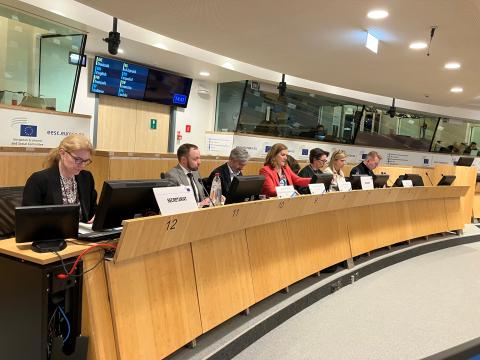
On 19 May, the European Economic and Social Committee’s (EESC) Section for the Single Market, Production and Consumption held a debate on the ECI Stop Destroying Videogames which places pressure on the EU institutions to address consumer rights in digital gaming.
Submitted to the European Commission on 26 January this year, the ECI gathered 1.3 million verified signatures, reflecting the widespread popularity of video games across the EU. According to recent figures, some 130 million Europeans play video games, representing 29% of the population.
The ECI calls for measures to stop game publishers from remotely disabling video games that consumers have already purchased. Currently, this can often happen at any time and without justification, leaving buyers unable to play the game and not entitled to any compensation. There is also no right to repair applicable to video games.
‘If designed responsibly, most games that connect to the internet can operate indefinitely without publisher support. Major publishers in the video game industry ignore consumer rights and spoil the market for both consumers and good faith actors. We, EU citizens, are asking the European Commission to address this critical consumer issue,’ said Pavel Zálešák, organiser of the ECI and deputy director of the NGO Stop Killing Games, at the EESC debate.
Participants in the EESC debate said that the current EU legislation and consumer agencies were poorly equipped to protect customers from the ‘killing’ of video games.
Moreover, the licence agreements required to run a game often bypass many existing consumer protections. ‘When a game is functional, it should not cease to function as a result of deliberate and avoidable decisions,’ stressed Alberto Hidalgo Cerezo, ECI signatory and law professor at CEU San Pablo University in Spain.
He gave examples such as planned digital obsolescence or products rendered unusable although technically viable – ‘consumers are defenceless’.
Wytze Koppelman, curator at the Netherlands Institute for Sound & Vision, one of the world’s largest media archives collecting digital media before it disappears, said games must remain functional if they are to be preserved for research, education and future access.
Representatives of the European Commission said the Commission would consider whether the requested measure is proportionate and whether the objectives of the initiative could be addressed, at least partly, through better enforcement or adaptation of existing rules.
To be considered by the Commission, an ECI – a tool that allows EU citizens to propose legislation – must collect at least one million signatures and reach minimum signature thresholds in at least seven EU countries. (ll)