
European Economic
and Social Committee
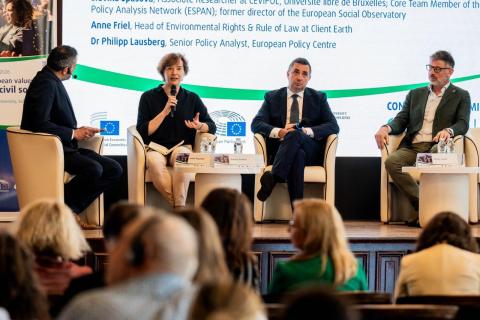
This fundamental question was at the heart of the roundtable discussion at the EESC Connecting EU seminar on ‘Made in the EU: competitive, social and sustainable’, held in Sofia on 6 July 2026. The discussion highlighted a simple but often overlooked reality: Europe’s economic strength, social cohesion and environmental ambitions are deeply interconnected.
By Sandra Parthie, President of the EESC Employers’ Group
As Europe’s social model depends on Europe’s productive capacity, the ‘Made in the EU’ strategy must keep investment, production, jobs and value creation in Europe. Companies must be able to invest and scale up in Europe if we want to maintain quality jobs, finance social protection and deliver on the green transition.
This can happen only if companies have the right framework conditions: affordable energy,
modern infrastructure, efficient telecommunications networks, faster permitting, and a truly integrated single market.
As businesses increasingly relocate investment and production outside the EU, Europe must create the conditions that encourage them to stay, grow and manufacture here. Recent investment decisions also demonstrate the value of strengthening Europe’s industrial base through cross-border cooperation. For example, German company Rheinmetall has announced plans to invest in Romania to manufacture tanks, creating industrial capacity and jobs within the EU while deepening cooperation between Member States. This shows how a strong European industrial ecosystem can combine investment, production and innovation across borders, reinforcing both competitiveness and resilience.
In addition, without profitable and innovative companies creating value, there is little to redistribute and little capacity to finance social progress.
This is why competitiveness and sustainability are not opposing goals, but mutually reinforcing pillars of a sustainable and modern European economy. This means that Europe does not need to choose between competitiveness and its social and environmental ambitions. Rather, competitiveness is what makes those ambitions achievable. A credible ‘Made in the EU’ strategy should therefore support strategic production, innovation and investment while maintaining Europe’s high standards and values.
Europe’s future prosperity will depend on its ability to create the conditions for businesses to succeed, workers to thrive and sustainable growth to flourish. A stronger, more competitive Europe is not an alternative to a Social Europe, it is its precondition.