
European Economic
and Social Committee
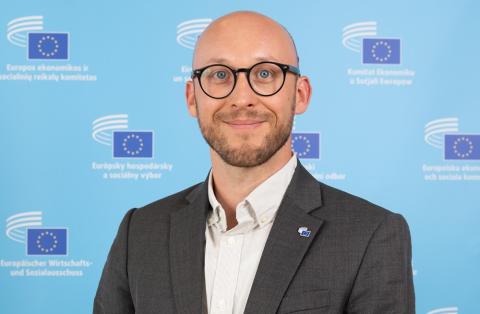
Four million Ukrainians are still benefiting from temporary protection in the EU, which grants access to work, education and social rights. The challenge now is to turn a temporary measure into sustainable long-term policies that prevent social tensions and protect labour rights, writes Mateusz Szymański, rapporteur of the opinion A predictable and common European way forward for Ukrainians in the EU.
By Mateusz Szymański
Russia’s aggression against Ukraine has created a situation that is unprecedented in the history of the European Union: the arrival not of thousands or hundreds of thousands, but of millions of people fleeing war. Thanks to the commitment of Member States and their citizens, the EU has been able to meet this challenge and provide refugees with safe shelter.
At the same time, the EU took an extremely important decision to grant, for the first time, so-called temporary protection to Ukrainians arriving in the EU. This mechanism enables immediate and collective protection, without the need to assess individual applications, for people unable to return to their country of origin. Its purpose is to harmonise rights across the EU. Employment and education are central pillars of these rights, alongside accommodation, healthcare and social assistance.
It is estimated that more than four million people currently benefit from temporary protection in the EU, most of them in Czechia, Germany and Poland. The majority are women and children. Today, questions about how to approach the long-term stay of Ukrainian refugees are becoming increasingly relevant. There are several issues that need to be discussed. First and foremost, we must prevent rising social tensions and ensure this topic is not misused for political purposes. This is precisely why an open, fact-based public debate is necessary. Civil society must be at the forefront of such a discussion.
Among the most important challenges are ensuring access to public services and creating the conditions necessary for Ukrainians to participate fully in the labour market. There are many barriers preventing them from finding employment (for example, the requirement to know the host-country language). Unfortunately, cases of unfair employment practices also occur. Additionally, the urgent shortage of housing in many Member States must be addressed, as new arrivals further increase demand.
While these issues concern the situation within the EU, what we need now is a long‑term plan for Ukrainians staying here. Any such plan must recognise that some refugees will return home once the situation stabilises and Ukraine becomes safe again. This is why we at the European Economic and Social Committee (EESC) are emphasising the importance of using frozen Russian funds held in EU banks for reconstruction. These funds should also support socially responsible reforms, particularly in labour market regulation and the fight against corruption. The success of the EU-Ukraine integration process will depend on avoiding social and economic tensions. This can only be achieved if the standards we know within the EU also become part of Ukraine’s legal system.
At the same time, we must begin discussing the future now and prepare concrete solutions. Temporary protection cannot last forever. It has already been extended several times, creating uncertainty that, in a sense, contradicts the very idea of temporary protection. Member States should therefore strengthen their administrative capacity and encourage Ukrainians to regularise their stay in the EU already, through means other than temporary protection. Unfortunately, there are worrying signs that administrative procedures are too lengthy and that authorities are not prepared to cope with such a high number of applicants. Hopefully, this will change. Digitalisation seems to offer an opportunity to make the entire process a success.
The EESC’s recommendations for integrating Ukrainians into the EU
In line with its core mission, the EESC recommends ways of transforming political decisions into practical solutions. The European Council has already agreed to extend temporary protection until March 2027 and has proposed to open a wider discussion on the long‑term future of Ukrainians in the EU. Accordingly, the EESC has put forward its own recommendations for both integration and the eventual return of Ukrainians.
Given its unique insight into local circumstances, the EESC is well positioned to address these issues, hence the EESC’s specific recommendations, which concern, among other things, working conditions. On the one hand, we see cases of abuse, which are unacceptable and must be addressed through proper enforcement of the law. On the other hand, many Ukrainians often work below their qualifications, which is also detrimental. Effective mechanisms for recognising qualifications are essential. At yet another level, our opinion emphasises the importance of being economically active and participating in civil society organisations, including in trade unions, as they effectively defend the rights of Ukrainian workers. This would also help build good relations and trust.
We must also take into account the situation in Ukraine itself. Unfortunately, over the years – and not only during the current Russian war of aggression against Ukraine – there has been far-reaching liberalisation of labour law there. The authorities do not hide their aversion to trade unions and social dialogue. An assessment of these regulations shows that many of them contradict the fundamental International Labour Organization standards. There is no justification for denying workers their rights, which – as is often forgotten – are basic human rights, even in times of war.
There is, however, some room for optimism. A tripartite memorandum on labour law reforms has recently been signed, aimed at bringing Ukrainian regulations closer to international standards. Let us hope this will indeed happen.
The EESC will continue its work in this area, which remains of crucial importance. In addition, several bodies in the EESC are dedicated to cooperation with Ukraine, where this discussion can be continued. Importantly, EESC members remain in contact with Ukrainians living in the EU through their networks. What matters to us is maintaining strong social and interpersonal relations – independent of high‑level political dynamics.
Mateusz Szymański is a member of the EESC’s Workers’ Group.