
European Economic
and Social Committee
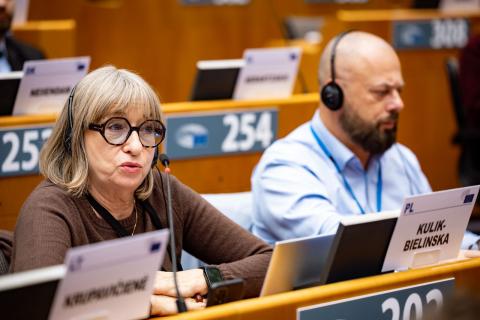
By Ewa Kulik-Bielińska, member of the EESC Civil Society Organisations’ Group and the EESC EU-Ukraine Civil Society Platform
Late 2025 and early 2026 witnessed a marked acceleration in diplomatic efforts aimed at resolving the nearly four-year full-scale war in Ukraine. While the November US-Russia 28-point peace plan, widely perceived as heavily favouring Russia and disadvantaging Ukraine, initially cast a shadow, December brought a surprisingly positive shift. The original plan was superseded by a revised 20-point proposal, developed by the Ukrainian government in collaboration with its European partners, offering a pathway towards a just and lasting peace, grounded in the principles of the United Nations Charter.
High-level diplomatic engagement and negotiations
A flurry of high-level talks ensued: discussions between European leaders in Berlin (15 December) and a meeting between the Ukrainian and US presidents at Mar-a-Lago, followed by a videoconference with European leaders (29 December), consultations with national security advisors and chiefs of staff in Kyiv (3-5 January) and finally a pivotal meeting in Paris (6 January) between the leaders of the coalition of the willing and representatives of the Ukrainian and US administrations. These intense negotiations resulted in an agreement on the core elements of a peace framework, including – crucially for Ukraine – robust security guarantees, to be activated upon the implementation of a ceasefire.
The Paris Declaration and European commitments
The 35 signatories of the Paris Declaration affirmed that ‘Ukraine’s ability to defend itself is critically important for ensuring the future of Ukraine’s and Euro-Atlantic collective security’, and pledged to:
- monitor and verify the ceasefire, under the oversight of the United States;
- provide sustained long-term military and technical support to the Ukrainian army;
- respond decisively to any further hostile actions by Russia;
- deploy international forces to assist Ukraine in maintaining security (including border protection) and stabilising the region following the ceasefire; and
- engage in enduring defence cooperation with Kyiv.
In parallel, at its meeting on 18-19 December, the European Council demonstrated its unwavering determination to support Ukraine’s military efforts. Citing the ‘enhanced cooperation’ provisions of Article 20 of the Treaty on European Union, the Council pledged to provide a EUR 90 billion aid package, to be financed through EU borrowing on capital markets. The loan would cover two thirds of Ukraine’s military and budgetary needs for 2026 and 2027 and would be repaid once Ukraine receives reparations from Russia.
Prior to this, on 12 December, the European Council resolved to freeze the assets of the Central Bank of the Russian Federation indefinitely until Russia stops the war and pays due reparations to Ukraine. This unprecedented decision was made under Article 122(1) of the Treaty on the Functioning of the European Union, which requires a qualified majority rather than unanimity – a smart way to strip the countries sceptical about supporting Ukraine (particularly Hungary) of the ability to use their veto power to extract concessions on other matters.
Obstacles to peace and the broader implications
The agreement forged within the Ukraine-US-Europe triangle represents a significant step towards a peace process, bolstering Ukraine’s negotiating leverage. However, achieving peace still hinges on the will of the aggressor, Russia, which continues to escalate attacks on critical infrastructure and residential areas, killing civilians and depriving millions of electricity, heat and water. Russia’s territorial demands, its opposition to any military presence of NATO countries in Ukraine and its refusal to agree to a ceasefire do not inspire optimism. Sustained pressure on Russia therefore remains imperative.
Participants in the EESC EU-Ukraine Civil Society Platform (CSP) urged the EU to take action, particularly by adopting the 20th sanctions package. Their declaration, published on 11 December, calls for all Russian banks to be targeted without exception and for a complete cessation of imports of oil, gas and oil products from the Russian Federation, including deliveries via pipelines or shipments via non-EU countries.
Achieving peace on the terms outlined in the 20-point plan, supplemented by the Paris security guarantees, would signify a triumph of democratic principles over aggressive, authoritarian imperialism. It would send a strong message that aggression and violations of international law will not be tolerated, helping to deter future conflicts and uphold the rules-based international order.
The immediate practical implications for Europe would be enhanced security, stabilised energy and commodity prices and reduced border and economic tensions. Politically, a successful peace process involving European diplomacy would further strengthen European solidarity and enhance Europe’s role as a global actor. Crucially, it would offer millions of refugees and internally displaced Ukrainians the prospect of returning home to reunite with their families and engage in reconstruction and recovery efforts supported by the international community. A lasting peace would pave the way for Ukraine’s closer integration into the EU and eventual membership, bringing significant economic and political benefits.