
European Economic
and Social Committee
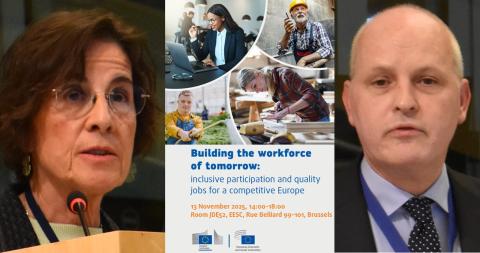
On 13 November, the EESC hosted a high-level conference on ‘Building the workforce of tomorrow: inclusive participation and quality jobs for a competitive Europe’. The debate brought together EU policymakers, social partners, researchers and civil society to address urgent challenges and opportunities in Europe’s labour market, focusing on two flagship reports.
The conference underscored that over 50 million working-age Europeans remain outside the labour market, with women, older people, migrants and persons with disabilities particularly underrepresented. Unlocking the potential of these groups is both a social and economic imperative.
‘Labour and skills shortages threaten to slow Europe’s transition efforts, towards a greener economy and a strengthened independence. The analysis provided by the Commission underpins sound policies to bring more people into the labour market and increase productivity’, Jeroen Jutte, Director for Employment and Social Governance Analysis at the European Commission, told the conference.
‘We need to secure resources and social spending to support employment, social targets and address new challenges. Investing in skills, promoting quality jobs, as well as eradicating poverty and marginalisation remain the key objectives of our joint work with the European Commission’, stressed Cinzia Del Rio, president of the EESC Section for Employment, Social Affairs and Citizenship.
The first panel discussed the Employment and Social Developments in Europe 2025 report (ESDE 2025), exploring how inclusive participation can address labour shortages and demographic change. Education and lifelong learning, active labour market policies and social dialogue are crucial for supporting vulnerable groups.
The second panel examined the Labour Market and Wage Developments in Europe 2025 report (LMWD 2025), focusing on quality jobs and competitiveness amid structural change and technological transformation. While employment growth has been robust, productivity growth is weak. Labour shortages persist, especially in essential sectors. Boosting productivity through innovation, digitalisation and investment in human capital was emphasised, alongside fair wages and job retention schemes.(lm)