
European Economic
and Social Committee
EESC PLENARY: It is imperative to destigmatise and demystify issues surrounding mental health
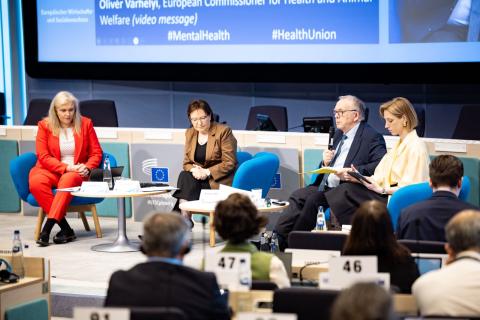
At the March plenary session, the European Economic and Social Committee (EESC) held a debate on one of the most pressing issues for children and young people in Europe today: emotional health. Rising levels of mental illness among young people is being increasingly exacerbated by unprecedented modern day pressures – from social media harms to economic insecurity and the psychological effects of recent and ongoing global crises. Based on this debate, the Committee is making suggestions for better mental health services in Member States, earlier prevention, better online safeguards and increased cooperation between EU institutions, Member States and civil society.
Section I of the debate, on “Emotional health in the EU: institutional perspectives and challenges”, included inputs from: Ewa Kopacz, Vice-President of the European Parliament, European Parliament Coordinator for Children’s Rights and Chair of the High-level Group on Gender Equality and Diversity; Agnese Lāce, Minister for Culture of the Republic of Latvia; Olivér Várhelyi, European Commissioner for Health and Animal Welfare; and Séamus Boland, President of the EESC.
Section II, on “Diagnosis, causes and diversity”, heard statements from Maria Walsh, Member of the European Parliament and Co-chair of the Intergroup on Mental Health; Pietro Barbieri, EESC rapporteur for the opinion SOC/799 on Mental Health Community Services (September 2024) and vice-president of the Civil Society Organisations’ Group; Octavian Bivol, UNICEF Deputy Regional Director for Europe and Central Asia; and Dominik Kuc, Board Member of GrowSPACE of Poland and Youth Forbes 25under25 winner.
Section III, on “Jointly exploring solutions and recommendations”, included Ana Polanco, Vice-President Europe Government and Public Affairs, Merck HealthCare; Dr Ledia Lazëri, Regional Adviser for Mental Health and Well-Being, WHO Regional Office for Europe; Kadri Soova, Director of Mental Health Europe; and Damian Kupczyk, President of Czepczyński Family Foundation, co-author of the ABC of Emotions and ABC of Empathy projects.
Opening the debate, EESC President Séamus Boland commented on important issues surrounding emotional health: For me, what is crucial is that this debate helps to bring the topic of emotional health and suicide out of the shadows; it is imperative that we destigmatise and demystify issues surrounding mental health. Communities, families and civil society organisations play a key role in those efforts
.
Members of the Civil Society Organisations’ Group engaged in the debate:
Rapporteur Pietro Barbieri stressed the dangers of re‑institutionalisation and called for community‑based, person‑centred support: Mental health matters at every stage of life. Mental health policies must prioritise inclusive, community‑based and co‑designed services, moving away from segregating settings and outdated approaches
.
In Section I, Katrīna Leitāne reframed the issue of young people’s emotional health as not a private medical struggle, but a structural political crisis
that is a direct result of difficult social and economic conditions, from housing to job security, that young people face across our Union
. She asked the panel how they would recommend steering the shift from crisis management toward wellbeing by design, by formally empowering youth organisations and recognising the youth sector as a primary preventive pillar of our social infrastructure
.
Andris Gobiņš said: When negotiations about budget are taking place at European level we should listen to young people. It is not acceptable that voluntary organisations are not eligible for EU operative grants. Voices of young people should be heard.
On the negative influence of social media, Corina Murafa touched on how the rapid shift from play-based childhood to a phone-based one has led to a sharp rise in anxiety and depression
. With rates of major depression tripling since 2010, we have the solutions and we have to implement them. We need to delay access to full feature smartphones with social media and internet access until the age of 14
and implement phone-free schools
.
Laura Albu also mentioned the dangers of social media when discussing the structural barriers and digital harassment that disproportionately silence girls
. In light of gender blind
institutional responses and violence against women and girls, emotional distress is not a medical mystery, but a logical response to an unsafe environment
. She called for an institutional framework that integrates the prevention of violence against women into all mental health strategies
.
In Section II, Hanna Markkula-Kivisilta mentioned the emotional impact of global crises on young people: Every second person has a pessimistic view on the future of the world” and “7 out of 10 people are worrying about work
. This is a pressing issue for civil society and young people cannot afford to sit back and wait” while “older men are destroying a world that they won’t have to live in. If we do not sort out this problem with young people and their wellbeing, we will be in trouble
.
But there is no one-size-fits-all
solution to this problem, as Ewa Kulik-Bielińska pointed out. Favouring community initiatives over medicalised solutions, peer-to-peer support is the best support
. But this remained a challenge, particularly in her home country, Poland, where there are no one-to-one supports in schools
and young people wait 240 days to see a psychologist
. To address this, she asked: how can institutions in the EU underpin and support organisations
such as GrowSPACE.
In Section III, Kinga Joó raised the issue of social media protections for children. A healthier digital childhood needs action: age-appropriate social media limits, smarter phone use in schools, and education and stronger support for families
. The risk associated with social media remained very significant
and regulating smartphone use during school hours had been shown to lead to less cyberbullying and improved academic performance
. But she argued that these policies also needed a multigenerational approach
to give parents guidance in navigating this digital environment, particularly in relation to AI
.
Laura Niclot spoke about the impact of economic instability on emotional health: Young people need to have some prospect of finding a job
. To address the issue, she called for structured dialogue with young people, training in formal and informal education, and initiatives led by young people themselves. Young people should have space to demonstrate collective commitment, to show that they can react to crises, to isolation and to poor health.
Michael McLoughlin rounded off the debate bringing it back to community intervention: We don’t always need medicalised intervention
. However, these supports and community initiatives were sometimes not valued
and were taken for granted
; such initiatives were often essential for the most disadvantaged communities
. Action ought to be taken to support young people’s emotional health. He pointed out: There are plenty of things that can be done at European level
.