
European Economic
and Social Committee
EESC PLENARY: Civil Society Week 2026 has set the course for stronger democracy and civic engagement in the EU
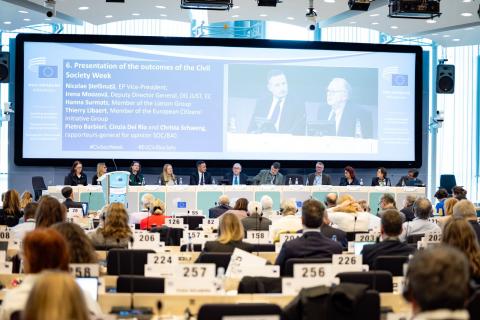
Following the third edition of Civil Society Week, under the theme ‘People, Democracy, Resilience – Our Future’, the EESC reviewed its key outcomes in a plenary debate with the European institutions and stakeholders on 18 March. It concluded that civic participation is more important than ever, with democratic values under growing pressure globally and across parts of the EU.
Opening the plenary debate on 18 March, EESC President Séamus Boland stressed the importance of dialogue and shared values: We have shown once again why dialogue and European values matter. We can’t succeed as a Union if we don’t continue upholding our values of peace, inclusion and resilience, to name a few that we need so badly in these challenging times.
Civil Society Week 2026 brought together some 1 000 participants over four days. It featured 19 sessions, which were organised in collaboration with members of the EESC’s Liaison Group, partners of the European Citizens’ Initiative (ECI) Day and national economic and social councils (ESCs).
One of the main outcomes of this year’s Civil Society Week was the first meeting of the Civil Society Platform’s steering group, marking a significant step towards more structured cooperation between the EU institutions and organised civil society. The platform, a key milestone of the European Commission’s EU Strategy for Civil Society, will be established at the end of 2026. The EESC will contribute to its development as a member of the steering group.
Pietro Barbieri, vice-president of the EESC Civil Society Organisations’ Group and one of the rapporteurs-general for EESC opinion SOC/840 on the EU strategy to support, protect and empower civil society, adopted in May 2025, stated that the EESC is part of the Civil Society Platform’s steering group’, and that ‘there are good signs for the platform’s launch
. He continued by saying that we must pay close attention to every detail of its design and that important decisions were still to be made.
Mr Barbieri was not the only member of the EESC Civil Society Organisations’ Group to take the floor in this EESC plenary debate.
Thierry Libaert, member of the EESC's Group on the European Citizens' Initiative, explained that, of the 120 ECIs that had been registered since 2012, only around 10 had received a positive response from the European Commission. On ECI Day, participants had therefore called for better institutional commitment and a clearer roadmap
. He underlined that the ECI was a unique opportunity to bring collective voices to the EU level and turn concerns into proposals and action. It was a way to bring the public closer to the EU institutions.
Cillian Lohan, President of the EESC Civil Society Organisations’ Group, said that Civil Society Week – bringing together European civil society and representatives of the EU institutions – had proven that a vibrant civil society was essential for democracy. He reminded the audience that The Civil Society Organisations’ Group and the entire Committee have worked tirelessly to ensure that the voice of civil society is heard at EU level since the establishment of the EESC in 1954. Our civil society networks and partners give us strength, and connecting with them only enhances the EESC’s legitimacy and the democratic legitimacy of the EU
.
Pavel Trantina addressed the topic of building resilience through civic education, which was covered in one of the Civil Society Week panels in which he participated. He highlighted one of the conclusions from the panel: Besides schools, youth organisations play a critical role in developing resilience through practical civic education. Investing in people’s resilience through youth organisations today therefore strengthens Europe’s capacity to face tomorrow’s challenges.
Lidija Pavić-Rogošić, vice-president of the Civil Society Organisations’ Group, spoke about the need for civil society involvement in policymaking and the role civil society played in democratic resilience. She said: Effective policies require investment in civic space, social cohesion and local partnerships. Co‑creation should become an EU norm. Participation mechanisms must be structured and permanent, giving the EESC a key role.
Zornitsa Rousinova, who is not only a member of the Civil Society Organisations’ Group but also the president of the Bulgarian Economic and Social Council, thanked the EESC for including ESCs in the Civil Society Week’s programme. National ESCs are the place where EU priorities meet national realities and organised civil society. They are essential partners to the EESC. Cooperation between them should be strengthened in the future.
Andris Gobiņš thanked the organisers of Civil Society Week and praised the quality of the programme. In addition to panel discussions and presentations, he welcomed the fact that small working groups allowed us to establish contact with others
.
Ewa Kulik-Bielińska spoke about the important tasks she had identified through the exchanges, one of them being the implementation of the EU Strategy for Civil Society. The upcoming Civil Society Platform is an important instrument, one that will enable civil society organisations working on human rights, the rule of law or democracy to enter a structured dialogue with the European Commission.
Over four days, the event served as a platform for dialogue, cooperation and exchange on issues directly affecting people’s daily lives. The discussions contributed to the conclusions entitled Next steps for a democratic and resilient future – delivering together a Union of opportunities, security and resilience, which were presented at the EESC March plenary session.
The outcomes will feed into future EESC opinions and be communicated to the European institutions, contributing to ongoing efforts to build a more democratic, inclusive and resilient European Union.
Read the EESC’s press release.