
European Economic
and Social Committee
Launched solutions with a gender perspective
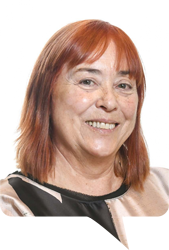 Isabel CAÑO AGUILAR
Head of Office, General Union of Workers (UGT)
Exactly one year ago, when lockdown struck, for the first time in many years the EESC's doors did not open to the public to celebrate Europe Day. We invented another way of opening our doors instead, another way of showing our commitment to society, another way of reaffirming our vocation as the voice of civil society. Our website was flooded with stories of how civil society organisations were facing an unknown and unexpected crisis.
At the time, no-one imagined this could ever happen again. Now 2021 is here and we are celebrating Europe Day virtually once again, and once again we are writing stories that tell of the year that has passed as our organisations have continued to cope with the challenges of the pandemic.
Workers have suffered the effects of successive lockdowns and business closures. As a woman and a trade unionist I would like to put the spotlight on women and their situation in the labour market. My organisation, the UGT, is deeply committed to equality and has continued throughout this period to work to identify the consequences of a crisis that particularly affects women in my country. We are also making proposals to ensure that the recovery offers solutions with a gender perspective and, once again, accompanying women workers throughout this difficult year.
Women in the time of COVID-19
The crisis caused by COVID-19 has highlighted what everyone knows: women are indispensable. They were essential, tireless workers, even at the cost of their health during the first part of the pandemic.
This crisis has also highlighted the structural problem of care, which is unfairly and overwhelmingly borne by women. For this reason, the UGT is calling for a gendered approach to recovery.
During the pandemic, women were more likely (32.1%) than men (27.4%) to be furloughed. Our country is improving in terms of equality between men and women, but there is still a long way to go and the gender employment gap persists.
Gender inequalities during the pandemic
Women are the most exposed to unemployment and job insecurity; we have the lowest activity rate and we take on most of the involuntary part-time work. In addition, the pandemic has brought to light the fact that women work mostly in the sectors that are are hardest hit by the health crisis, those that have been extensively feminised, with worse working conditions and more precarious, temporary, worse-paid jobs …
In Spain, nine out of ten people who take leave of absence to care for a family member are women. This was already the case before COVID. Almost 80% of the people who say their reason for being unemployed is care work are also women. It is a priority to implement public policies to tackle the serious problems of our welfare state, which clearly affect and harm women.
8 March 2021. Why is there not equality?
This year's 8 March has been taken over by the COVID-19 crisis and it is more necessary than ever to redouble our efforts to fight for equality in the face of the challenges. Traditionally, we celebrate 8 March with large demonstrations in the streets. However, this 8 March, although very different, has shown that our demands are more vital than ever.
It is clear that we still have a long way to go to achieve equality between men and women in the workplace because it is not just a question of the wage gap - it is the employment gap, the worse working conditions, precarious contracts or shorter and unstable working lives, or the double burden of care and employment.
We discuss all of these issues in our weekly podcast ¿por qué no iguales?, broadcast on YouTube on International Women's Day.
What have we done?
Since March 2020 we have set up a WhatsApp group (682403638), where all workers can search for the answers to employment questions, furlough or any other employment circumstance arising from the pandemic situation and the measures that have been put in place in the different production sectors.
The Spanish trade union organisations have also drawn up a series of extraordinary measures that have already been sent to the employers' organisations (CEOE and CEPYME) and to the government, in order to provide for possible coronavirus-related situations and contingencies in the workplace.
The UGT is calling for the economic measures approved by the government to be complemented by a social security benefit which, on a temporary and exceptional basis, would allow 100% paid time off work to meet the need to care for people. This would largely benefit women.
It is clear that the COVID-19 crisis is amplifying inequalities such as the gender gap, and highlighting the shortcomings of our social services - shortcomings that mostly affect women. Now, more than ever, the European institutions must value the importance of the public sector and the welfare state and be faithful to the spirit of the European project - building a Europe that protects, and that provides robust answers to the problems of citizenship.
The UGT is a feminist trade union, and equality cannot be an empty word. It is essential to prevent this crisis from exacerbating inequalities: effective equality is a priority objective and an inalienable value for the UGT.